

Quick answer: A patient access solution is the combination of people, processes, and technology a healthcare organization uses to manage a patient's first steps into care: scheduling, registration, insurance verification, referral management, and patient intake. Patient access is the front end of the revenue cycle, so gaps here lead directly to lost appointments and lost revenue. Traditional patient access services rely on front desk staff or outsourced teams. Digital patient access solutions add Voice AI and intelligent virtual assistants (IVAs) that answer calls, book appointments directly in the electronic health record (EHR), and route complex requests to staff. For specialty practices such as orthopedics and pain management, the strongest solutions focus on capturing every new-patient call.
A new patient with back pain calls a specialty clinic at 8:05 on a Monday morning. The line rings, rolls to hold, and they hang up. By 8:10, they've booked with a competitor.
Most patient access solutions are built for hospital billing teams, and they focus on what happens after a patient is already on the schedule. Specialty practices lose revenue much earlier than that, right at the phone.
This blog explains what patient access is, what a patient access solution includes, where new patients get lost, and how digital patient access solutions help specialty practices book more patients without adding front desk staff.
What Is Patient Access?
Patient access is the set of steps that bring a patient into care, from the first call or referral through scheduling, registration, and insurance verification. It is the front end of the revenue cycle, so every later step depends on it being done correctly. When patient access fails, practices lose appointments and see more claim denials.
What is a patient access solution and what does it include?
A patient access solution is the people, processes, and technology a practice uses to manage those first steps: scheduling, registration, insurance verification, referrals, and patient intake (collecting a new patient's demographic, clinical, and insurance details before the visit). Options range from in-house staff to outsourced patient access services to Voice AI.
The Healthcare Financial Management Association (HFMA) measures patient access through its MAP Keys (Measure, Apply, Perform), a set of industry-standard metrics like scheduled appointment percentage and insurance verification rate (HFMA, 2026). Gaps at intake become lost revenue: a skipped eligibility check leads to a denied claim, and a faxed referral sits unscheduled for days.
Core patient access services:
- Appointment scheduling
- Patient registration and demographics
- Insurance eligibility verification
- Referral management and prior authorization
- Patient intake
Front-end errors carry real weight. More than 41% of all claim denials trace back to front-end patient access errors (Change Healthcare, 2022), and registration and eligibility errors cause 27% of medical practice claim rejections (MGMA). Practices that treat patient access as a scheduling task, rather than the foundation of their healthcare IT outsourcing and revenue strategy, tend to see those numbers firsthand.
Where Patient Access Breaks Down for Specialty Practices
Why do patients still call to book appointments?
Many patients, especially older adults, prefer speaking to a person when booking with a new provider. Phone calls let them ask questions about insurance, symptoms, and location before committing. For orthopedic and pain management practices, whose patients skew older, the phone remains the primary front door.
Consumer behavior data backs this up. Between 48% and 50% of healthcare consumers prefer scheduling by phone, and 41% designate it as their preferred method specifically when booking with a new provider (Kyruus Health, 2022). Among Baby Boomers, that preference climbs to roughly 60% (Kyruus Health, 2023).
The problem is that practices are not set up to catch that volume. Picture a Monday at 8:00 AM: the waiting room is full of check-ins, and the phone is ringing nonstop. Or a patient who finishes work at 7:00 PM, calls the clinic, and reaches voicemail. Both calls represent real demand that often goes uncaptured.
Where new-patient calls get lost:
- Unanswered calls during peak hours
- Long hold times that end in hang-ups
- Voicemail that patients never leave a message on
- After-hours and weekend calls with no coverage
- Front desk staff pulled between phones and in-person patients
The data on this is stark. A study of 7,000 calls across 22 medical practices found that 42% of calls placed during business hours went unanswered (OhMD). Average hold time sits around 1 minute 47 seconds, and 60% of callers hang up after just 60 seconds on hold (Talkdesk; IntelePeer, 2026). Roughly 41% of patient calls arrive outside standard 8:00 AM to 5:00 PM weekday hours (Relatient). And when a caller does abandon the line, 85% never try again. Many call a competitor instead (IntelePeer, 2026).
Staffing adds another layer of strain. Front desk and reception roles see 21.42% annual turnover (MGMA, 2024), which means practices are frequently training new staff while trying to keep the phones covered. These gaps compound the broader patient intake management challenge and show up directly in missed calls and hold times that practices rarely track closely enough to notice the pattern.
Types of Patient Access Solutions
What are digital patient access solutions?
Digital patient access solutions use technology to handle scheduling, registration, and intake without a staff member on every interaction. They include online self-scheduling, digital intake forms, and Voice AI agents that answer phone calls. The most complete digital patient access solutions book appointments directly in the EHR and hand complex calls to a person.
Will Voice AI replace front desk staff?
No. Voice AI handles routine calls like scheduling, confirmations, and directions so front desk staff can focus on patients in the office and on complex requests. The best results come from a hybrid model where AI answers every call and people handle the exceptions.
Practices choose between an in-house front desk limited by business hours and turnover, outsourced patient access services that add capacity but still rely on staffed queues, and digital patient access solutions that answer 24/7 but are only as good as their EHR integration. Within digital, self-scheduling links and intake forms serve patients comfortable doing it themselves, while Voice AI and intelligent virtual assistants (IVAs), software that understands natural speech and holds a conversation, handle the phone call itself. Unlike an interactive voice response (IVR) system's "press 1 for scheduling" menu, an IVA understands "I need to see someone about my knee" and books the visit.
Check out the difference between IVA’s and IVR’s this podcast episode
The three main approaches:
- In-house front desk: Full control, limited hours, tied to hiring and turnover
- Outsourced patient access services: Extra capacity, often billed hourly, still staffed by people in queues
- Digital patient access solutions: 24/7 coverage, instant answer, depends on EHR integration quality
Most patient access vendors work after a patient is already booked, handling eligibility, prior authorization, and denial recovery for large health systems. Digital intake tools cover check-in and reminders but assume the patient will use a link or app. Neither solves the moment a patient calls and no one answers, and older patients keep calling even after a self-scheduling link goes live. That is the gap our Voice AI and the IVA are built to close, and it shapes where Voice AI works in patient experience.
The math supports it. A fully loaded front desk FTE (full-time equivalent employee) costs $58,000 to $63,000 per year (BLS), and about half of that time goes to routine phone requests. While 68% of medical groups have added or expanded AI (MGMA Stat), adoption for answering the phone still lags.
| In-House Front Desk | Outsourced Patient Access Services | Digital Self-Service Tools | Netfor’s Managed Patient Access | |
| Coverage | Business hours | Extended hours at added cost | 24/7, web and text only | 24/7 phone, web, text, and chat coverage, nights and weekends included |
| Speed to answer | Varies with staff load | Depends on queue staffing | Patient-driven | Immediate, no hold queue |
| Phone callers | Yes, when available | Yes | No | Yes, with 87% of new-patient appointment calls booked |
| EHR integration | Manual entry | Often a separate system | Varies | Books directly into the EHR |
| Cost model | Salary plus benefits | Hourly or per call | Software subscription | Managed monthly service |
| Staffing risk | Turnover and hiring gaps | Vendor attrition | Low | Low. AI handles routine calls, your staff handles the exceptions |
| Best fit | Small, low-volume clinics | Overflow capacity | Tech-comfortable patients | Multi-location, high-volume specialty clinics |
Most specialty practices end up combining approaches. The real question is which one answers the phone first.
How Voice AI Improves Patient Access for Orthopedics and Pain Management
How does Voice AI improve patient access and intake?
Voice AI answers every call immediately, identifies the patient, applies the practice's scheduling rules, and books the appointment directly in the EHR. It collects intake and insurance details during the same call. When a caller has a complex question or an urgent symptom, it transfers them to staff.
How much does a missed call cost a specialty practice?
In specialty care, a missed new-patient call costs more than one visit. In orthopedics and pain management, the first consult often leads to imaging, procedures, or surgery. A single lost call can mean thousands of dollars in downstream revenue.
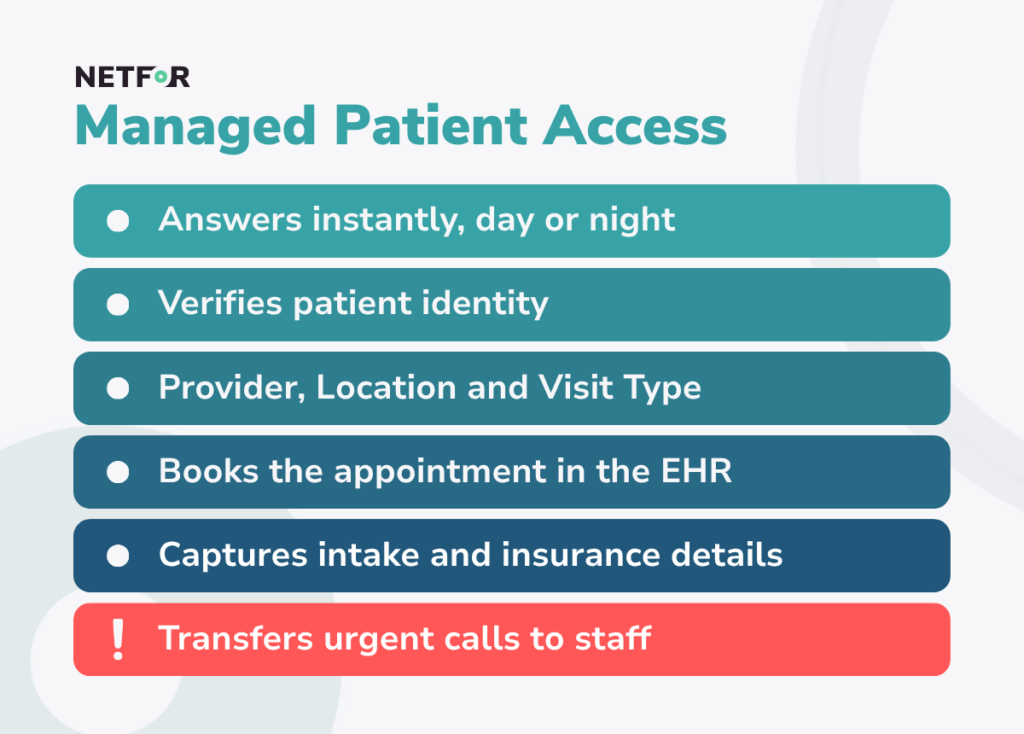
A typical Voice AI call follows a clear sequence. The system answers instantly, verifies the patient's identity, matches them to the right provider, location, and visit type, books the appointment in the EHR, captures intake and insurance details, and transfers urgent or complex calls to a staff member.
What a Voice AI Agent handles on a new-patient call:
- Answers instantly, day or night
- Verifies patient identity
- Matches the patient to the right provider, location, and visit type
- Books the appointment in the EHR
- Captures intake and insurance details
- Transfers urgent or complex calls to staff
Specialty care raises the financial stakes of every missed call. In pain management, callers are frequently in active discomfort and willing to book with whichever clinic answers first. The specialty also relies on serial procedures, such as epidural steroid injections, nerve blocks, and radiofrequency ablation, which means one booked new patient can lead to months of follow-up care. A pain management patient calling at 7:00 PM should be able to book on the spot rather than reach voicemail.
In orthopedics, the economics work differently but point the same direction. Referral volume drives much of the new-patient pipeline, and a meaningful share of initial consults convert to imaging or surgery over time. A multi-location group needs scheduling rules that route callers to the correct location and provider, something a basic answering service cannot replicate.
One live deployment illustrates what this looks like in practice. A multi-location pain management group running on eClinicalWorks, live since April 2026, uses a Voice AI agent to manage inbound calls.
EMBED: https://www.netfor.com/resource-center/case-study/the-pain-experts/
Deployment results:
- 3,200+ calls handled per month
- 533 new-patient calls per month looking to book
- 87% of those appointment calls booked by the AI Agent
- 6.8x ROI, based on an average appointment value of about $250
That 6.8x figure is not an outlier when you look at the broader economics. An initial orthopedic consult typically collects between $285 and $360, and roughly 30% of new orthopedic consults convert to surgery within six months. Average facility revenue per ASC (ambulatory surgery center) case in orthopedics runs about $3,791, the highest of any outpatient surgical specialty. An initial pain management consult generates roughly $200 to $280 directly, with serial procedures adding to that total over the course of treatment. For context on what consistent answering looks like elsewhere, AI intake workflows paired with eClinicalWorks integration are becoming a standard combination for multi-location specialty groups.
How to Evaluate a Patient Access Solution
Start with outcomes: what percentage of new-patient calls get booked, and what the solution returns compared to its cost. Then confirm it integrates directly with your EHR, covers after-hours calls, escalates to staff when needed, and meets HIPAA (Health Insurance Portability and Accountability Act) requirements. A solution that books well but cannot write to your schedule will create double entry.
Is Voice AI HIPAA compliant?
Yes, if the vendor is set up correctly. Every vendor handling patient information must sign a Business Associate Agreement (BAA), including its speech recognition and AI model providers, and should provide encryption, a SOC 2 Type II audit (which tests security controls over 6 to 12 months), and written confirmation that patient calls are never used to train AI models. Beyond compliance, judge a patient access solution by booking rate and ROI (new-patient calls × booking rate × average appointment value, compared to monthly cost) and by bidirectional EHR integration through FHIR or HL7 standards, so appointments write directly to the schedule instead of being re-entered by staff.
Patient access solution checklist:
- Books directly into your EHR in real time
- Answers 24/7, including weekends
- Reports booking rate and call outcomes
- Transfers urgent or complex calls to staff
- Signs a BAA and holds a SOC 2 Type II report
- Does not use patient calls to train AI models
- Supports specialty scheduling rules across locations
- Shows ROI against your average appointment value
Reporting should tie back to the HFMA MAP Keys discussed earlier, giving practice leaders a consistent way to track scheduling, pre-registration, and insurance verification performance over time. For practices weighing whether to build this capability internally or bring in a specialized partner, it is worth reviewing the build or buy considerations before making a final decision.
Claim denial data reinforces the stakes: 82% of denials are considered potentially avoidable (Change Healthcare, 2022), and most of those avoidable denials trace back to the same front-end gaps a strong patient access solution is designed to close.
Answer Every New-Patient Call, Protect What Comes After It
Patient access is the front end of the revenue cycle, and for specialty practices, the phone is where the most new patients get lost. Adding front desk headcount does not keep pace with call volume or turnover, no matter how committed the staff. Digital patient access solutions that answer the phone close the gap that web tools and traditional RCM vendors leave open. Practices should evaluate any solution on booking rate, EHR integration, compliance, and ROI, not on a feature list alone.
Practices that answer every new-patient call protect both that first visit and the procedures that tend to follow it. Netfor Managed Patient Access pairs Voice AI with human escalation and books directly into the EHR, built specifically for multi-location orthopedic and pain management groups rather than hospital billing offices. Netfor's broader healthcare experience includes work with organizations like Marathon Health, reflecting the same commitment to answering the phone and getting patients to the right care.
See how Managed Patient Access helps specialty practices book more new patients without adding front desk staff.