

Quick answer: Patient intake management is the process of collecting, verifying, and organizing patient information before and during a visit, including scheduling, insurance verification, forms, and EMR data entry. A patient intake system is the software that runs this process. Specialty clinics such as orthopedic, pediatric, pain management, and dermatology practices often need intake software built around their specific scheduling and documentation needs, not a generic one-size-fits-all platform.
Most practice administrators assume that any intake platform will work for any clinic. Buy the software, plug it in, and the front desk bottleneck disappears. But that assumption costs specialty practices patients and revenue every single day.
Here is the problem: A mid-size specialty practice that receives 800 inbound calls a month with a 35% missed call rate loses roughly 42 new-patient encounters. At an average first-visit production value of $300, that adds up to $12,600 in lost monthly revenue, or more than $151,000 in uncaptured gross clinical production each year. Most practices have no visibility into how much they're actually losing.
This guide breaks down what patient intake management actually covers, what a patient intake system should include, and whether your specialty needs something different from generic software. If you are a Practice Administrator or Healthcare IT Director weighing software against adding front desk headcount, you will leave with a clear framework for making that call.
What Is Patient Intake Management, and Why Is It a Process Problem First?
Patient intake management is the set of pre-service and point-of-care workflows responsible for capturing, validating, and synchronizing patient information with your clinical and administrative systems. This includes patient demographics, medical histories, clinical screening questionnaires, legal consents, and insurance benefits.
Here is the distinction that trips up most buyers. Patient intake is a process. A patient intake system is the software that runs that process. Software that does not fix the underlying workflow just moves the bottleneck from one place to another. If your front desk is drowning because of how patients are scheduled and verified, a digital form does not solve that. It simply relocates the problem.
Key concepts to understand before you evaluate any platform:
- Intake is operational, not clerical: It dictates practice throughput, revenue cycle integrity, and patient retention, not just check-in speed.
- Digital pre-registration compresses check-in dramatically: New patient check-in drops from an average of 25 minutes on paper to 5 to 7 minutes with pre-visit digital intake (SchedulingKit, 2026).
- Accuracy improves at scale: Paper-to-chart entry produces a 20% error rate, while patient-entered digital forms lower that to 0.67%.
This is where managed patient access starts to matter. Treating intake as an ongoing operational function, rather than a one-time software purchase, is what separates practices that capture patients from those that lose them.
What Should a Patient Intake System Actually Include?
When you evaluate patient intake management software, the feature list matters less than one thing: does it integrate with your Electronic Health Record (EHR)? An EHR is your practice's core clinical record system, such as Epic, athenahealth, or eClinicalWorks. EMR integration determines whether intake software reduces staff burden or creates a second system your team has to manage by hand.
Direct EHR integration eliminates duplicate data entry. At enterprise scale, automated intake integration across an entire network can eliminate hundreds of hours of front-desk labor.
The catch is that clean integration is far from guaranteed. The MGMA 2026 Phone and Fax Solutions Survey, which assessed 302 medical group practices, found that 64% operate document platforms with no integration to their underlying EHR/PM systems (MGMA, 2026). On top of that, 40% of medical group leaders described their document intake workflows as actively inefficient.
When you evaluate software, look for these integration features:
- Discrete-field, bidirectional synchronization: The system should write validated data directly into your EHR, not deposit a flattened PDF into the chart's media tab that staff must retype.
- Write-back permissions: Confirm the platform can insert appointments and populate problem lists automatically, so staff is not toggling between systems.
Practice administrators agree on what matters. When ranking software selection criteria, they placed security compliance (93%), direct EHR/PM integration (91%), and transparent return on investment (84%) at the top (MGMA, 2026). For groups managing several sites, this is also a question of broader multi-location healthcare IT strategy, not a single software decision.
Do Specialty Clinics Need Different Intake Software Than General Practices?
Yes. Specialty practices operate under clinical, diagnostic, and payer constraints that diverge sharply from general primary care. Deploying an undifferentiated, generic intake form in an orthopedic, pediatric, pain management, or dermatology practice creates bottlenecks, missing diagnostic records, unverified specialty benefits, and higher claim denial rates. Each specialty faces its own structural intake challenge.
What Does Patient Intake Software for Orthopedic Clinics Need?
Orthopedic practices handle everything from new injuries and referrals to follow-ups and post-op calls. When every request depends on front-desk availability, missed calls and incomplete intake can quickly turn into lost patients and more work for staff.
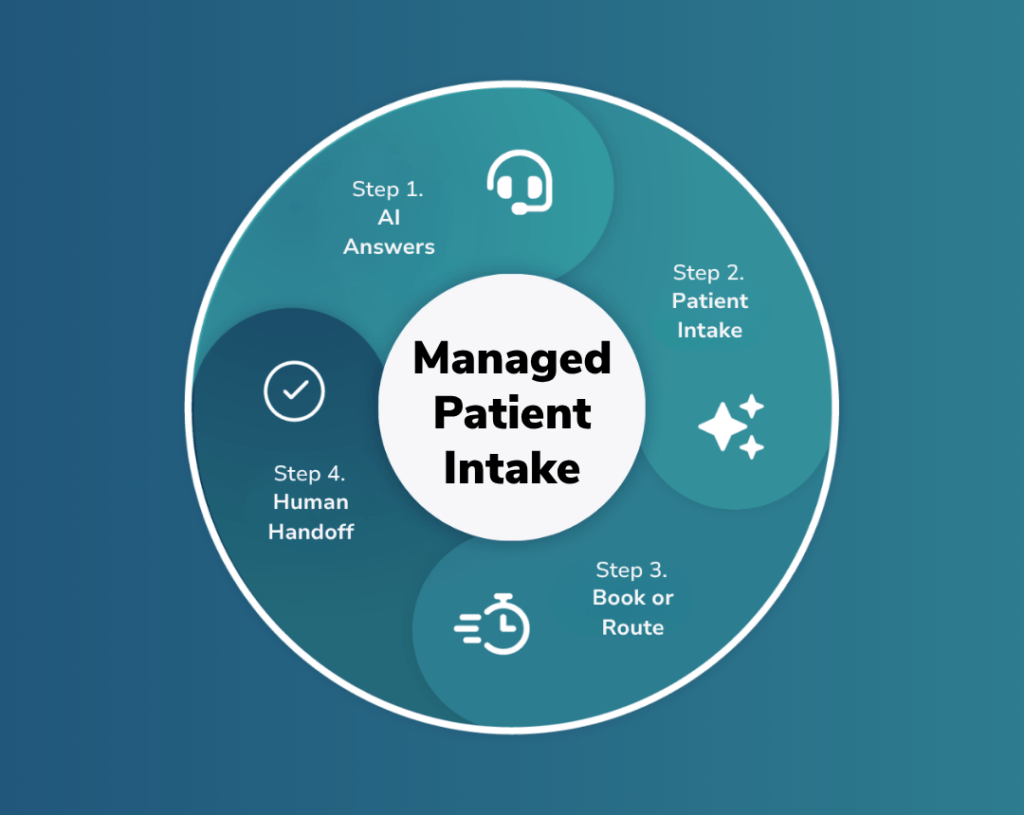
Managed Patient Access helps take that pressure off the front desk. AI can answer inbound calls, capture patient information, identify what the patient needs, book eligible appointments directly into the EHR, and route clinical or complex requests to staff with context.
See Managed Patient Access for Orthopedic Practices
What Does Patient Intake Software for Pain Management Clinics Need?
Pain management practices manage a constant flow of new patients, procedure scheduling, follow-ups, medication questions, and other patient needs. That makes getting each caller into the right workflow just as important as answering the call itself.
Managed Patient Access helps manage that front door. AI can capture structured intake, book eligible procedures and follow-ups directly into the EHR, and route medication, clinical, or complex requests to the appropriate staff.
See Managed Patient Access for Pain Management Practices
What Does Getting Intake Wrong Actually Cost?
Missed calls quickly become missed opportunities. 20% to 40% of medical office calls can go unanswered, and the problem gets worse as call volume grows. In fact, 59% of practices report handling more than 300 calls per day (OmniMD, 2024).
For practices, the cost goes beyond a missed phone call. Patients may go elsewhere, staff spend more time on callbacks and incomplete intake, and scheduling opportunities get lost in the process.
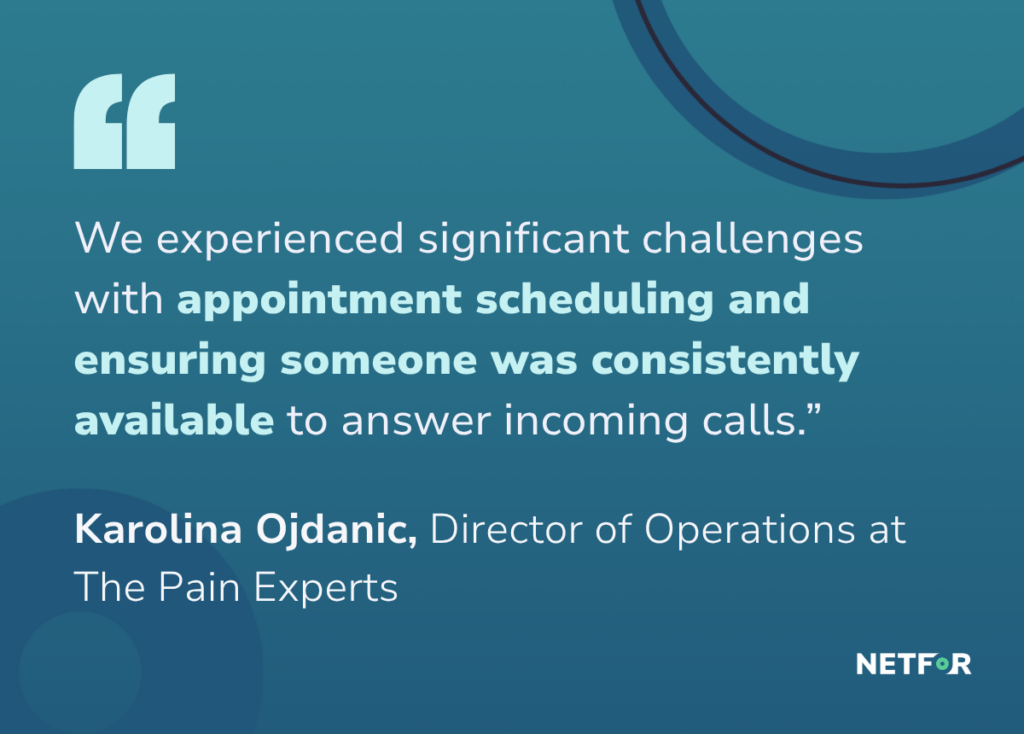
The Pain Experts saw what happens when that capacity is recovered. In one month, Netfor's AI Agent handled 3,254 patient calls, including 533 new-patient scheduling calls, with 87% of eligible appointments booked without human intervention. The deployment delivered an estimated 6.8x value-to-cost ratio.
How Netfor's Managed Patient Access Closes the Gap
Most vendors sell you software and hand you the burden of running it. Netfor treats intake as an operational shield, not a product on a shelf. Managed Patient Access combines the technology with the people and processes to run it, so your front desk is not left managing yet another system.
That distinction matters when you look at the recoverable revenue above. The Pain Experts did not need more front desk staff. They needed a managed layer that captured calls, verified patients, and booked appointments around their specific pain management workflow. This is also where AI-powered patient intake fits, handling high call volumes and after-hours demand that a fixed headcount cannot cover. Practices already thinking about healthcare IT outsourcing find this model easier to justify than expanding payroll.
How Do Managed Intake and Generic Software Compare?
Not every practice needs the same approach. Understanding where each option fits helps you match the solution to your situation.
- Generic intake platforms (broad digital front door): Vendors like Phreesia lead in scale, processing more than 70 million visits annually and holding a KLAS score of 90.0 out of 100 in Patient Intake Management (KLAS Research, 2024). Best for large systems wanting a standardized check-in experience, though users cite complex pricing and costly add-ons (KLAS Research, 2024).
- Identity-focused platforms: CERTIFY Health centers on biometric identity verification and unified pre-registration, rating 4.5 out of 5 on Capterra (G2, 2026). A strong fit when patient identity fraud and check-in consolidation are the priority, though biometric features require specialized hardware.
- Vertical operational platforms: The CareFlow ecosystem serves specific domains like imaging centers and post-acute referral intake (Elion Health, 2025). Useful when your need is confined to one function, but you may need separate products for scheduling versus referrals.
- Managed patient access (Netfor): Combines AI-powered patient intake and scheduling with ongoing management built around specialty workflows. Best for practices that want to handle more patient demand without adding front-desk staff, with EHR integration that helps automate the work from call to booking.
Book a Managed Patient Access demo today to see the platform
Choose a generic platform if standardization across a large system matters more than specialty fit. Choose managed patient access if missed calls, no-shows, and specialty-specific documentation are hurting your margins and you would rather not hire your way out of it.
Turn Your Front Door Into a Competitive Advantage
Patient intake management decides whether new patients become part of your practice or become part of a competitor's schedule. The evidence is clear on two points. First, generic intake software fails specialty practices because it ignores how orthopedic, pediatric, pain management, and dermatology clinics actually schedule and process patients. Second, the cost of getting it wrong is measurable and large, from $151,000 in annual missed-call revenue to a 3% to 14% top-line loss from no-shows.
What sets a managed approach apart is that it treats intake as an ongoing operational shield rather than a one-time purchase. That is how The Pain Experts recovered demand worth an estimated $552,000 a year without adding a single front desk hire.
If your front desk cannot keep up, the answer is not more headcount. See how managed patient access can help your specialty practice capture more patients and protect your revenue.