

Healthcare IT outsourcing is the practice of partnering with a specialized provider to manage IT support, infrastructure, and service delivery for healthcare organizations. This includes help desk support, field services, and ongoing system management. For multi-location clinics, outsourcing improves response times, reduces downtime, and ensures consistent support across every site. It also helps organizations stay compliant with HIPAA and other regulations through structured processes and auditability. Ultimately, outsourcing healthcare IT allows providers to focus on patient care while improving operational efficiency and patient experience.
Healthcare organizations face intense pressure from every angle. Tighter margins, rising patient expectations, more locations to support, and stricter compliance requirements make operating a clinic challenging. When technology fails in a clinical setting, it does more than slow down basic operations. It disrupts patient care, burdens your medical staff, and creates serious regulatory risks.
Many multi-location healthcare organizations try to support complex systems, maintain uptime, and meet compliance demands using limited internal IT bandwidth. That approach often leads to inconsistent service, slower response times, and a poorer patient experience overall. A clinic cannot provide top-tier care if doctors are locked out of their computers or patients cannot schedule appointments.
Healthcare IT outsourcing gives organizations a way to improve system uptime, standardize support across all locations, and strengthen security compliance. By partnering with experts, care teams can stay focused on their patients instead of dealing with frustrating IT problems.
What Is Healthcare IT Outsourcing and Why It Is Growing Fast
What is healthcare IT outsourcing and how does it work?
Healthcare IT outsourcing means hiring an external technology partner to handle your organization's IT needs. This model commonly includes IT help desk support, nationwide field services, network management, and compliance tracking.
The industry is seeing a massive shift from viewing IT as pure cost savings to seeing it as a strategic operational value. Multi-location healthcare networks need consistent support across dozens or hundreds of sites. Internal IT teams often find themselves stretched across too many systems and locations, making it impossible to provide fast, reliable service.
As Marathon Health's Service Delivery Director Tracy Gold puts it, "Healthcare providers are clinical experts, not technical specialists. We wanted to ensure our staff could focus on what they do best delivering exceptional patient care."
Organizations are adopting healthcare IT services rapidly to solve this exact problem. They need reliable healthcare technology solutions that scale as their clinic footprint grows.
Consider a multi-location healthcare network acquiring new regional clinics. Their internal IT team cannot physically travel to set up new networks while simultaneously answering help desk calls from existing locations. Outsourcing healthcare IT bridges this gap perfectly.
Key details highlighting this market growth include:
- The global healthcare IT outsourcing market is expected to grow from $54.76 billion to $94.46 billion by 2030, achieving an 8.1% compound annual growth rate (Maximize Market Research, 2024).
- Healthcare IT solutions are expanding to include fully managed service desks and automated infrastructure management.
- Healthcare outsourced IT support helps organizations shift from capital expenditures to predictable operational costs.
Why IT Problems Become Patient Experience Problems
How does healthcare outsourced IT support improve patient experience?
Healthcare outsourced IT support ensures systems stay online and help desk calls get answered quickly. This connects directly to better care access, smoother clinic visits, and happier patients who do not have to wait for broken technology to be fixed.
Downtime is a massive clinical and operational issue. When an outage occurs, it affects patient scheduling, blocks access to health records, disrupts staff communication, and breaks care continuity. Managing this across multiple locations amplifies the challenge.
Poor IT support actively hurts the patient and customer experience. If a clinic loses access to its scheduling systems, patient visits are delayed. If patients abandon calls due to long hold times, they will likely choose another provider. Call center and support performance gaps are a major issue in the healthcare space.
The cost of these failures is significant:
- Downtime costs medical practices between $7,500 and $7,900 per minute (Symmetric Group, 2024).
- Research shows 96% of healthcare organizations reported experiencing at least one unplanned EHR outage (IT For Scrubs, 2024).
- The average healthcare call center speed of answer is 3 minutes and 22 seconds (Dialog Health, 2025).
- The first call resolution benchmark sits at just 52% in healthcare, meaning almost half of all callers require a follow-up (Healow Genie, 2025).
How Healthcare IT Outsourcing Improves Operations, Uptime, and Service Delivery
What are the benefits of outsourcing IT in healthcare organizations?
Outsourcing IT provides specialized 24/7 support, predictable cost control, rapid scalability, and immediate staff relief. It ensures maximum system uptime so medical professionals can concentrate entirely on delivering care.
Transitioning from reactive break-fix support to proactive management completely changes how a clinic operates. A centralized outsourced help desk supports multiple clinic locations simultaneously, creating standardized support across the entire network.
This model provides much faster help desk responses and better issue routing. It significantly reduces the burden on your internal staff. IT outsourcing for healthcare industry leaders provides a predictable service model that ensures cost efficiency.
When a healthcare organization uses AI-enabled intake and routing, issues reach the right technician immediately. This speeds up resolution times and gets doctors back to their patients faster.
See how AI helped a specialty practice handle more patient calls and automate appointment booking in our latest case study.
Measurable improvements from outsourcing include:
- Organizations realize 30% to 50% total cost of ownership savings over three years compared to maintaining in-house IT models (NetCom Online, 2025).
- AI-first support models reduce first response times from hours to just minutes.
- Clinics experience a 25% to 35% reduction in support requests through improved self-service and expert knowledge management (Netfor, 2024).
Compliance, Cybersecurity, and Nationwide Field Services
Is outsourcing healthcare IT secure and HIPAA compliant?
Yes. The right IT outsourcing partner provides built-in compliance, detailed auditability, and robust security controls that align perfectly with HIPAA and other federal healthcare regulations.
Compliance and cybersecurity are central reasons why clinics choose outsourcing. Keeping up with HIPAA, the Cyber Incident Reporting for Critical Infrastructure Act (CIRCIA), incident response protocols, and reporting pressures is a full-time job. Clinics need complete auditability, network visibility, and structured escalation paths.
Nationwide field services play a massive role in supporting multi-location clinics securely. A rural or remote clinic might need fast onsite technical support to resolve a router issue. Smart hands support extends centralized IT expertise directly into the field, ensuring onsite response, staging, deployment, and repair consistency are handled properly.
If a security incident occurs, organizations need immediate reporting and containment. Managed service providers handle these events swiftly to protect sensitive patient data.
Key security and field service metrics to consider:
- In 2023 alone, data breaches exposed 168 million healthcare records (Konfirmity, 2024).
- Starting in 2026, CIRCIA will require substantial cyber incident reporting within 72 hours (Elisity, 2024).
- Top providers meet Tier 1 response benchmarks of 15 minutes, with full resolution within 4 hours (Oxmaint, 2024).
- Best-in-class field service providers maintain a first run rate of 95% to 97%, meaning the problem is fixed on the very first visit (Netfor, 2024).
What to Look for in a Healthcare IT Outsourcing Partner
What should multi-location healthcare organizations look for in an IT partner?
Healthcare organizations should look for an IT partner with proven healthcare experience, national field coverage, guaranteed rapid response times, and documented case studies showing successful operational outcomes.
When evaluating a partner, you must look closely at their multi-location support capability. You need an integrated approach that covers the IT help desk, field services, and full lifecycle management. The partner must prove their compliance readiness and security controls.
Service delivery consistency matters just as much as technical skill. If a technician is incredibly smart but takes three days to arrive at your clinic, patient care still suffers. You want a partner capable of supporting rapid expansion without creating IT disruption.
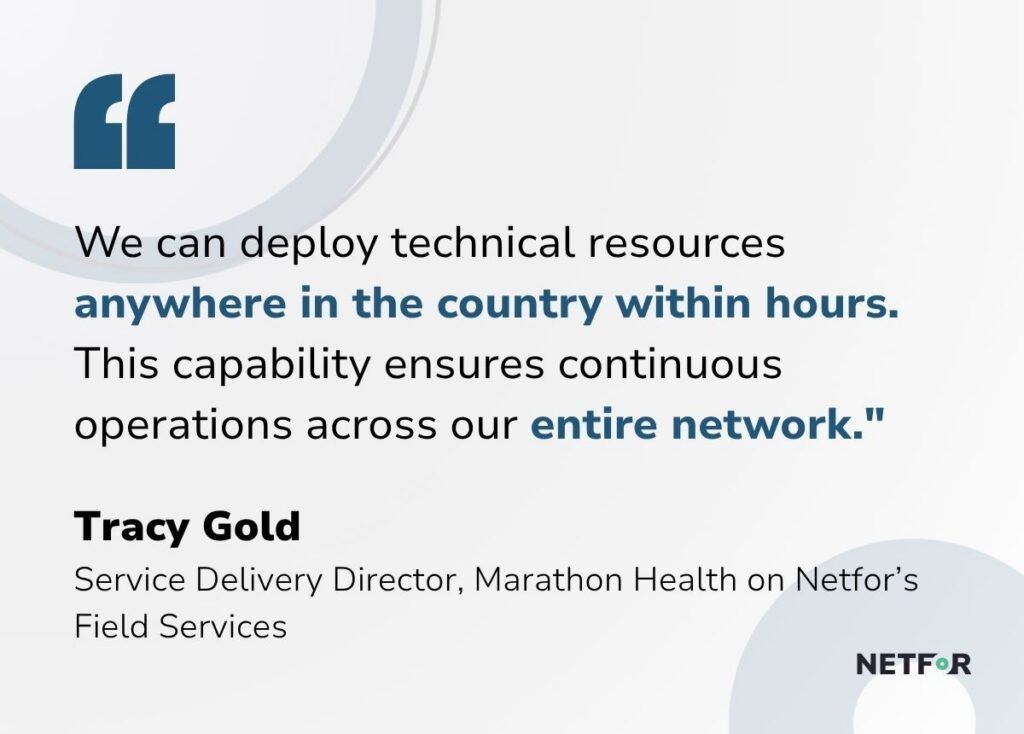
A perfect example is Marathon Health. They needed scalable healthcare IT support to handle massive growth. By partnering with Netfor, they successfully supported their vast network.
Important success facts from this partnership:
- Marathon Health partnered with Netfor to support nearly 800 health centers and successfully modernize the network infrastructure of approximately 100 locations (Netfor, 2024).
- The partnership drastically reduced support tickets.
- Clinicians were finally able to put their complete focus back on patient care rather than fighting with network connectivity.
Read the whole story here: Marathon Health Case Study
Healthcare IT Outsourcing vs Other Approaches
Healthcare organizations typically decide between three real options for their technology management. Understanding alternatives and competitor positioning will help you decide when each approach makes sense.
Option 1: In-House IT Teams
Relying completely on internal staff is best for single-location clinics or environments with very low technical complexity.
Strengths:
- You maintain full internal control over all systems.
- Staff provides immediate onsite presence for the single location.
- Employees develop deep familiarity with your internal processes.
Limitations:
- It is incredibly hard to scale across multiple locations.
- Maintaining staff is expensive due to salaries, benefits, tools, and turnover.
- Providing true 24/7 coverage is almost impossible for a small team.
- Response times drop significantly during outages or ticket spikes.
Option 2: Hybrid IT Model
Using a mix of internal staff and multiple vendors is best for organizations transitioning toward outsourcing.
Strengths:
- This approach offers flexibility to fill specific gaps.
- It allows you to keep some internal expertise.
- Transitioning creates less initial disruption than moving to full outsourcing.
Limitations:
- Vendor fragmentation makes management very difficult.
- Service delivery becomes highly inconsistent across locations.
- Vendors often resort to finger-pointing during major outages.
- Coordination across different systems requires heavy internal management.
Option 3: Healthcare IT Outsourcing Partner
A fully managed model is best for multi-location healthcare organizations and rapidly growing clinic networks. Competitors in this space include companies like TechMagic, PI Tech, and Prelude Services. However, partnering with a specialized provider like Netfor ensures seamless integration of field services and help desk support.
Strengths:
- You get standardized support across all locations.
- Partners provide a 24/7 help desk paired with nationwide field services.
- You benefit from faster, SLA-driven response and resolution times.
- The service includes built-in compliance and auditability.
- You can scale fast without hiring internal staff.
- The predictable cost structure protects your budget.
Limitations:
- It requires strong onboarding and partner alignment initially.
- You give up some day-to-day internal control in exchange for structured governance.
Side-by-Side Comparison
| Capability | In-House IT | Hybrid Model | Healthcare IT Outsourcing |
| Multi-location support | Limited | Inconsistent | Standardized across all sites |
| Response times | Varies | Varies by vendor | SLA-driven, consistent |
| 24/7 coverage | Rare | Partial | Built-in |
| Field services | Limited reach | Vendor-dependent | Nationwide coverage |
| Compliance support | Internal burden | Fragmented | Built-in processes |
| Cost predictability | Low | Medium | High |
| Scalability | Slow | Moderate | Fast |
| Patient experience impact | Inconsistent | Inconsistent | Improved and standardized |
When Healthcare IT Outsourcing Makes the Most Sense
Healthcare IT outsourcing becomes the clear choice when you operate multiple clinics or locations. It is necessary when your team deals with constant IT issues and downtime. If the patient experience is impacted by slow support or system failures, you must make a change.
Most healthcare organizations do not fail because they lack technology. They struggle because their IT support model does not scale with their operations. Outsourcing solves this by creating one consistent support model, one accountable partner, and one system for managing uptime, compliance, and service delivery.
Secure Your Clinic's Future Operations
Healthcare IT outsourcing is about far more than just reducing costs. Better IT support leads directly to better patient and staff experiences. Multi-location healthcare organizations absolutely need scalable, consistent, and compliance-ready support to thrive.
The impact of making this shift is undeniable:
- You will experience significantly reduced downtime.
- Your clinics will benefit from stronger service delivery.
- Patients will have a better experience interacting with your staff.
- Internal teams can focus entirely on care instead of troubleshooting computers.
The ultimate differentiator is finding a partner that successfully combines healthcare IT services, national field support, compliance awareness, and flawless multi-location execution.