

Quick answer: Multi-location IT support is the coordination of on-site technical assistance, hardware maintenance, and issue resolution across all of a company's physical locations. As mid-sized technology firms expand, in-house and rotating-technician models struggle to keep pace, creating inconsistent service and repeated onboarding costs at every visit. A single-partner field service model with technician continuity fixes this by returning the same technician to the same locations.
A technician arrives to fix a network issue. Before touching a single cable, they spend twenty minutes figuring out where the wiring closet is, which switch feeds which register, and who to call if something goes wrong. The next time something breaks, a different technician shows up and repeats the entire process.
That twenty-minute reset is the real problem, and it repeats at every location, on every visit. As mid-sized technology firms grow past a single campus and start managing IT support across multiple locations, in-house technical support and rotating vendor models start breaking down. The issue is not a shortage of technicians. It is that no single technician actually knows the site. That gap drives up resolution time, increases cost as tickets escalate through support tiers, and leaves individual locations exposed whenever a technician is out or a hardware failure hits.
A single-partner field service model built around technician continuity solves the actual bottleneck. When the same technician returns to the same locations, site knowledge stays intact instead of resetting on every visit. Netfor proved this at scale with the UPS Store case study, routing the same technician back to the same stores whenever possible and cutting ramp time to near zero across 5,500 locations.
What Multi-Location On-Site IT Support Actually Means
Multi-location IT support is the delivery of physical, site-specific technical work across every location a company operates. This includes hardware repairs, network troubleshooting, and on-site diagnostics, all delivered with consistent quality no matter where the location sits on the map.
Check out Netfor’s Field Service Capabilities here
What is multi-location IT support? Multi-location IT support is on-site technical work, hardware, networking, installs, and repairs, coordinated across every location a company operates. It's different from a help desk, which resolves issues remotely over phone or chat. On-site work needs a technician physically there, and it gets harder as a company grows because every new site adds its own layout, equipment, and history.
Consider the difference between a single-campus IT team and a distributed footprint. In a single building, the IT team shares the same space, the same equipment, and the same institutional knowledge. Everyone knows where the server room is and who to call when the network drops. Once a firm spreads across many sites, that shared knowledge fragments. Each location develops its own layout, its own equipment mix, and its own undocumented history that no central team fully understands.
Here is what falls under on-site technical support management:
- Hardware installs and repairs
- Network troubleshooting
- POS and device servicing, including POS system installation
- Physical site inspections
- Technician dispatch and scheduling
This becomes a distinct operational category once a mid-sized technology firm, roughly 200 to 2,000 employees, grows past a single campus. Internal teams are also structurally thin for this kind of coverage. Desktop support has fallen to a median of 6.3% of total IT staff, down from 9.1% in 2019 (Avasant, 2024). That lean ratio works fine inside a dense corporate headquarters, but it fails when physical hardware support is needed across scattered sites.
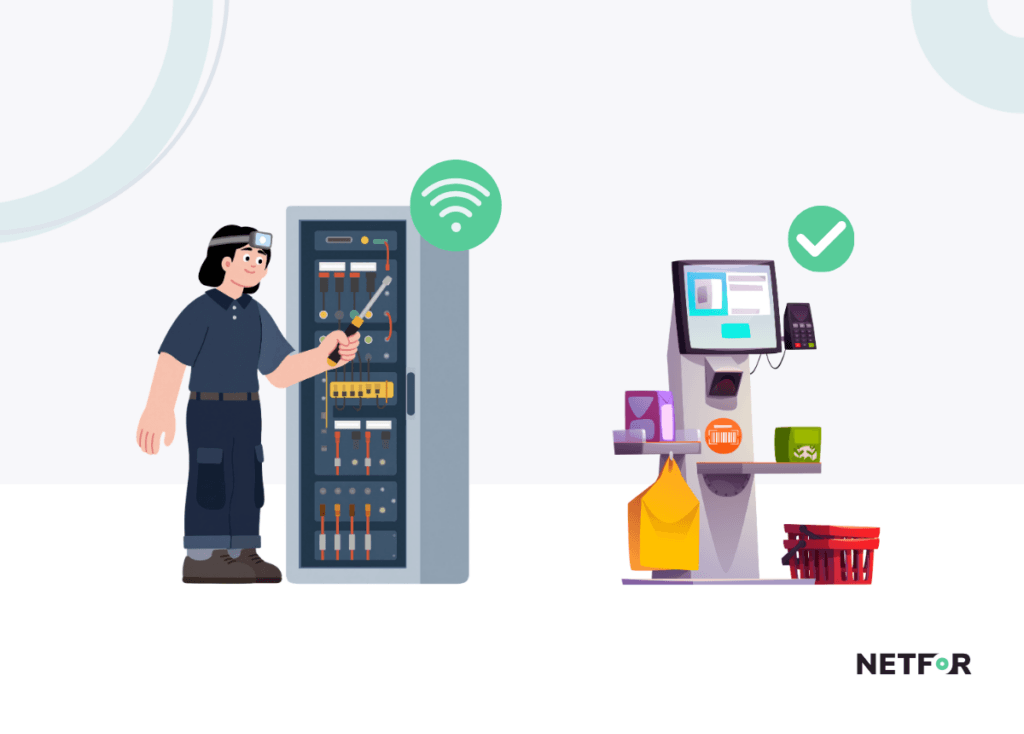
Why In-House Technical Support Breaks Down Across Multiple Locations
Why does in-house technical support break down across multiple locations? In-house technical support breaks down because the core problem is site familiarity, not headcount. In a single-site environment, institutional knowledge lives in people's heads. Once that knowledge fragments across distributed sites, every visit becomes a partial reset, and rotating technicians arrive with no baseline understanding of the location.
Picture the "different technician every visit" scenario. The first technician learns where the wiring closet sits and which switch feeds which register. That knowledge leaves with them. The next visit, a new technician starts from zero. The first stretch of every job goes to re-learning the site instead of fixing the problem. Multiply that across hundreds of locations and the lost hours become real money.
The numbers back this up. Research from the Aberdeen Group indicates that technicians lose approximately 30% of their total shift capacity searching for basic asset documentation, physical diagrams, and replacement components (Aberdeen Group, 2024). That is time spent hunting for information before any diagnostic work begins.
Here is what breaks down specifically:
- No consistent documentation across sites
- Technician turnover resetting institutional knowledge
- Time lost searching for basic site information instead of diagnosing the issue
- Inconsistent service quality from one location to the next
Turnover makes the discontinuity worse. Nearly half of field service technicians, 49%, do not plan to remain in the profession over the next three years (Service Council, 2024). When technician turnover is high, every site visit becomes a fresh onboarding exercise. Cross-industry data confirms the result: 42.3% of operators experience inconsistent service quality and 28.8% suffer persistent knowledge loss as direct consequences of field technician turnover (UpKeep, 2026). These are the same in-house technical support problems that show up over and over as firms scale.
What Breaks at Scale for Mid-Sized Technology Firms
Technical support scalability problems come from two things: rising costs as unresolved issues escalate through support tiers, and a geographic breaking point where travel time between sites consumes too much of the response window. Once transit eats the schedule, a lean internal team stops being economically workable.
Simply put: Help Desk calls get expensive when they can't resolve remotely, and Field Service requests get expensive when technicians spend more time traveling than fixing.
Explore Netfor’s AI-enabled Help Desk Solutions for your multi-location organization.
Imagine a firm with one or two technicians covering a regional cluster of sites. The model has no slack. One absence due to illness or vacation, and a site loses much of its daily support capacity. Research shows that a single-technician absence removes 37% of a site's daily operational capacity (UpKeep, 2026). Add a hardware failure at a second location on the same day, and coverage collapses entirely.
Here are the signs a company has hit the scalability wall:
- Rising escalation costs as tickets move from help desk to on-site dispatch
- Inconsistent processes because each site develops its own workaround
- Technicians spending more time in transit than on repairs
- Coverage gaps whenever a technician is out
There is also a clear geographic inflection point. When driving distance between sites exceeds 60 to 90 minutes, maintaining full-time internal staff becomes economically inefficient, because technician time shifts heavily toward unbillable driving instead of productive repair work (VentaVid, 2024). Solving this well requires a structured approach to IT lifecycle management, where deployment, support, and maintenance connect instead of fragmenting across sites.
What Works Instead: The Single-Partner Model
How does field service management improve consistency across distributed locations? Field service management improves consistency by centralizing scheduling, documentation, and dispatch, then routing the same technician back to the same locations whenever possible. This preserves site knowledge across visits and replaces site-by-site improvisation with standardized processes.
Need a single partner for field execution? We support organizations on a per-job basis.
The alternative to a fragmented model is direct: a single-partner model built around technician continuity, paired with a modern field service management platform. The same technician, or a small dedicated team, returns to the same locations whenever possible.
Dedicated routing eliminates the "re-learning the site" problem entirely. A returning technician already knows the layout, already knows which switch feeds which register, and already knows who to call at the location. The twenty-minute reset disappears because there is nothing to reset. This is how you deploy technology across every location without rebuilding site knowledge on every trip.
Here is what a single-partner model provides:
- Consistent technician assignment per site
- Centralized documentation accessible across the whole support team
- Standardized processes instead of site-by-site improvisation
- A direct escalation path when field work connects back to the help desk
- Reduced downtime across all locations needing work
The business case for this model is strong. Organizations that combine core in-house technical leadership with a dedicated field partner reach an 89% customer retention benchmark (Aberdeen Group, 2024). Outsourcing to a structured provider also reduces operating costs by 30% to 50% compared to maintaining internal field teams in every secondary market (Deloitte, 2024).
Proof in Practice: Consistency at Scale
The clearest proof of this model comes from The UPS Store, which operates more than 5,500 independently owned locations and roughly 25,000 employees. This is the multi-location IT support challenge at its most demanding.
Before the shift to continuity, the pattern matched everything described above. A different technician showed up at each visit, and the first stretch of every job went to re-learning the store. The wiring, the equipment, the contacts, all of it had to be relearned each time.
After partnering with Netfor, the approach changed. Netfor routes the same technician back to the same locations whenever possible, cutting that ramp time to near zero. Franchisees are treated as distinct businesses rather than ticket numbers, and the same technician returns to build familiarity and trust over time. This held not for a handful of stores, but across all 5,500 locations.
Here is what changed as a direct result:
- Near-zero ramp time per visit
- Consistent technician relationships at the site level
- Faster resolution because no re-learning is required
- Consistency that held at a scale of thousands of locations, not just a few
The measurable outcomes tell the story. The program answers 92% of support calls within 60 seconds and resolves roughly 90% of issues on the first call, about 20 percentage points above the industry average. It carries a Net Promoter Score of 37, the highest the network has ever recorded, and generates approximately $500,000 in annual operational savings (Netfor, 2026). Supporting thousands of locations under one accountable model, rather than a tangle of disconnected vendors, is what made these results possible.
“Managing a network of 5,500+ locations demands consistency, speed, and reliability. Netfor’s support across fulfillment, in-store technology, and IT services has strengthened our operational efficiency and uptime, ensuring our locations remain productive and our customers well served.”
— Sean O’Neal, Vice President of Retail Operations, The UPS Store
The Real Fix Is Continuity, Not Headcount
Multi-location IT support does not break down because a firm hires too few technicians. It breaks down because site familiarity resets on every visit, driving up cost, slowing resolution, and leaving locations exposed. Adding more rotating technicians only spreads the same problem across more sites.
The fix is technician continuity delivered through a single-partner field service model. When the same technician returns to the same locations, site knowledge stays intact, processes stay consistent, and resolution stays fast.
If your team is managing IT support across a growing number of sites, the question is not whether you have enough technicians. It is whether the same ones keep coming back. Explore how Netfor's Field Services can bring continuity and consistency to every location you operate.