

Executive Summary: AI customer service is software that listens to or reads customer requests, sorts them by urgency, and either answers them right away using an existing knowledge base or hands them off to a human agent with full context. It runs omni-channel across phone, chat, email, and text to reduce wait times and keep support consistent during busy periods. The goal is not to replace agents. It is to handle routine work so your people can focus on what actually needs a human. Businesses considering it should start with their most repetitive requests and build from there.
Most businesses that struggle with AI customer support do not have a technology problem. They have a clarity problem. They are not sure what AI actually does, where it fits, or whether their operation is ready for it. This guide answers all three questions in plain language, with real examples, no jargon, and a clear next step at the end.
Whether you are managing support across multiple retail locations, running a franchise network, or advising clients on operational decisions, this is the overview you can read in one sitting and actually use.
What Is AI Customer Service?
AI customer service uses software to answer, sort, and route customer questions automatically. The goal is simple: get people to the right answer faster, without making your agents repeat the same conversation fifty times a day.
It is worth clearing up the biggest misconception right away. AI customer service is not about replacing your team. It is about giving your team backup on the work that does not need a person, so the people you have can focus on the interactions that do.
The software works the same way whether a customer reaches out by phone, chat, email, or text. Across all of those channels, it does three things:
- Listens to or reads what the customer needs
- Sorts the request by urgency and type
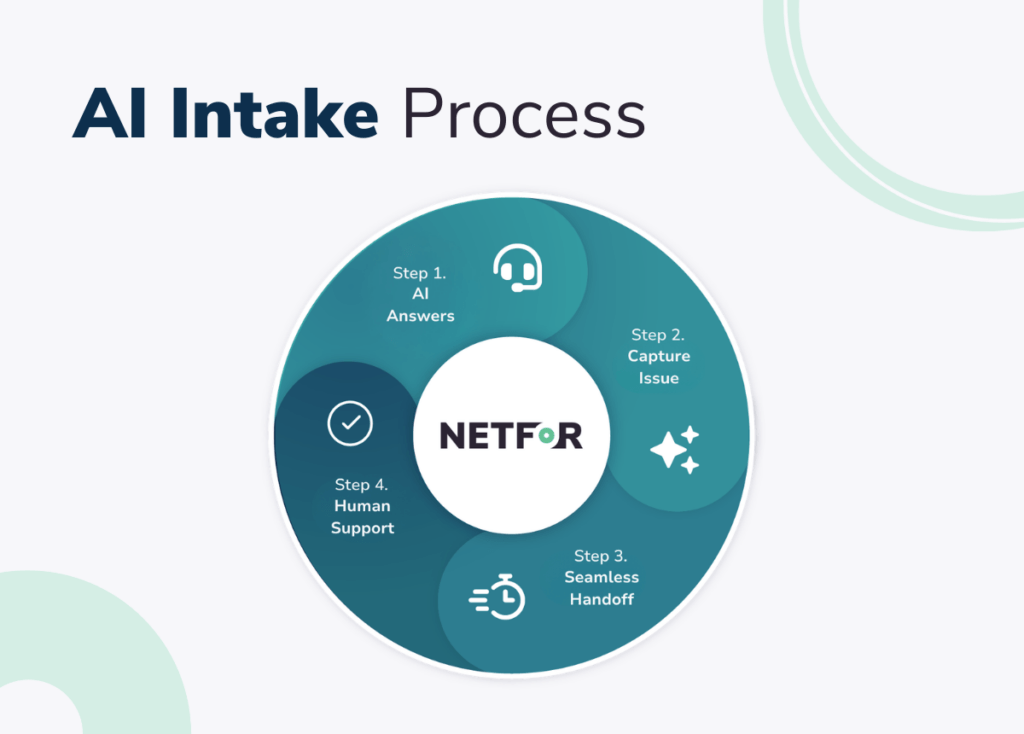
- Either solves it right away or hands it to the right person with full context
Here is a practical example. A customer calls about a payment error mid-purchase. The Conversational AI recognizes the urgency because revenue is at risk. It captures the transaction details and error context. Then it either resolves the issue directly or routes the call immediately to a human agent who already has the full picture. No hold music. No repeated explanations. Just a fast path to resolution.
That is what conversational AI for customer service actually looks like in practice.
What Are the Key Benefits of AI in Customer Service?
The benefits of AI-powered customer service show up in outcomes your operation can measure. Here are five worth knowing:
- Faster answers, no hold music or long phone trees: Customers explain their issue once. IVA’s or Intelligent Virtual Agents capture complete context in seconds and gets them moving toward a resolution immediately.
- Fewer repeated stories: When a human agent does need to step in, they receive the full interaction history upfront. Customers never have to start over.
- Handles busy periods without emergency hiring: Whether it is a product launch, a system outage, or the holiday rush, AI scales instantly. You do not need to staff up for spikes.
- Works consistently across every channel: Phone, chat, email, and text all get the same intelligent AI intake and routing experience.
- Frees up agents for the work that needs a human touch: Complex billing disputes, emotionally charged calls, and sensitive situations stay with your people, not handled by the IVA.
Consider a system outage scenario. Hundreds of customers call at once. Without AI, whoever called first gets help first, regardless of how urgent their situation is. With Netfor’s Intelligent Virtual Agents, absorbing the spike, every caller is heard immediately, details are captured from each location, and the most critical issues get routed to the front of the line. That is the kind of operational advantage that shows up directly in service quality and customer retention.
Netfor's AI customer support platform delivers 95% first-call resolution without adding headcount. That number reflects what is possible when AI handles volume and humans handle complexity.
What Does AI Customer Service Look Like in Real Businesses?
This is the part that matters most. AI customer service is not a future concept. It is already running in operations like yours, handling situations like these every day.
Here are four real-world scenarios where AI customer service performs well:
- System outages: Your POS system goes down. Hundreds of store managers call at once. AI absorbs the spike instantly, no busy signals. It gathers details from every caller, creates tickets with full visibility into impact, and routes the most critical locations to the front of the queue. Managers get help based on business impact, not call order.
- Sales-blocking issues: A customer cannot complete a purchase because of a payment error. AI recognizes that revenue is at risk, captures the transaction details, and routes the call immediately to an agent who can solve it fast. The sale is saved. The customer is not frustrated. Neither outcome would be guaranteed without AI in the loop.
- Peak demand periods: Black Friday. A major promotion. Call volume triples overnight. AI handles order status, tracking, and FAQ questions on its own, without agent involvement. Complex issues get queued with full context. Service levels hold without emergency hiring.
- Appointment scheduling: Customers need to book, change, or cancel appointments at any hour. AI handles it automatically, syncs confirmations, and frees your agents to focus on requests that genuinely need a person.
These are the use cases where AI in customer experience delivers consistent, measurable results. Not hypothetical wins. Operational ones.
It is also worth noting how this differs from what tools like Zendesk AI, Intercom Fin, and Salesforce Agentforce offer. Those are software-only platforms. Zendesk AI is strong on chat messaging but limited outside that channel. Intercom Fin is built primarily for deflecting chat volume. Salesforce Agentforce is a powerful enterprise AI agent platform, but it requires heavy internal IT configuration. Netfor's approach is different: AI services paired with the operational execution and live onshore agents to back it up. The technology plus the team that knows how to run it.
How Do You Know If Your Business Is Ready for AI Customer Service?
Being ready for AI customer service is not about having the most advanced technology stack. It is about having clean systems, clear goals, and a realistic picture of what to automate and what to leave to people.
Here are four signs your operation is ready to start:
- Your team is repeating the same routine questions over and over: If your agents spend most of their day answering the same ten questions, that is exactly the volume AI is built to absorb.
- Hold times or call volume spikes are hurting customer satisfaction: If you are losing customers to wait times during busy periods, AI can close that gap without adding headcount.
- Your current systems can actually connect to new tools: AI works best when it can talk to your CRM, ticketing platform, and phone system. If those connections exist, integration is straightforward.
- Leadership wants results without a full rip-and-replace: Good AI customer service implementations are built to work alongside what you already have, not to replace it.
AI readiness is a real concept with real criteria. It is not a gut feeling. Businesses that skip this step and move straight to purchasing a tool are the ones that end up with failed implementations that cost far more than the platform fee.
For businesses that are not sure where they stand, Netfor offers a formal AI Readiness Assessment.
It is a fixed-scope, structured diagnostic that scores seven areas of your operation on verified evidence from a working session, not a self-reported survey. It tells you exactly what is ready, what is not, and what to build first. For businesses that want to understand AI intake or Voice AI more deeply before committing to a full deployment, the assessment is the right starting point.
What Are the Best Practices for Using AI in Customer Service?
A successful rollout does not start with turning everything on at once. It starts with the right scope, the right guardrails, and a plan to grow. Here are five practices that separate the implementations that work from the ones that stall.
- Start with your busiest, most repetitive requests, not the hardest ones: Order status, appointment scheduling, FAQs, these are the right first targets. They are high volume, low complexity, and easy to validate.
- Keep a clear handoff path to a human for anything sensitive or complex: AI-driven outsourcing works because the human element never disappears entirely. Customers who need a person should always be able to reach one, with full context transferred automatically.
- Make sure the AI sounds like your brand, not a generic bot: Configurable brand voice is a core feature of well-built AI platforms. Every interaction should feel like it is coming from your team.
- Track and review conversations regularly to catch mistakes early: Every AI interaction should be logged and reviewable. Audit what the AI said, why it made certain decisions, and where it fell short.
- Roll out in stages: validate with real data, launch, then optimize over time: Instead of automating everything on day one, start with order status and appointment scheduling, prove it works, then expand from there.
This approach is how Netfor's own process works: Validate, Activate, Optimize. Prove the value before committing, launch with clean configuration and integration, then tune the system continuously based on real conversation data.
Frequently Asked Questions About AI Customer Service
Will AI replace customer service agents?
No. AI customer service handles high-volume routine work so agents can focus on complex issues that require human judgment and empathy. The goal is a better-performing team, not a smaller one.
What channels can AI customer service cover?
Phone, chat, email, and text, all with the same consistent intelligent intake and routing experience across every channel.
Do I need to replace my current systems to use AI?
No. Well-designed AI customer service platforms connect to your existing CRM, ticketing system, and phone infrastructure. No rip-and-replace required.
How do I know if my business is ready for AI customer service?
Start with a formal readiness assessment. It will surface gaps in your data, systems, and processes before any tool is deployed. Netfor's AI Readiness Assessment is a structured, half-day session that gives you a scored action plan for $2,500 flat.
What happens if AI cannot answer a question?
It hands the customer off to a human agent with full interaction context. The customer never has to repeat themselves, and the agent already has everything they need to resolve the issue.
AI Customer Service Works Best as a Teammate, Not a Replacement
The businesses that get real results from AI customer service are the ones that treat it as a partner for their support staff. They start with simple, repetitive requests. They prove value in stages. They keep humans in the loop for anything that genuinely needs a person.
That is exactly how Netfor builds AI customer support: designed to work with your existing systems, not around them, with a human always available when the situation calls for one. After 30+ years delivering customer support for multi-location businesses, Netfor applies the same operational discipline to AI that it applies to human staffing: defined workflows, real-time oversight, and continuous improvement.
If you are ready to find out exactly where your operation stands, start with a Netfor AI Readiness Assessment. Half a day. A flat fee. A plan you can act on.