

Executive Summary: An AI readiness assessment is a structured, evidence-based evaluation of whether an organization's people, data, processes, and governance can support AI before any tool is purchased. A genuine AI readiness assessment framework scores what can be verified across seven dimensions: Knowledge, Data, Process, Intelligence, Integration, Team, and Governance. The result is a plain verdict and a recommended sequence, not a vague score.
Start the AI Readiness Assessment Here
Every leadership team gets asked whether they're ready for AI. Almost none of them can answer with real evidence instead of a gut feeling.
Most organizations make this decision based on self-perception, a free scorecard, or a consulting audit structured to justify a further sale. None of those options measure what actually predicts success or failure. The result: according to MIT Sloan's Project NANDA, 95% of generative AI pilots fail to reach production scale or deliver measurable return (MIT SLOAN, 2025). Of the $684 billion invested globally in dedicated AI initiatives in 2025, over $547 billion delivered zero meaningful return on investment (TALYX, 2026).
Understanding how companies are using AI in customer experience is one thing. Knowing whether your specific operation can support it is another. This piece defines what a genuine AI Readiness Assessment actually measures, walks through the framework, and shows what separates a real readiness check from a guess dressed up as one.
What Does an AI Readiness Assessment Framework Actually Evaluate?
An AI readiness assessment is not a survey your team fills out about itself. It is an evidence-based evaluation of whether your operation can support AI, scored on what can be verified rather than what a team believes to be true.
Netfor's AI Readiness Diagnostic scores seven dimensions:
- Knowledge: Does your operation have documented, consistent, and accessible knowledge that an AI system can draw from?
- Data: Is your data clean, structured, and accessible, or fragmented across legacy systems?
- Process: Are your workflows documented and stable enough to automate, and do they account for human oversight?
- Intelligence: What level of AI capability is actually appropriate for your current operational maturity?
- Integration: Can AI tools connect to your existing systems without requiring a major rebuild?
- Team: Does your staff have the skills and organizational alignment to adopt and sustain AI?
- Governance: Do you have the policies, controls, and oversight mechanisms to deploy AI responsibly?
This last dimension gets the least attention and causes the most damage. More on that below.
Capability also has to be scored in stages. According to Gartner's AI Maturity Model, organizations progress from Level 1 (Awareness) through Level 5 (Transformational) (GARTNER, 2026). The core problem in mid-market organizations is that most are operating between Level 1 and Level 2, yet attempting to execute Level 4 systemic automation without establishing the Level 3 data pipelines required to sustain it. Adoption is not readiness. Readiness has to be measured.
Why Do Most AI Projects Fail Before They Start?
The failure patterns are consistent across independent research. Three root causes appear in the overwhelming majority of failed projects.
The data quality tax is the most immediate. Gartner projects that 60% of AI projects lacking AI-ready data will be abandoned through 2026 (GARTNER, 2026). A Fortune 500 manufacturer committed $12 million to an AI quality control project, only to find that production data was siloed across 47 distinct file formats in 23 legacy operational technology systems. Integrating those systems required an additional $8 million in unbudgeted capital. The project was abandoned at a $20 million total loss (BERI.NET, 2026).
Organizational antibodies are the second failure mode. When AI tools are deployed without redesigning workflows around them, staff default to legacy manual workarounds. In documented inventory optimization deployments, up to 78% of operational managers continued to override AI recommendations based on subjective assessment, severing the feedback loops required for machine learning to function (BERI.NET, 2026).
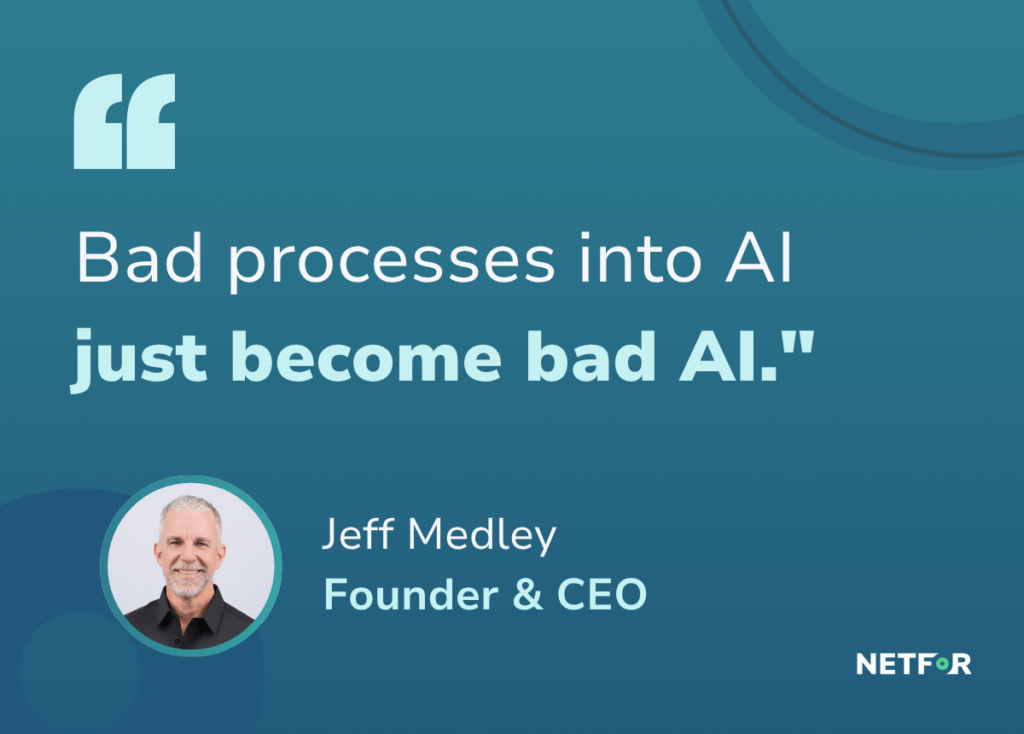
As Jeff Medley, CEO and Founder of Netfor, puts it directly:
The absence of a defined success metric rounds out the pattern. Approximately 73% of failed AI projects lacked clear, pre-defined operational performance metrics before technical development began (IFACTORY AI, 2026). Systems built as open-ended technology demonstrations routinely fail during financial review when measurable contribution to earnings cannot be verified.
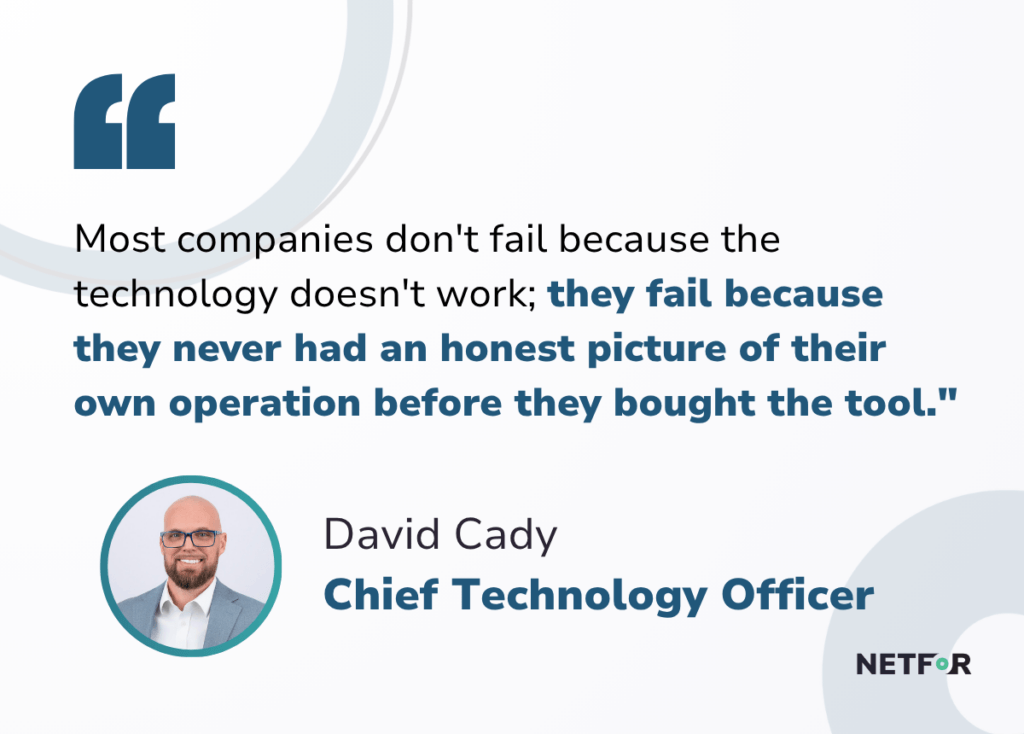
"Most companies don't fail at AI because the technology doesn't work," says David Cady, CTO of Netfor. "They fail because they never had an honest picture of their own operation before they bought the tool."
The AI Readiness Checklist: What to Verify Before You Evaluate Any Tool
A practical AI readiness checklist covers three operational areas before a tool is ever evaluated.
Data architecture and telemetry readiness: Your data needs to meet a production standard, not just exist. That means checking data quality, format consistency, volume across legacy databases, and whether data is accessible via real-time pipelines rather than siloed repositories.
Process and workflow maturity: Before selecting any software, service organizations need to map standard operating procedures, document specific decision points, and establish baseline task performance metrics. Workflow redesign must happen before software integration, not after.
- Human-in-the-loop (HITL) approval gateways, operational override mechanisms, and user feedback loops are structural requirements, not nice-to-haves. They prevent the process rejection patterns that account for 67% of documented deployment failures (MCKINSEY, 2026).
Financial modeling that accounts for full lifecycle cost: Standard accounting models undercount enterprise AI lifecycle costs by 40% to 60% (ALICELABS, 2026), because they treat AI tools as static software purchases rather than dynamic operational systems requiring continuous data maintenance, model retraining, and governance oversight. Pre-investment models should enforce the 10/20/70 allocation rule and include a mandatory 25% cost contingency buffer to absorb implementation complexity. The hidden cost of moving too fast compounds quickly when these inputs are skipped.
For a service desk evaluating AI, the starting question is not "which tool should we buy?" It is: "Is our data clean enough to train on? Are our workflows documented enough to automate? Have we defined what success looks like before we write a check?"
Check out our AI Customer Support service capabilities here.
Why Governance Is the Dimension Most AI Readiness Audits Skip
An AI readiness audit measures whether your data and processes can support AI. An AI governance assessment measures whether you have the controls to deploy it safely. Most checklists skip the second half entirely.
The governance gap is not theoretical. Shadow AI is the unsanctioned use of third-party generative tools by employees bypassing IT controls, accounted for 20% of corporate data breaches in 2025 (SHATTERED.IO, 2026). Employees using public AI tools to process client communications or financial data without guardrails is the most common exposure point, and it often happens without leadership awareness.
Board confidence in AI oversight is not improving. Only 8% of boards rate their own AI expertise as strong, and 40% of directors name AI oversight as their single most challenging governance issue (DILIGENT, 2026).
Agentic AI (autonomous software systems that can take multi-step actions without human approval at each step) is accelerating the problem: 74% of organizations plan moderate-to-extensive deployment of agentic tools within two years, but only 21% maintain a mature governance model for them (DELOITTE, 2026).
Regulatory exposure is also increasing. The EU AI Act entered general application in August 2026, with significant statutory fines for organizations that fail to meet data governance, transparency, and human oversight requirements (AILEXCONSULTING, 2026). U.S. state-level frameworks, including Colorado's SB 26-189 effective January 2027, are adding parallel compliance obligations across state lines. A complete AI governance assessment addresses this exposure directly. A free scorecard does not.
How Does Readiness Differ Across Industries?
Retail is already using AI in Customer Experience, from AI Call Center support to Voice AI for routine questions. Netfor's conversational AI services shows what this looks like done well: AI-driven intake backed by onshore human agents for escalation. The real gap isn't the tool; it's whether the data behind demand is clean enough to support it.
Franchise operators need Franchise IT Support standardized across locations before AI Help Desk automation works. Gartner found 53% of successful AI deployments in infrastructure and operations happen in IT service management (GARTNER, 2026), which looks a lot like a well-run help desk. This is also where IVA vs IVR matters: an intelligent virtual agent on top of inconsistent phone systems won't help until the process is standardized.
Healthcare moves carefully. Clinical labor shortages drive demand for AI Patient Intake, but enterprise AI governance has to be resolved before any patient-facing tool goes live.
QSR is moving fast on AI Call Center and Voice AI at the drive-thru. Brands weighing AI Driven Outsourcing need the same check as anyone else: clean data, documented process, governance in place, before jumping to How To Build an AI Strategy.
Free Scorecard vs. Consulting Audit vs. AI Readiness Diagnostic
| Option | What It Measures | Cost | Can It Recommend Against Buying AI? |
| Free online scorecard | Self-perception; what your team rates itself | $0 | No |
| Large consulting audit | Maturity, typically structured to lead into a broader engagement | $25,000 and up | Rarely |
| Netfor AI Readiness Diagnostic | Verified evidence from your operation, scored across 7 dimensions | $2,500, flat | Yes |
Book your AI Readiness Assessment here.
Free scorecards are lead-generation tools. They produce a self-rated score with no verification and no accountability to your actual operational data. A large consulting AI maturity audit may be more rigorous, but it is typically expensive, slow, and structured to justify further engagement, which biases the outcome toward a purchase recommendation.
In each sector, the same pattern applies: intelligent virtual agents (IVAs) and other AI tools perform well when deployed on a prepared operation and fail when deployed on top of one that was not assessed first.
Netfor's AI Readiness Diagnostic is a fixed-scope, three-to-four-hour working session for a flat $2,500. It scores what can be verified in the room, not what a team rates itself. It ends with a scored assessment, your top three findings, a recommended sequence, and a "not yet" list of what to hold off on building. If the honest answer is that you are not ready for AI, the Diagnostic says so.
Frequently Asked Questions About Our AI Assessment:
What is an AI readiness assessment?
A structured, evidence-based evaluation of an organization's capability to support AI, scored across dimensions like data, process, team, and governance, on verified evidence rather than self-ratings.
Is my business ready for AI?
Readiness depends on whether your data, workflows, and governance can actually support the tool, not on whether you want it to work. Only 13% of organizations report a positive impact from AI so far (FORRESTER, 2026). A structured assessment is the only reliable way to know before you spend on a tool.
How do I know if my business is ready for AI in practice?
Check three things: whether your data is clean and accessible, whether your workflows have been redesigned around the tool rather than layered under it, and whether you defined a success metric before development started. If any of those three are missing, you are not ready yet.
How long does an AI readiness assessment take, and what does it cost?
Netfor's AI Readiness Diagnostic is a fixed-scope, three-to-four-hour session for a flat $2,500 with no open-ended engagement and no follow-on sales pressure.
What is the difference between an AI readiness audit and an AI governance assessment?
An audit measures whether your data and processes can support AI. A governance assessment measures whether you have the controls to deploy it safely. A complete readiness check covers both.
Can an AI readiness assessment recommend against buying AI?
It should. An assessment that only ever confirms you are ready is not measuring anything real. If the assessment cannot produce a "not yet" verdict, it is confirming what you already wanted to hear, not what is actually true.
Stop Guessing. Get a Verified Answer.
AI readiness is measurable. Most failed AI projects fail for reasons that were visible before a dollar was spent on a tool: fragmented data, undocumented workflows, undefined success metrics, and no governance controls. These are not technology problems. They are operational problems, and they show up clearly when you look for them with a structured framework.
Netfor's AI Readiness Diagnostic scores what can be verified in the room. It is built to say no when that is the honest answer, and to give you a clear action plan when you are ready to move. Half a day. A flat fee. A verdict you can act on.
Book the AI Readiness Assessment and replace uncertainty with a plan.