
AI readiness is not about selecting the right software. It means having a unified data infrastructure, documented workflows, and a governed knowledge base strong enough for AI to draw accurate answers from. Companies fail at AI implementation when they automate broken processes instead of fixing them first. The path to AI readiness starts with simple, low-risk workflows like intent gathering and scheduling, then expands to complex, integration-heavy workflows only after those succeed, with human-in-the-loop guardrails managing accuracy throughout.
Enterprises have poured massive budgets into AI in recent years. Boards approved the funding. Vendors were selected. Pilots were launched. And then, quietly, most of them stalled.
The failure rate is not a surprise to anyone paying close attention. What surprises most organizations is the reason. AI implementations are not failing because companies chose the wrong large language model (LLM), the technology class that powers modern conversational AI agents and generative tools. They are failing because companies deployed AI on top of broken or undocumented processes and expected the technology to fix what the process could not.
That is the argument Netfor CEO Jeff Medley made clearly in a recent Netfor podcast conversation, and it is backed by a growing body of evidence. AI is not the strategy. Removing operational friction from your knowledge and workflows is the strategy. AI is the tool that scales it once that friction is gone.
This post defines what AI readiness actually means, explains why implementations fail, and walks through how to sequence adoption so your organization builds on solid ground rather than automating its way into a faster version of the same problems.
Why Do AI Implementations in Customer Service and IT Help Desks Fail?
The numbers are hard to ignore. More than 80% of AI projects fail to deliver their intended business value, roughly double the failure rate of traditional IT projects. By mid-2025, the share of enterprises abandoning most of their AI initiatives had surged from 17% to 42% (S&P GLOBAL MARKET INTELLIGENCE, 2025).
These are not isolated incidents. They are a pattern, and the pattern has a clear cause: fear-driven adoption. Companies launched AI because they were afraid of falling behind, not because they had a clear operational plan. The result is a predictable cycle of deployment, reversal, and rehiring.
The case studies are well documented. Klarna's AI chatbot replaced hundreds of agents and projected tens of millions in savings, then quietly rehired human agents after complex case resolution quality dropped. Commonwealth Bank of Australia eliminated customer service roles for an AI voice bot, then reversed course after complaint volume spiked. IBM automated routine HR inquiries successfully, but the cases requiring human judgment still needed people, prompting a significant wave of new hiring.
The layoff reversal data tells the same story. Many corporate leaders who eliminated roles through AI later admitted it was a strategic error, with a significant share having to rehire for the same positions within 18 months.
For a deeper look at how these reversal patterns play out in voice AI specifically, Netfor's analysis of voice AI implementations documents the same root causes at work.
"That's where we're seeing success: we look for areas that are redundant, look for workflows that can be automated, and low-risk areas that can be operationalized by AI while keeping a human in the loop. That's where we're seeing revenue."
— Jeff Medley, Netfor Founder & CEO
Signs an AI reversal is coming:
- The AI was deployed before workflows were documented or mapped
- Pilot success was measured by cost reduction, not resolution quality
- Complex edge cases were excluded from the pilot scope
- No escalation path was defined for issues the AI could not resolve
- Knowledge base content was not audited before the deployment went live
How Does Knowledge Management Affect AI Accuracy in Customer Service?
Choosing a better model will not fix a bad knowledge foundation. That distinction matters because most organizations focus their AI investment on the wrong layer.
Data quality, not model selection, is the dominant driver of AI failure. Most executives identify data as the biggest barrier to AI implementation, yet only a small fraction of organizations say their internal data is actually AI-ready.
Poor data quality carries a real price tag. Organizations lose an average of $12.9 million annually to bad data, and companies with governed data foundations see dramatically higher AI ROI than those running the same tools on weak, siloed data. Gartner warns that the majority of enterprise AI projects will fail by 2028 due to a missing semantic layer, the governed, consistent definition of business terms that AI systems rely on to generate accurate answers.
The failure mode for AI on bad data is more dangerous than most organizations realize. Legacy rules-based automation fails loudly and stops for human review when it encounters bad data. AI agents fail quietly, generating confident but incorrect outputs and executing flawed downstream actions like refunds or escalations without a checkpoint (PROCESS EXCELLENCE NETWORK, 2026). Customers experience the damage before anyone on the operations team notices.
A well-maintained customer support knowledge base and a structured approach to knowledge management are not supporting infrastructure for AI. They are the prerequisite.
"More answers builds knowledge, and having context to it is what lets you troubleshoot and find the right answer."
— Jeff Medley, Netfor Founder & CEO
What a governed knowledge base needs before AI deployment:
- A single, authoritative source of truth for all product, policy, and process information
- Named owners responsible for reviewing and updating content on a defined schedule
- Consistent terminology aligned with how customers actually ask questions, not internal jargon
- Search analytics to identify content gaps and failed queries
- Integration with live systems of record so conversational AI assistants responses reflect current data
- A documented escalation path for questions the knowledge base cannot answer
What Is the Law of Diminishing Returns in First Call Resolution?
First Contact Resolution (FCR), defined as the percentage of customer inquiries resolved during the initial interaction with no follow-up required, is one of the most important metrics in customer service and IT support operations. It connects directly to cost, satisfaction, and retention.
The connection is direct: improvements in FCR reduce operating costs, lift customer satisfaction, and drive retention. Customers who face a high-effort support experience are far more likely to leave, while those who get fast, complete resolutions are significantly more likely to recommend the brand.
What Jeff Medley calls the "law of diminishing returns" in first call resolution is this: each additional percentage point of FCR improvement costs more than the last. Getting from 65% to 75% FCR is achievable with good process and training. Getting from 90% to 95% requires significantly more investment, and the cost of that final push often exceeds the value it returns.
Understanding this curve before setting AI targets is not optional. It is the difference between a realistic deployment roadmap and an AI project that was always going to disappoint.
Customer service vs. IT help desk FCR benchmarks:
- Human-led customer service: 69% to 75% FCR industry average
- Human-led IT help desk: 65% FCR industry average
- AI-assisted IT service desks: 75% FCR, with 35% of tickets resolved without human involvement
- Escalated Tier 3 technical tickets cost more than four times as much to resolve as standard Tier 1 tickets
Netfor's work with a global retailer on first call resolution and knowledge management improvement demonstrated that focused operational investment in these two areas, before any AI deployment, produced measurable gains in both customer satisfaction and cost efficiency. For more on what AI help desk support looks like when the operational foundation is in place, see Netfor's full breakdown of hybrid IT service delivery.
What Does It Mean for a Company to Be "AI Ready"?
AI readiness is not a tool decision. It is an infrastructure and process decision made before any vendor conversation begins.
"One of the advantages we have, with decades of experience, is that we're focused in one area: knowledge lifecycle management. That's what we've been doing for decades."
— Jeff Medley, Netfor Founder & CEO
The reality is clear: very few organizations are truly AI-ready. Most large transformation projects fall short of their goals, and the primary cause is not a technology gap. It is undocumented workflows and poor process foundations. Digital transformation efforts routinely fail for the same reason, confirming that the barrier to AI success is operational, not technical.
Ignoring process readiness is costly. Re-engineering a broken automation after deployment costs significantly more than mapping the process correctly from the start, and formal process mapping before automation leads to a major reduction in post-deployment errors.
Automating a broken process does not fix it. It produces a faster broken process. That is the core insight that separates organizations that scale AI successfully from those that reverse their deployments at significant cost.
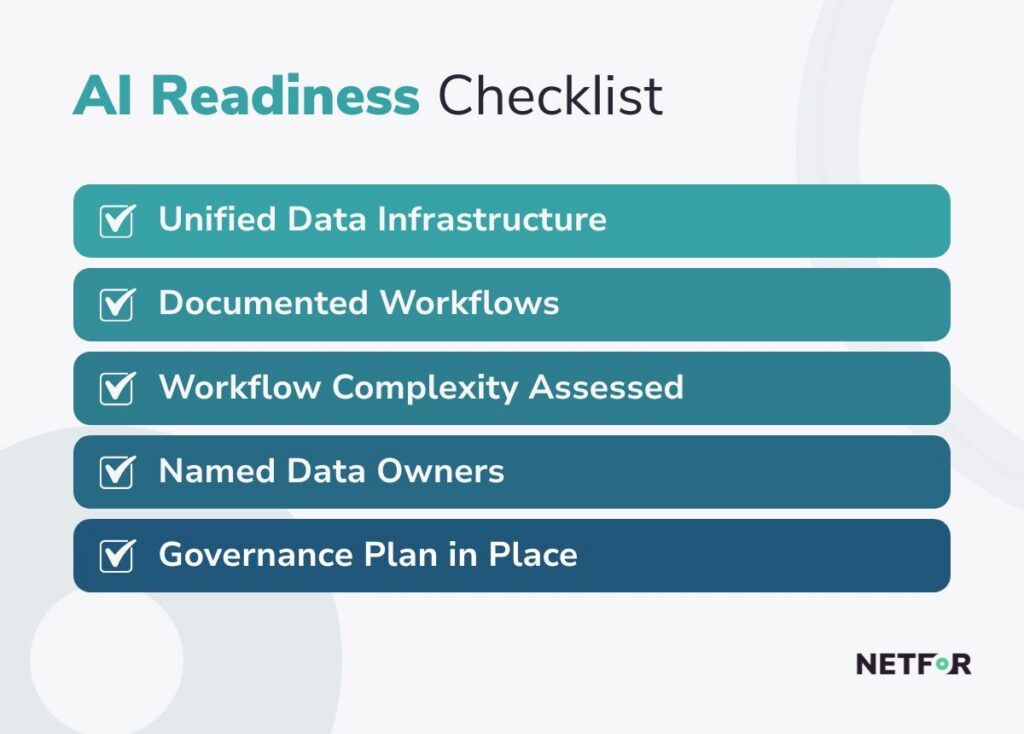
AI readiness checklist:
- Unified data infrastructure with a single source of truth across systems
- Documented workflows for every process targeted for automation
- Workflow complexity assessment completed (simple vs. multi-system vs. legacy ERP integration)
- Named data owners accountable for quality and currency
- Governance plan with review cycles, escalation paths, and compliance documentation
- Human-in-the-loop framework defined before any pilot goes live
Workflow complexity determines realistic deployment timelines, not enthusiasm. Simple workflows like intent routing, scheduling, and password resets deploy quickly. Moderate workflows requiring multi-system integration take longer. Complex enterprise workflows with legacy ERP integration and multi-agent orchestration can take several months. Setting timelines based on actual complexity, not optimism, is what separates successful deployments from stalled ones.
What Workflows Should Companies Automate with AI First?
The answer is consistent across every successful deployment: start with simple, low-risk workflows. Prove them out. Then expand.
Human-in-the-loop, defined as a governance model where a human reviews or approves AI actions before or after execution, is not optional friction. It is the guardrail that prevents quiet AI failures from compounding before anyone notices. Regulated industries are learning this by mandate. Every other industry should learn it by choice.
Jeff Medley's framing from the Netfor podcast is precise on this point: AI readiness starts with data infrastructure and workflow complexity assessment, not tool selection. Netfor's own approach, built on 30 years of knowledge lifecycle management, follows the same logic. Clients move from information-delivery workflows into integration-heavy workflows only after the simpler ones are stable and the human-in-the-loop guardrails are validated.
Simple AI intake workflows are the right starting point for most organizations. They are low-risk, high-volume, and fast to prove value without exposing the business to the failure modes that hit complex deployments prematurely.
Phased AI adoption sequence:
- Foundation: Process mapping, data cleanup, knowledge base audit, and baseline measurement
- Expansion: Sandboxed pilots on simple, low-risk workflows with human oversight at every decision point
- Optimization: Performance tuning, compliance review, and escalation path validation
- Innovation: Scaling validated workflows enterprise-wide with full governance documentation
This is not a slow approach. It is a sequenced one. The organizations reversing AI rollouts skipped the first two phases entirely. The cost of that shortcut is visible in every case study in this post.
For more on what AI customer support looks like when these phases are followed in order, Netfor's operational guides walk through the architecture in detail.
Fix the Foundation First, Then Let AI Scale It
The companies reversing AI rollouts did not have a model problem. They had a readiness problem. They deployed AI on top of undocumented workflows and thin knowledge bases, then discovered that AI scales whatever is already true about your process, including the parts that do not work.
Curious about what an AI Readiness Assessment can do for your business?
The law of diminishing returns in first call resolution is real, and it applies directly to AI investment. Understanding the cost curve before setting targets is how you build AI goals your operation can actually meet.
Netfor has spent 30 years managing the knowledge lifecycle that AI now depends on. The same knowledge architecture that drives 92%+ first call resolution in Netfor's human-staffed operations is what our clients build on before AI ever enters the picture. That sequencing is why clients scale AI successfully rather than reverse it.
If your organization is evaluating where AI fits into your IT help desk or customer service operation, start with an AI readiness assessment. The infrastructure work is the strategy. AI is what scales it.