

What is AI customer support? AI customer support uses artificial intelligence to automate, route, and assist with customer service interactions. It improves response speed, routing accuracy, and operational scalability across every contact channel.
It works by automating high-volume, repetitive tasks while ensuring complex issues are escalated to human agents with full context. This reduces wait times, lowers operational costs, and improves resolution speed. When implemented correctly, AI in customer support enhances customer experience by eliminating friction, increasing first-call resolution, and enabling businesses to scale service operations without adding headcount.
An estimated $3.7 trillion in global sales is at risk each year due to poor customer service, and more than half of consumers will switch providers after a single bad experience (Oxford Global Resources, 2026).
Customer support sits at the center of your operation's revenue and retention. Right now, for most organizations, it is a cost structure that scales poorly. Every increase in demand requires more headcount, more training, and more overhead. AI customer support tools fix this by taking over the high-volume, repetitive front end of service delivery so your team can focus where human judgment actually matters.
What Is AI Customer Support and Why Is It Different
If you ask a support manager what their biggest problem is, they will describe the same thing: too many tickets, not enough people, and customers who expect immediate answers. The traditional fix has always been to hire more agents. That model is breaking.
Human labor accounts for 60 to 80 percent of total support costs according to LiveChatAI's 2025 benchmark analysis. This means the cost structure scales directly with demand. Double your ticket volume, double your budget. It is a model that cannot survive the growth expectations most operations are facing today.
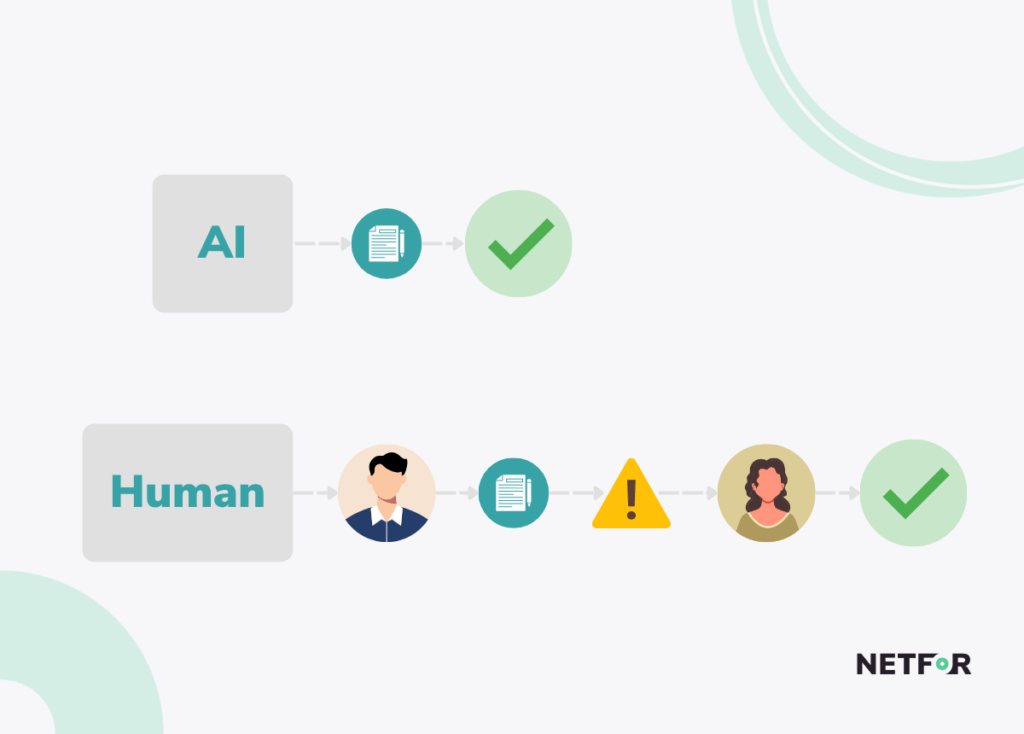
AI customer support breaks that link. Instead of every new ticket requiring a proportional human response, artificial intelligence takes over the intake layer: reading the request, categorizing it, routing it to the right team, and in many cases resolving it entirely. When escalation is needed, the human agent receives full context. The customer does not repeat themselves. Resolution is faster because the AI already did the groundwork.
The core components of a functioning AI customer support system are:
- Intelligent intake that captures and categorizes inbound requests from email, chat, and voice in under a second.
- Automated routing and prioritization that sends high-severity tickets to the right team immediately.
- Self-service automation that resolves FAQs, order status requests, and account lookups without human involvement.
- Seamless human handoff that transfers full context when escalation is needed.
Where Traditional Support Breaks Down
- Tickets pile up during Monday morning surges, product launches, and seasonal spikes with no overflow capacity.
- Misrouting wastes time, with manual triage sending 23 to 40 percent of tickets to the wrong team before they reach resolution.
- Agents burn out on repetitive, low-complexity work that AI could handle automatically.
- Customers wait, then leave. 60% of callers abandon contact after two minutes on hold, according to Call Center Studio.
The Real Cost of Poor Customer Support on Your Operation
Support teams are often viewed as a cost center rather than a revenue driver. That framing is wrong, and the numbers show why. Every interaction your team fails to handle correctly has a price attached to it beyond the immediate labor cost.
A chatbot interaction costs approximately $0.50. A human-handled interaction averages $6.00. An agent-assisted voice call can reach $13.50 to $22.00 depending on handle time according to LiveChatAI. That cost difference compounds fast at volume. For a mid-sized operation handling thousands of tickets per week, the delta between AI-resolved and human-resolved interactions becomes a multi-million dollar operational gap over a year.
The deeper cost comes from what poor support does to retention. More than half of consumers will switch to a competitor after a single bad experience. That number climbs to 86% after two bad experiences according to Oxford Global Resources. When customers leave because they could not get a fast, accurate answer, the revenue loss does not show up as a support ticket failure. It shows up as churn.
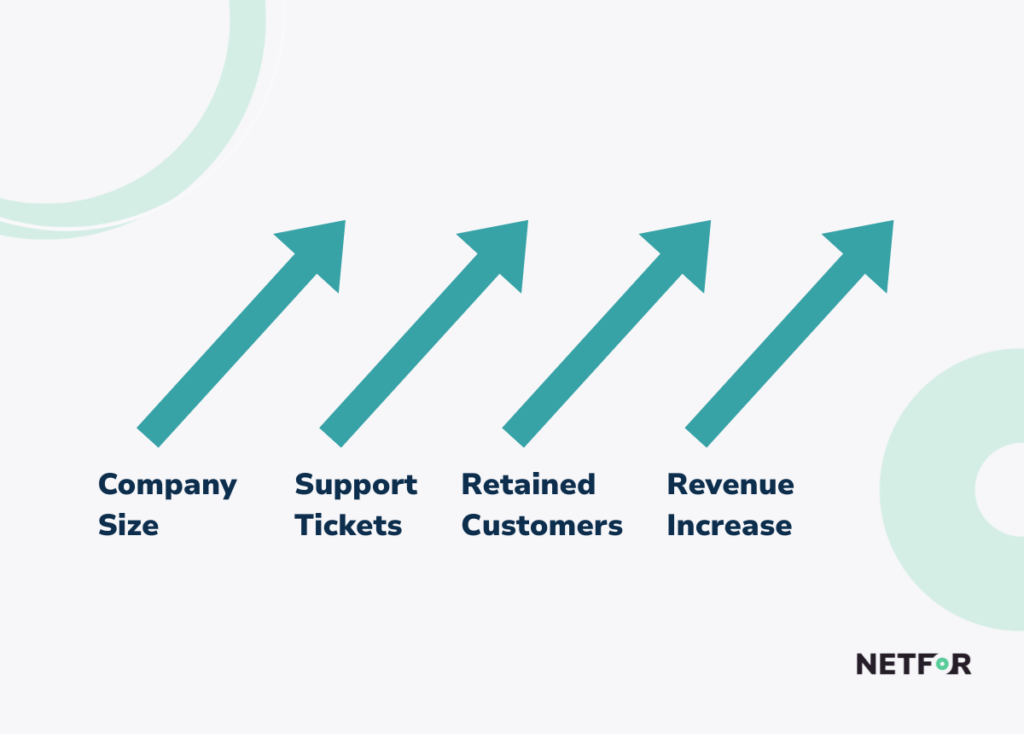
The ROI case for fixing this is well documented. A Forrester and Sprinklr analysis found that enterprises using AI customer service achieved 210% ROI over three years with a payback period under six months according to a Substack cost-benefit analysis. Organizations that implement AI effectively see a 35% drop in support costs alongside a 32% revenue increase, because faster and more accurate service drives retention as well as efficiency.
How Poor Support Hurts Your Business
- Higher cost per ticket due to over-reliance on human agents for interactions AI could resolve in seconds.
- Avoidable churn when customers leave after a single frustrating experience that better routing would have prevented.
- Unnecessary hiring to cover volume spikes that AI could absorb without adding headcount or training costs.
- Budget locked in labor that could be reallocated to higher-value CX initiatives that directly impact retention and growth.
How AI Customer Support Systems Actually Work
An AI customer support system acts as the first point of contact for every inbound request. Instead of placing a customer on hold or routing them to a generic inbox, the AI answers immediately and begins working.
The system reads the incoming message or call, identifies the customer's intent, and decides in under two seconds what to do with it. For a simple request like an order status check, a password reset, or a policy question, the AI resolves it without involving a human agent at all. For a complex or sensitive issue, the AI routes it to the right team with the customer's full context already attached, so the agent can start with answers rather than questions.
According to Fini Labs' triage automation research, AI categorization accuracy reaches 95%, compared to 77% for manual human triage. Routing decisions that take a human team 5 to 12 minutes drop to under 2 seconds. Misrouting rates fall from as high as 40% down to approximately 4%. Manual triage alone consumes up to 40% of agent work time according to Dialzara, time that AI reclaims immediately and reallocates to resolution.
The most effective model is a hybrid approach. AI handles the high-volume, repeatable front end. Humans handle complex escalations, relationship-sensitive situations, and anything requiring real judgment. Gartner predicts that over 50 percent of customer service organizations will double their technology spend by 2028 while simultaneously shifting agents into higher-value roles, not eliminating them.
Related: See how AI and IVA technology compares to legacy IVR systems for call center modernization
What an AI Customer Support System Actually Does
- Answers contacts instantly across email, chat, and voice with no hold time.
- Reads and categorizes inbound requests automatically with 95% accuracy.
- Routes tickets to the correct team or agent.
- Resolves high-volume, low-complexity requests without any human involvement.
- Transfers full customer context to agents when escalation is needed.
Scalability: The Operational Advantage Traditional Support Cannot Match
Scalability is where the gap between traditional support and AI customer support becomes impossible to ignore. Traditional models scale linearly with cost. Double your ticket volume and you need to double your staff. For growing companies, multi-location operations, and businesses with seasonal demand swings, this model fails.
AI scales differently. The same system that handles 50 contacts on a slow Tuesday can handle 50,000 contacts on the day after a major product launch or during a regional outage. According to Sierra's Black Friday playbook, when Casper's traffic doubled during a major sale, an AI agent maintained a 74% resolution rate without adding staff. When Tubi deployed AI to manage live television event surges, response times shifted from hours to minutes and containment reached 80%.
For multi-location operations, the stakes are even higher. When a network goes down across dozens of locations simultaneously, hundreds of calls flood in at once. Human teams cannot absorb that volume. AI can prioritize the outage, notify inbound callers that the issue is known, and route critical escalations to specialized technicians immediately. The Netfor franchise support model supports more than 7,000 locations nationwide for one client and is built on exactly this kind of AI-enabled surge capacity. For a closer look at how this translates to call center operations specifically, see Netfor's AI call center strategies.
AI Scalability Enables
- Instant response during unpredictable volume surges with no degradation in quality or accuracy.
- Near-zero call abandonment across every communication channel regardless of volume.
- Consistent service quality under the kind of pressure that causes manual teams to break down.
- Multi-location standardization so every location delivers the same intake and routing experience.
Is AI customer support scalable for growing businesses and multi-location operations? Yes. AI scales from handling a handful of interactions to millions without adding headcount or increasing marginal costs. For multi-location environments where simultaneous surges can overwhelm any human team, AI is the only model that maintains consistent response quality at volume.
How AI Improves Customer Satisfaction and First-Call Resolution
First-call resolution is the clearest measure of whether your support operation is working. When a customer contacts you and their issue gets resolved in a single interaction, they are more likely to stay, more likely to return, and far less likely to complain publicly or seek a competitor.
When AI captures full intent and data at intake, the customer does not repeat themselves when transferred to a human agent. When routing logic sends the right ticket to the right agent the first time, resolution is faster. When agent copilot tools surface relevant knowledge base answers in real time, agents resolve issues accurately without putting the customer on hold to research.
The concern that AI degrades customer experience is not supported by evidence. NextPhone's 2026 statistics show that 80 percent of customers interacting with AI-powered service report a positive experience, and AI-enabled teams reach 87.2 percent positive ratings within six months of implementation. The experience is only poor when the AI is a scripted chatbot with no routing logic behind it.
Related: See how Netfor approaches AI in customer experience for 2026
AI Improves Customer Satisfaction By
- Eliminating hold times and queues that drive abandonment before a resolution is reached.
- Reducing the need for customers to repeat information across agents or channels.
- Increasing resolution speed through intelligent routing and real-time agent assist.
- Maintaining consistent, accurate answers across email, chat, voice, and messaging.
How does AI improve customer satisfaction and first-call resolution rates? AI reduces wait times, captures full customer context at intake, and routes contacts to the right agent on the first attempt. This leads to faster resolutions, fewer repeat contacts, and measurably higher satisfaction scores across all channels.
Choosing the Right Support Model for Your Operation
Customer support leaders evaluating AI have three primary paths. The wrong path at the wrong time is expensive to undo. Get an honest read on where your operation actually stands.
The first is a traditional human-only support model. It offers strong empathy and judgment for complex interactions but scales linearly with cost. Any increase in ticket volume requires proportional headcount growth. For high-volume or fast-growing operations, this model becomes financially unsustainable.
The second is a basic chatbot or software-only AI deployment. These tools automate simple FAQ deflection and reduce front-end volume on low-traffic channels. The problem is that they frequently fail on anything outside a narrow script. When the bot cannot handle a request, the call bounces back to human agents, recreating the exact bottleneck the tool was supposed to solve.
The third is a managed AI and human hybrid, which is the model Netfor uses. AI handles the volume, the intake, and the routing. Humans handle the escalations, the complex cases, and the relationship-critical interactions. Full operational accountability is maintained end to end, not just during the hours the chatbot is working.
Comparison of Customer Support Models
- Traditional human-only: High empathy and judgment, no scalability, cost grows linearly with demand.
- AI software only: Automates basic interactions, limited on edge cases, frequently bounces unresolved contacts back to staff.
- Managed AI and human hybrid: Handles high volume, intelligent routing, full escalation accountability, and consistent quality at scale.
When Each Approach Makes Sense
- Low-volume operations with complex, sensitive interactions benefit from human-led support with AI assist tools.
- Mid-size operations with predictable ticket types see strong results from AI software with defined routing rules.
- High-volume, multi-location, or rapidly growing operations require a managed AI and human model to maintain quality and control costs. Learn how Netfor builds this for enterprise environments.
What are the best AI customer support tools and capabilities to look for? The best tools focus on intelligent intake, accurate routing, priority detection, and seamless human handoff. A chatbot that only answers scripted questions is not a complete solution. Look for platforms that integrate into your service delivery workflow end to end, not tools that sit on top of it.
Turning Your Customer Support Operation Into a Growth Asset
Customer support is the highest-leverage operational decision most businesses are under-investing in. When support works, customers stay longer, spend more, and refer others. When it does not, they leave after the first bad experience and they do not come back.
The impact of modernizing your support operation with AI is measurable and rapid. You answer more contacts, resolve more of them on the first attempt, spend less per interaction, and free your human team to focus on the complex, high-value work that actually requires their judgment.
The key differentiator is choosing a partner that offers more than software. You need a system that combines AI efficiency with human oversight, structured escalation logic, and total operational accountability. Not a chatbot that leaves edge cases stranded.