

Franchise IT support is a managed technology support model built for multi-location franchise operations. It covers help desk response, on-site field service dispatch, POS and retail technology support, and 24/7 availability across every location in a brand's network. Unlike standard IT support, franchise IT support is designed for distributed environments where a single location may have one associate on duty, system failures immediately halt revenue, and consistent response across hundreds of sites is non-negotiable. A purpose-built franchise IT support partner handles the full retail technology stack, answers in under 30 seconds, and scales as the brand grows.
It is 12:15 p.m. on a Friday. The POS system at a franchise location goes down. There is one associate on the floor, a line growing at the register, and a hold queue that has been ringing for four minutes. Every minute that passes could cost you thousands in lost profits.
That is not a hypothetical. That is Tuesday for franchise operators running on IT support models that were never designed for their environment.
Standard break/fix vendors, shared help desk queues, and fragmented vendor relationships all fail the same way: slowly and expensively. The associate cannot leave the floor to troubleshoot. The vendor does not know the brand's system. The hold music plays on.
This blog defines what franchise IT support services should actually deliver, sets the response time and technology coverage standards operators should hold their partners to, and shows what a purpose-built model looks like in practice.
How Is Franchise IT Support Different from Standard IT Support?
The U.S. franchise sector is not slowing down. The establishment count is on track to reach approximately 845,000 units in 2026, with more than 12,000 net new locations opening this year alone. (IFA / FRANdata, 2026) Every one of those locations runs on technology that must work, every shift, every day.
Multi-unit operators control 58.8% of all franchised locations in the United States while representing only 19.3% of franchisees. (IFA / FRANdata, 2026) That concentrated, distributed footprint demands centralized IT infrastructure, not the single-site support model most vendors sell.
Standard IT support is built for centralized environments with multiple IT-literate staff on site. Franchise locations routinely operate with one associate on duty who cannot step away from the register to troubleshoot, let alone manage a multi-vendor call. IT staffing ratios in retail are stretched to approximately 1 IT staff member per 500 users, meaning localized technical support at the store level is effectively nonexistent without an external partner. (NETFOR, 2026)
The gap between standard IT support and what franchises actually need shows up fast. Here are five ways franchise environments break standard IT support models:
- Single-associate stores have no one to perform basic triage while on hold
- POS and payment systems are revenue infrastructure, not peripheral devices
- Simultaneous outages across a brand's network overwhelm shared support queues
- Hardware ages at uneven rates across location cohorts, creating inconsistent ticket profiles
- Technology varies by location vintage, franchise agreement, and refresh cycle
And the root cause of most outages is not the device sitting on the counter. According to research from Jumpmind, 53% of all retail IT support downtime originates from network infrastructure and connectivity failures, not the POS device itself. Stores average 14 to 18 hours of unplanned network outages annually. (Jumpmind, 2026)
How Fast Should Franchise IT Support Respond to a Store Outage?
The financial case for fast response is not abstract.
Average retail POS downtime costs $4,700 per minute for a blended mid-market operator. Mid-sized retail fleets face up to $9,000 per minute. (rtgpos.com / Pinpoint Tech, 2026) Consumer patience is measured in minutes, not hours. The average customer starts becoming restless after just 2.5 minutes at the checkout. By the 5-minute mark, 33% will abandon their purchase entirely. (Nile Solutions Group, 2026)
The downstream damage compounds. 67% of customers who experience a payment processing failure during a store visit do not return to complete the purchase. 40% permanently defect to a competitor after a single unresolved technical issue. (NETFOR, 2026) One bad Friday afternoon does not just cost one transaction. It costs a customer relationship.
The industry benchmark for voice answer speed in high-risk retail environments is 20 to 30 seconds, with elite operations holding abandonment rates at 5% or below. (BlueTweak, 2026) Hold times beyond 2 to 3 minutes on voice channels produce severe operational inefficiency for store staff. 31% of QSR employees are pulled away from their core duties at least weekly to manage technology troubleshooting. (BusinessWire, 2026)
For Netfor, a sub-30-second live answer is not a differentiator. It is the operational floor. Achieving it requires more than good intentions. It requires structure:
- Dedicated franchise support queues, not shared general lines mixed with other client types
- Agents trained on the specific brand's technology stack before taking live calls
- Priority routing for P1 issues: POS down, payment terminal failure, network outage
- Escalation paths built into the queue that reach field dispatch without requiring a callback
- 24/7 IT support availability, because franchise and QSR locations do not operate on business hours
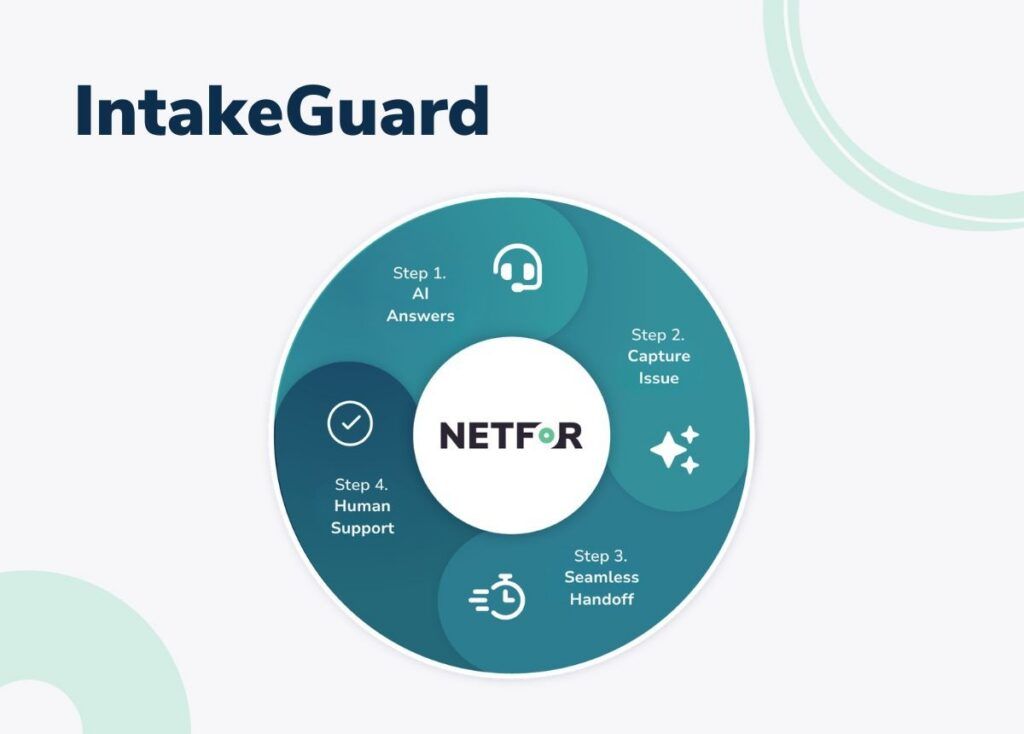
When you bolt our AI-enabled intake onto that, you get an experience that allows calls to be answered, triaged, and routed before a human agent even picks up the line. IntakeGuard captures the caller's location, identifies returning contacts, reads intent from the first few seconds of conversation, and delivers a complete structured ticket to the right queue automatically.
Learn more about IntakeGuard here.
What Does Franchise IT Support Cover?
Franchise IT support is not a help desk with extra call volume. It covers the full retail technology environment, from the POS terminal at the counter to the drive-thru timer out back.
Most franchise operators are running hardware that is older than it should be. POS systems have a 3 to 5 year lifecycle, but plenty of locations are still on equipment well past that window. Older hardware breaks more often, costs more to maintain, and generates significantly more downtime when it does fail. (CMIT Solutions, 2026)
For restaurant and QSR operators, the technology scope gets even more complex. Drive-thru systems, kiosks, and mobile ordering platforms each fail in their own ways, and frequently. When any of them go down during a peak shift, the workaround is usually a frustrated employee with a notepad. (BusinessWire, 2026)
When a remote fix is not possible, a technician has to show up ready to solve the problem on the first visit. That is not always what happens. The industry average First Time Fix Rate sits at 80 to 88%, which means more than one in ten dispatches requires a return trip. (NETFOR, 2026) Every extra truck roll adds cost and keeps the location down longer. Netfor’s first time fix rate sits at 95% for it’s nationwide clients.
A true franchise IT support partner covers the full stack, not just one layer of it:
- POS systems and payment terminals
- Digital signage and menu boards
- Network infrastructure and structured cabling
- Kiosks and self-service screens
- Drive-thru communication and timer systems
- Kitchen Display Systems (KDS)
- Desktops, laptops, and peripheral devices
- Device fulfillment, staging, and configuration
What Should You Look for in a Franchise IT Support Services Provider?
As franchise networks grow, so does the technology they depend on. It's common for franchisors to work with separate vendors for networking, POS systems, cybersecurity, hardware, help desk support, and field services. While each vendor may perform well individually, managing them all quickly becomes a challenge.
Every additional vendor adds another contract, another support process, and another point of accountability. When an issue spans multiple systems, such as a POS outage caused by a network problem, valuable time can be lost while vendors determine who owns the issue.
Research shows that organizations managing more than 10 IT vendors can see procurement and vendor management costs increase by 20% to 30%. Consolidating vendors can reduce overall IT costs by 15% to 25% while simplifying support and improving accountability. (Fruth Group, 2026)
When evaluating franchise IT providers, look for these capabilities:
- Dedicated support teams that understand franchise operations
- Nationwide field service managed through a single partner
- Device staging, imaging, and fulfillment before equipment reaches stores
- Service level agreements (SLAs) focused on response and resolution, not just ticket acknowledgment
- Proven experience supporting multi-location franchise brands at scale
The right IT partner doesn't just resolve tickets. They simplify operations, reduce vendor complexity, and help every location receive consistent support.
How Netfor's Franchise IT Support Model Is Built for Scale
Netfor has supported more than 7,000 franchise locations across retail, QSR, and convenience channels. The UPS Store is a named example of a multi-service engagement covering service desk, field services, fulfillment, and call center under one relationship. (NETFOR, 2026)
A Fortune 500 retail franchise achieved $2.5M in support cost savings through Netfor's consolidated support model. (Netfor Retail Case Study, 2026) Savings at that scale come from eliminating redundant vendor contracts, reducing failed dispatches, and resolving tickets faster through brand-specific knowledge management.
Netfor's field service network delivers a 95% First Time Fix Rate across 40,000+ completed sites, compared to the 80 to 88% industry average. (NETFOR, 2026) That gap translates directly to fewer truck rolls, less extended downtime, and lower total cost per incident.
Managed outsourced IT support runs $36,000 to $48,000 annually per seat, reducing total costs by 20 to 40% compared to in-house models. A single in-house IT technician costs $108,500 to $176,000 when fully loaded with salary, benefits, training, and turnover. (CMIT Solutions, 2026 / NETFOR, 2026) Flat-rate per-location billing aligns partner incentives with uptime. Standard rates range from $450 to $650 per location monthly for national mid-market support, with enterprise pricing at $650 to $900 and above. (SpecGravity, 2026)
Here is what Netfor's franchise IT support services include:
- 24/7 service desk with sub-30-second live answer targets
- Nationwide field service dispatch at 95%+ First Time Fix Rate
- ISO 9001:2015-certified fulfillment center for device staging and configuration
- Brand-specific knowledge bases built to each franchise's systems and escalation procedures
- Integrated escalation from help desk to field dispatch without requiring store callbacks
- Scalable model supporting 1 location or 6,000 under the same process and standards
- AI-powered Intake that captures complete issue details, routes requests to the right team, and escalates urgent issues automatically before a human ever answers
The customer satisfaction outcomes from this model are measurable. When stores reach a live agent in under 30 seconds, when tickets resolve on the first call, and when field technicians arrive ready to fix the issue on the first visit, the downstream effects show up in NPS scores, retention rates, and repeat customer visits.
Franchise IT Support Model Comparison
| Factor | Break/Fix | General Managed IT | Franchise IT Support (Netfor) |
| Response model | Call when broken | Ticketing queue | Dedicated franchise queue, live answer |
| Answer time target | Varies, often 15-30 min | 15-30 min | Under 30 seconds (0 seconds with IntakeGuard) |
| Technology coverage | Hardware only | General IT stack | Full retail/QSR stack including POS, signage, KDS |
| Field service model | Third-party brokered | Third-party brokered | Managed technician network, 95%+ First Time Fix Rate |
| Brand knowledge | None | Generic | Brand-specific knowledge base |
| Scale proof | N/A | Varies | Scales with your business needs (up or down) |
| Fulfillment capability | Not included | Rarely included | Stored, staged, configured, shipped, and ready to install |
| Cost model | Per incident | Monthly flat or per-user | Per Interaction or per-location flat rate |
The Standard Has Changed
Franchise IT support is not general IT support applied to more locations. It is a different discipline with different response standards, different technology scope, and different operational consequences when it fails.
The financial case is concrete. $4,700 per minute in average retail POS downtime. 40% of customers permanently defecting after a single unresolved technical issue. 7 to 12 fragmented vendors creating 30 to 45 minute containment delays. The math on inadequate support is not complicated. It is expensive.
The right partner answers in under 30 seconds, covers the full retail technology stack, dispatches a technician on the first attempt 95% of the time, and has the location count to prove it.
Netfor has supported more than 7,000 franchise locations across retail, QSR, and convenience networks. The process, the technology coverage, and the response time standards are already built. Franchise operators do not need to construct that model from scratch. They need a partner who has already proven it at scale.