

Customer experience (CX) is the complete perception a customer forms of a brand based on every interaction, from discovery through purchase, support, and renewal. Unlike customer service, which is a single touchpoint, CX covers the entire relationship.
Customer experience management (CXM) is the discipline of designing, measuring, and improving those interactions to drive loyalty, reduce churn, and grow revenue. In 2026, a strong CX program blends human support, AI-assisted resolution, and consistent digital delivery across every location and contact point.
Here is the gap most companies miss: most organizations measure customer experience, but very few actually manage it. That space is where revenue leaks and competitors gain ground. This guide defines what CX is, why it drives financial outcomes, and what it takes to build a program that holds up across locations, channels, and expectations in 2026.
What Is Customer Experience (CX) and How Does It Differ From Customer Service?
Customer experience is the total perception a customer forms of your brand across every interaction, from awareness through post-purchase support. It is the full arc of the relationship, not a single moment.
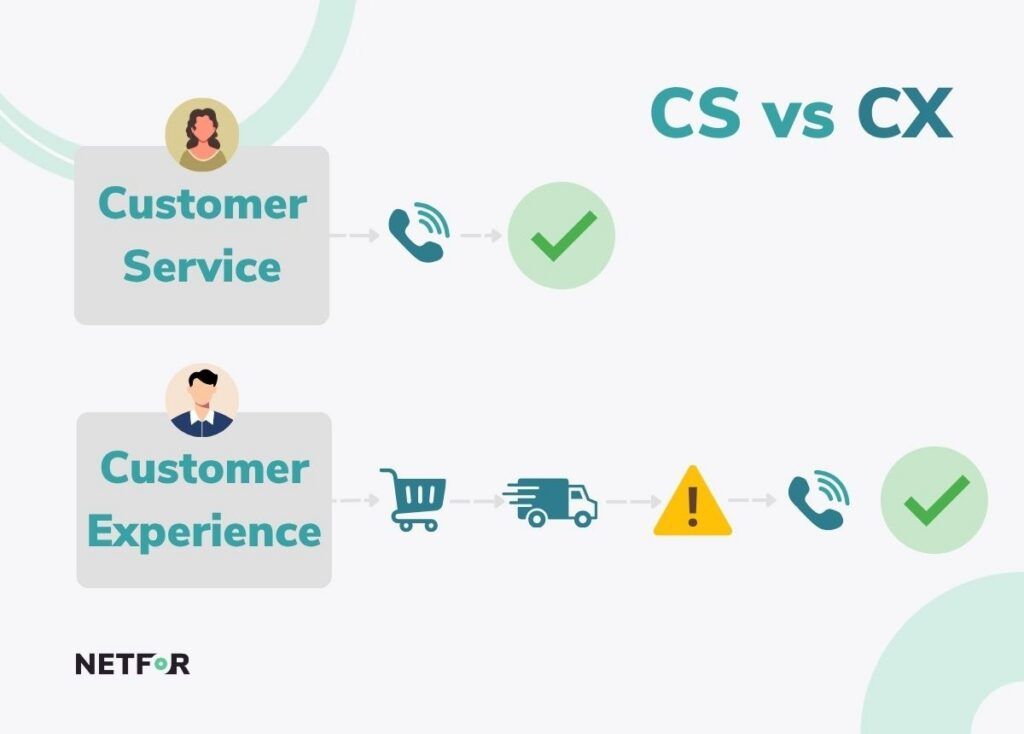
This is where many companies stumble. They treat managing customer service and customer experience as the same thing. They are not. Customer service is one touchpoint, usually a support call. Retail customer experience covers everything: pre-purchase research, the transaction, delivery, returns, and support afterward. A company can have great service agents and still deliver poor CX if any other part of the journey creates friction.
Think of it like a restaurant. The food might be excellent, but if the parking was a nightmare, the wait was 45 minutes, the server disappeared after taking your order, and the check took forever, you probably won't be coming back. The meal was great. The experience was not.
The customer journey ties it all together. Every touchpoint feeds the overall perception. When AI and AI in customer experience enter the picture, touchpoints multiply, which means more chances to build or break trust.
What customer experience includes (and what it does not):
- Every channel a customer touches: phone, chat, email, in-store, and self-service portal
- Pre-purchase research and first impression
- The transaction and fulfillment experience
- Post-sale support, returns, and issue resolution
- NOT limited to: call center interactions, complaint handling, or NPS scores
Consider a retail example: A customer enjoys a flawless in-store visit, then hits a painful return process days later. Both moments are customer experience. If you only manage the in-store moment, the return drives that customer away.
The hard part is that you often cannot see the damage. Roughly 11% of customer interactions globally are rated very poor, yet fewer than 1 in 3 customers report negative experiences directly to companies (QUALTRICS XM INSTITUTE, 2026). So organizations discover losses in quarterly reports, not in real time. And 90% of executives believe customer loyalty has grown, but only 40% of consumers agree (PWC, 2025). That blind spot is exactly where revenue slips away.
Why Does Customer Experience Investment Pay Off?
Customer experience is a direct financial variable, not a soft metric. Revenue growth, retention, and even stock performance correlate with CX quality. The impact shows up on the P&L, not just in surveys.
Here are some deep facts: CX leaders achieved 17% average revenue growth over five years compared to 3% for laggards, a 14% point gap (FORRESTER, via JOHNNY GROW, 2026). CX leaders also generated cumulative stock returns 415 points above the S&P 500, while laggards trailed 374 points below, a 7.8x performance gap (WATERMARK CONSULTING, 2026).
Now look at the cost of doing nothing: Around 32% of customers leave a brand they love after a single bad experience, and 59% of US customers defect after several (PWC, 2026). A failed escalation causes a 50% immediate loss of that customer's revenue value, while a successful recovery (which happens in roughly 33% of optimized scenarios) drives a 20% to 50% increase in purchase volume (CCMC CONSUMER RAGE STUDY, via JOHNNY GROW, 2026).
The flip side is the compounding return of getting CX right. CX leaders grow revenue 4% to 8% above their markets thanks to longer customer lifetimes and organic referrals (BAIN, via JOHNNY GROW, 2026). Loyalty lowers acquisition costs and raises purchase frequency, a far more efficient way to grow than chasing new buyers.
What poor CX costs you per customer:
- 20% of customer lifetime value (LTV) is lost when a complaint goes unresolved and unvoiced
- 30% of LTV lost when a complaint is handled poorly
- 50% of LTV lost when an escalation fails entirely
- 5 to 25 times more expensive to acquire a new customer than to retain one
These numbers explain why so many organizations choose to outsource customer service to partners built for consistent recovery and retention. When the math on lost lifetime value is this steep, protecting every interaction becomes a financial priority.
What Does Customer Experience Management (CXM) Actually Require?
Customer experience management (CXM) is the operational discipline of designing, measuring, and improving interactions across the full journey. It turns CX from a feeling into a managed business function. CXM requires formal ownership, journey-level measurement, cross-functional governance, and real data infrastructure, not just satisfaction surveys.
The five stages of CXM maturity (Qualtrics XM Institute):
- Stage 1: Investigate (41% of organizations): No one officially owns CX. Problems get handled when they surface, not before. Most companies start here and stay longer than they should.
- Stage 2: Initiate (30%): The company starts listening, surveys go out, feedback gets collected, but the data rarely drives decisions. Awareness without action.
- Stage 3: Mobilize (18%): A dedicated CX team exists. There are standards. Someone is accountable. This is where intentional improvement begins.
- Stage 4: Scale (9%): CX is no longer one team's job. It is built into how every department operates, measured consistently, and connected to business outcomes.
- Stage 5: Embed (2%): CX is organizational muscle memory. The company adapts in real time, learns from every interaction, and does not wait for complaints to act.
So where do CX programs break down?
- The data trap. Most companies try to build a complete picture of every customer by connecting all their systems. It rarely works. 80% of organizations that attempt this abandon the project, blocked by messy data that costs an average of $12.9 million a year to untangle. (GARTNER, via E-CENS, 2026)
- No one owns the full journey. When marketing owns the website, sales owns the deal, and support owns the complaint, no one sees the whole picture. Customers feel the gaps. Companies that manage the full journey end-to-end are 30% more likely to report above-average revenue growth. (CXTODAY, 2026)
- Chasing scores instead of fixing problems. Collecting customer feedback is not the same as acting on it. Many programs optimize for better survey numbers while the underlying problems stay in place.
- Ignoring the people delivering the experience. A 10% increase in employee commitment produces a 22% increase in customer spending. (FORRESTER, via CMSWIRE, 2026) How your team feels about their job shows up in how your customers feel about your brand
Key Point: A successful CX strategy follows directly from these failure points. Formal CX ownership with executive sponsorship, end-to-end journey mapping tied to operational data, multi-channel consistency, AI-assisted support paired with human escalation, and post-sale systems that protect customer lifetime value. Strong customer service management sits at the center, turning strategy into daily execution.
How Does AI Improve Customer Experience in 2026?
AI improves customer experience by reducing resolution times, handling high volumes of tier-1 inquiries autonomously, and enabling faster first responses. The catch is that AI only works when paired with a clear human escalation path. Without that, it raises frustration instead of lowering it.
Start with the channel explosion. The average B2B buyer now touches 10.2 distinct channels in a single purchase journey, up from 5 in 2016. Companies with strong omnichannel engagement retain 89% of customers, versus only 33% for weak strategies (MCKINSEY, 2026).
Customers expect speed everywhere. In fact, 82% expect an immediate response to a sales question, and 60% define "immediate" as under 10 minutes, yet the average business takes over 42 hours (GREETNOW, 2026).
This is where AI customer support earns its keep. Currently, 88% of contact centers use some form of AI, but only 25% have fully integrated it. AI-native platforms achieve first call resolution (FCR) rates of 55% to 70%, with average handle times under 3 minutes (LORIKEET, 2026). The cost difference is dramatic: $1.84 per contact for self-service versus $13.50 for agent-assisted, while AI-native systems resolve interactions at $1.00 to $3.00 each (GARTNER, via LORIKEET, 2026). No surprise that 91% of customer service leaders report executive pressure to implement AI in 2026.
But AI has limits. Complex, emotional, and high-stakes interactions still need a person. About 79% of Americans prefer a human agent for complex issues, 61% want human follow-up even after an AI interaction, and 71% believe a human should validate AI outputs (GREETNOW, 2026). The lesson is the hybrid model: AI for speed, humans for complexity. Strong knowledge management makes both halves work, giving AI accurate answers to surface and agents instant context when a case escalates.
Response time expectations by channel vs. actual performance:
- Email: customers expect under 4 hours. The average is 12 hours 10 minutes.
- Live chat: customers expect under 30 seconds. The average is 2 minutes 40 seconds.
- Phone: callers tolerate up to 2 minutes 37 seconds. The average hold time is 5 minutes 12 seconds.
- Social media: 76% expect a response within 1 hour. The average is 2 to 5 hours.
Digital customer experience is no longer a differentiator. It is the baseline. The brands that win meet these expectations consistently, not occasionally.
What Does CX Execution Look Like in Retail, B2B, and Multi-Location Operations?
Strategy is easy to write down. Consistent execution across locations, channels, and shifts is where most programs fall apart. The way CX plays out differs by business model, but the financial stakes are high everywhere.
In B2B customer experience, the buying cycle is buyer-led long before a salesperson enters the picture. Most buyers have already researched, compared, and formed an opinion before making first contact. That means your digital experience is doing the selling, and experience is still the primary reason B2B buyers switch suppliers.
In retail, loyalty is decided after the sale. Returns are the clearest test. A smooth, hassle-free return builds trust and drives repeat purchases. A difficult one ends the relationship. Most first-time buyers are making their decision to come back based entirely on what happens after the transaction.
For multi-location and franchise operators, consistency is not a branding concern, its a revenue variable. Customers expect every location to feel like the same brand. One bad experience at one location creates doubt about all of them.
This raises the build-versus-outsource question. In-house US contact center agents cost $28 to $48 per hour fully loaded. Onshore outsourced delivery achieves comparable CSAT at 85% but at a lower per-interaction cost of $6.50 versus $10.74 in-house (CALLFORCE GLOBAL / OUTSOURCE ACCELERATOR, 2026). For organizations weighing how to improve customer service at scale, the model you choose directly affects both cost and consistency.
What separates high-performing outsourced CX from average in-house delivery:
- Dedicated knowledge bases trained to the client's environment (Netfor: 16,000+ articles)
- Faster average handle time (5.5 min outsourced vs. 6.0 min in-house)
- Lower attrition (25% vs. 30 to 45% in-house), reducing constant retraining
- Scalable capacity across seasonal spikes without fixed headcount
- SLA-backed performance transparency: FCR, CSAT, and response time
This is where a proven customer service call center partner separates itself from a software-only platform. Some big-name tools give you the technology, but they do not staff your shifts, train your agents, or guarantee your service levels. Netfor delivers the execution layer, with a 92%+ FCR rate, 97% of calls answered in under 20 seconds, a knowledge base of more than 16,000 client-specific articles, and over 30 years of CX delivery experience.
Check out our most recent article on Knowledge Bases.
CX vs. Customer Service and In-House vs. Outsourced Delivery
If you are deciding how to structure your CX program, two comparisons matter most.
Comparison 1: CX vs. Customer Service
- Customer service: reactive, transactional, single touchpoint
- Customer experience: proactive, systemic, full lifecycle
- Measuring only customer service scores while ignoring the broader journey is Stage 1 behavior, where 71% of organizations still sit
Comparison 2: In-House vs. Outsourced CX Delivery
| Dimension | In-House | Outsourced (Onshore BPO) |
| Fully loaded cost per agent | $28 to $48/hr | Lower per-interaction rate |
| Cost per interaction | $10.74 | $6.50 |
| CSAT | 85% | 85% (onshore average) |
| FCR | 75% | 92% with Netfor |
| Agent turnover | 30 to 45% | ~25% |
| Scalability | Fixed headcount | Variable on demand |
| Knowledge | Unclear documentation and tribal | Dynamic knowledge base with access to a knowledge team with Netfor |
When in-house makes sense: High-complexity, high-LTV accounts that need deep brand immersion and tight governance.
When outsourced makes sense: High-volume tier-1 interactions, multi-location brands, and organizations needing scalable capacity without fixed overhead.
Turning Customer Experience Into a Competitive Advantage
The core message is simple. Customer experience is a financial system, not a feeling. With $3 trillion in global sales at risk from poor CX annually, and the revenue gap between leaders and laggards compounding year after year, the cost of treating CX casually keeps climbing.
A few takeaways are worth holding onto: CXM requires real operational infrastructure, and 71% of organizations are still stuck in reactive mode. The 9% that have scaled their programs grow revenue roughly 1.5 times faster than laggards. AI accelerates delivery, but it does not replace the human judgment that complex, high-LTV interactions demand. And consistency across every location and channel is what separates the brands customers trust from the ones they leave.
Netfor operates at Stage 4, where most organizations have not yet arrived. With a 92%+ FCR rate, 97% of calls answered in under 20 seconds, and a 16,000-article knowledge base built to client-specific environments, Netfor delivers the consistency, speed, and visibility that multi-location brands need to compete on customer experience services at scale.
Ready to close the gap between measuring CX and managing it? Learn how Netfor's customer experience solutions deliver consistent, measurable CX across every location and channel.