

IT staffing is the process of sourcing, vetting, and deploying qualified technology professionals to fill support gaps inside an organization. These professionals may work on a temporary, project-based, seasonal, contract-to-hire, or ongoing basis. IT staffing services commonly support roles such as help desk agents, desktop support technicians, field service specialists, and IT project staff. Companies use IT staffing solutions to scale support quickly, reduce hiring costs, improve service continuity, and maintain quality during demand spikes, technology rollouts, or staffing shortages.
The market for technical talent is tight. There are often more than 440,000 active tech job postings in the United States, while internal hiring cycles for IT support roles can take 42 to 90 days. Most organizations are not falling behind because they lack effort. They are falling behind because traditional hiring is too slow for today's support environment.
A static in-house IT team also carries a high cost. Fully loaded annual expenses for one IT support technician can range from $108,500 to $176,000 when salary, benefits, taxes, tools, training, and travel are included (Techmate). At the same time, 28% to 33% of new IT hires leave within the first 90 days (FirstHR, 2026). For multi-location retail, healthcare, restaurant, logistics, and franchise organizations, those costs multiply fast.
This guide explains what IT staffing is, how the major models differ, what seasonal demand really costs, and how to decide whether a staffing agency, managed service provider, or technical BPO partner is the right fit.
What is IT staffing and how does it work?
IT staffing means working with an external partner to find, screen, and place technical professionals into your operations. Instead of relying only on internal HR teams to post jobs, review resumes, and run technical interviews, you use a partner with access to qualified candidates and proven screening methods.
There are three common models:
- Contract placement: A temporary worker fills a defined role for a set period.
- Staff augmentation: External talent joins your internal team to increase capacity.
- Managed staffing: A partner provides the talent and manages daily execution, performance, scheduling, and support workflows.
This distinction matters. Help desk staffing and IT support staffing require more than basic technical knowledge. A qualified technician must understand ticketing systems, escalation paths, user communication, service-level expectations, and the business impact of downtime.
For example, a retail IT director trying to fill a Tier 1 help desk role through public job boards may spend weeks reviewing resumes. A specialized staffing partner with a pre-vetted bench can often provide a qualified technician much faster. The difference is not just speed. It is operational readiness.
The global IT staffing market was valued at $202.30 billion in 2024 and is projected to reach $306.50 billion by 2030 at a 7.2% CAGR (Research and Markets, 2026). The temporary IT staffing segment is expected to reach $121.30 billion by 2030, growing at an 8.7% CAGR.
What IT staffing services typically cover:
- Help desk and Tier 1 support
- Desktop support and field technicians
- IT project staffing
- Contract-to-hire placements
- Seasonal and burst-demand support
- Managed staffing operations
- White-label support desk deployment

When should a company use outsourced staffing instead of hiring directly?
You should consider outsourced technical staffing when the cost, delay, or risk of direct hiring outweighs the value of adding another internal employee. This often happens when support demand is urgent, seasonal, location-based, or difficult to predict.
The real cost of hiring is more than salary. It includes recruiting time, HR coordination, manager interviews, onboarding, software licenses, benefits, payroll taxes, and lost productivity while the seat remains open. A Tier 1 support specialist earning $60,000 per year can represent hundreds of dollars in unrealized daily output while the role is vacant. Over a 90-day hiring window, that loss becomes significant.
Turnover adds another layer of cost. Replacing an entry-level help desk employee can cost 30% to 50% of annual salary, while mid-level technical roles may cost 50% to 125% (SHRM / Gallup / Center for American Progress, 2026). Bad hires are also expensive. Many employers report at least one poor hire, with average costs reaching $17,000 per poor placement (CareerBuilder / INOP, 2026).
By contrast, outsourced IT staffing solutions often run $36,000 to $48,000 annually per seat, which can reduce total costs by 20% to 40% compared with fully loaded in-house support models (Techmate / Network 1 Consulting, 2026).
Hidden costs of direct IT hiring include:
- Recruiting ads and internal HR time
- A 42 to 90 day vacancy window
- Training before full productivity
- Turnover and replacement costs
- Benefits, payroll taxes, and tools
- Management time spent on daily oversight
If your organization needs speed, flexibility, and cost control, outsourced staffing is often the stronger option.
What IT staffing solutions are available for seasonal or burst demand?
Seasonal staffing helps organizations scale IT support only when they need it. This is valuable for businesses that experience predictable spikes but do not need extra headcount year-round.
Retail and e-commerce companies are a clear example. During Q4, customer support tickets, POS incidents, payment issues, and network demands often rise sharply. Fashion and retail brands can see a 182% increase in technical support tickets during peak periods (Excellent Networks, 2026). A one-second delay in page load time can also cause a 7% drop in transaction conversions.
Education faces a different seasonal cycle. K-12 districts and universities often use the summer months to image devices, refresh networks, configure classrooms, and prepare support systems for the next school year. Many school districts rely on outsourced seasonal contractors to complete this work before students return (CoSN / People Solutions, 2026).
Across industries, contingent labor now makes up a meaningful share of IT departments, and many IT leaders plan to increase their use of contract staff (TEKsystems / SIA, 2026). Why? Because fixed headcount creates a difficult choice. You either overstaff during slow periods or understaff during peaks. Neither option supports efficiency.
Industries with high seasonal demand include:
- Retail and e-commerce: Q4 surge from November through January
- Education: Summer device imaging and network projects
- Transportation and logistics: Warehouse, routing, and supply chain peaks
- Finance and insurance: Q1 audits, reporting, and compliance activity
- Healthcare: System upgrades, clinic expansions, and healthcare IT support coverage gaps
The right staffing model gives you capacity when demand rises without locking you into permanent labor costs.
How do you evaluate an IT staffing services provider before signing a contract?
Not all staffing providers offer the same value. Some agencies simply search job boards, forward resumes, and leave the rest to you. Others maintain pre-vetted benches, manage onboarding, track performance, and provide operational support.
You need to know which model you are buying.
Start with vetting depth. Ask how candidates are screened, which technical tests are used, whether background checks are included, and how communication skills are evaluated. In support roles, soft skills matter. A technician who can resolve a technical issue but frustrates the end user still creates operational risk.
Next, review deployment speed. A strong partner should know how quickly they can place qualified resources. Specialized staffing partners with pre-vetted benches may deploy support in 24 to 72 hours, while internal direct hiring can take 45 to 90 days (OnBenchMark, 2026).
You should also ask for retention data. Organizations using proactive staffing pipelines see much stronger 90-day retention than those relying on reactive hiring from job boards (Yochana, 2026).
For field service roles, request performance metrics such as first-time fix rate and SLA compliance. Managed partners using Field Service Management systems can outperform traditional staffing methods through better scheduling, technician tracking, and dispatch coordination (Field Nation / FMS Guides, 2026).
What to evaluate before signing:
- Candidate screening and technical testing
- Deployment speed and bench availability
- 90-day retention benchmarks
- First-time fix rate for field technicians
- SLA compliance history
- Daily management responsibilities
- White-label support capability
- Reporting and escalation processes
The goal is simple: choose a provider that improves outcomes, not one that only supplies resumes.
View our AI Ready Checklist here.
What is the difference between IT staffing agencies and managed IT staffing partners?
The main difference is responsibility. IT staffing agencies usually provide people. Managed IT staffing IT services like Netfor provide people plus operational execution.
A traditional staffing agency fills roles. Your organization still manages schedules, queues, ticketing, quality, escalations, coaching, and performance. This can work well when you only need temporary headcount or a contract-to-hire candidate.
A managed IT staffing partner, or technical BPO, takes on more responsibility. They may manage ticket flows, telephony, reporting, dispatch, escalation logic, training, and service delivery. This model is especially valuable for distributed organizations with many locations.
Consider a restaurant, retail, or franchise environment with 50 or more sites. If each location depends on different local vendors, support quality becomes inconsistent. One region may get fast help while another waits. Tools may differ by site. Security patches may be delayed. No single party may own the final outcome.
When a POS or order transmission system fails in a QSR environment, the business impact is immediate. Frontline teams may shift to manual processes. Transaction speed can drop, order errors can rise, and customers may leave. Unresolved technical issues also damage trust. Research from Netfor notes that 40% of customers may defect after a single unresolved technical issue in restaurant environments (Netfor / Restaurant IT Support, 2026).
What breaks without centralized staffing support:
- Inconsistent technician quality across regions
- Tool sprawl from site-level decisions
- Slow response in rural or remote areas
- No revenue-based incident prioritization
- Delayed rollouts and patching
- Weak accountability across vendors
If you manage a distributed operation, you need more than headcount. You need a support model that protects uptime, service quality, and customer experience.
IT Staffing Agencies vs. Managed Staffing Partners vs. Technical BPO
Choosing the right provider starts with understanding what each model is built to do.
IT Staffing Agencies
- Provide contract workers quickly
- Support temporary and contract-to-hire needs
- Leave daily management to your team
- Do not usually provide full support infrastructure
Works best for: Single-seat backfill, temporary headcount, and simple project staffing.
Managed IT Services
- Support defined technical projects
- Provide shared technical oversight
- Often focus on migrations, upgrades, and consulting work
- May not be built for dailyhelp desk outsourcing operations across many sites
Works best for: Cloud migrations, system upgrades, implementation projects, and technical consulting.
Technical BPO Partners
- Provide full white-label operational execution
- Manage ticketing, telephony, agents, dispatch, and reporting
- Support multi-location IT support environments
- Use triage logic that accounts for revenue impact and operational urgency
Works best for: Distributed retail, QSR, healthcare, and franchise organizations that need consistent 24/7 IT support without building the full infrastructure internally.
When each model makes sense:
- You need one role filled fast: use a staffing agency.
- You need a system migration or upgrade: use managed services.
- You need scalable, white-label support across many locations: use a technical BPO partner.
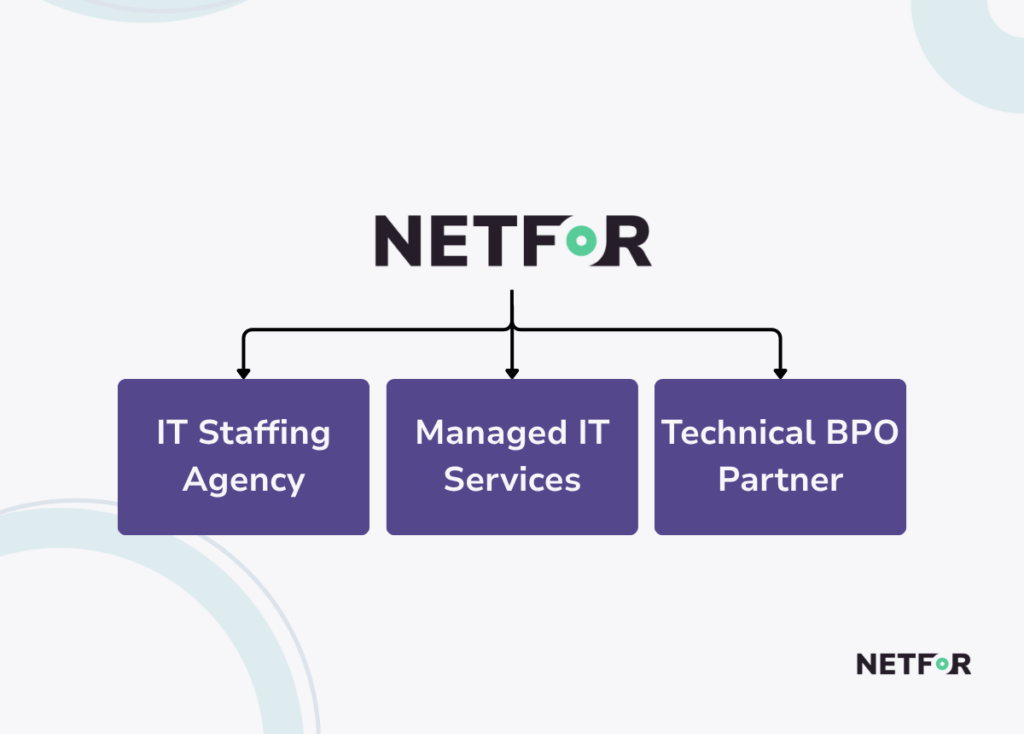
Selecting the right model matters because the wrong choice creates hidden work. If you hire a staffing agency when you really need operational ownership, your internal leaders still carry the management burden. Netfor supports all three models, staffing, outsourcing, and fully managed operations, so businesses can choose the level of ownership and support that fits their goals.
Moving Forward With Scalable IT Staffing
The IT talent shortage is not a short-term problem. Organizations that rely only on direct hiring will continue to face long vacancies, high turnover costs, and uneven service quality.
The best staffing model depends on your real operating needs. A staffing agency may be enough for a single temporary role. Managed services may be right for a defined technical project. A technical BPO is often the better choice when you need consistent, scalable support across many locations.
Netfor is not a traditional staffing agency that only sends resumes. It is a technical BPO partner that provides white-label operational execution, trained agents, field services, ticketing support, and revenue-centric triage logic. For distributed organizations, this approach reduces downtime, lowers support costs, and improves consistency.
Read our IT staffing services blog to learn more, or explore Netfor's IT staffing services.