

A voice AI agent, also called an intelligent virtual agent (IVA), is an AI-powered system that handles customer calls through natural conversation, either executing structured workflows like appointment booking and intake, or answering questions from a connected knowledge base. Voice AI is now deployed across call centers, healthcare practices, and customer service operations to reduce hold times, handle high call volumes, and route callers efficiently. When configured correctly with proper guard rails, escalation protocols, and maintained knowledge management, voice AI reduces cost per interaction and improves customer experience. When those elements are missing, it fails.
More than 80% of AI projects fail to reach measurable success, roughly double the failure rate of traditional IT projects (RAND Corporation, 2024). For voice AI specifically, the consequences show up fast. Callers get frustrated, brand trust takes a hit, and businesses sink money into a product that was never set up to perform.
Here is the part most vendors will not tell you. The technology is rarely the problem. Most businesses evaluating voice AI are shopping for a platform before they have done the operational work that makes any platform succeed. Knowledge management, workflow design, and escalation architecture decide the outcome long before the software does.
This blog explains how voice AI actually works, why the majority of deployments fail, and what small businesses, franchises, and large enterprises each need to evaluate before committing to a solution. By the end, you will know which type of voice AI fits your operation, what it should cost, and what "done right" looks like before you ever go live.
What Is Voice AI and How Does It Actually Work?
Voice AI is an AI-powered system that handles customer calls through natural conversation. Also called an intelligent virtual agent (IVA), it either executes structured workflows like booking an appointment, or retrieves answers from a connected knowledge base. The difference between those two jobs matters a great deal, and we will get to it shortly.
Curious about IVAs vs IVRs? Listen here: https://www.youtube.com/watch?v=wThue1BWMec
Under the hood, the process follows three steps:
- Speech-to-text: the system converts the caller's voice into text.
- Large language model (LLM) processing: the model predicts the most contextually appropriate response.
- Text-to-speech: the system converts that response back into natural-sounding audio.
This is a sharp departure from legacy interactive voice response (IVR), the static "Press 1 for billing, Press 2 for support" menu trees most callers have learned to dread. Legacy rule-based IVR systems achieve less than 35% containment (Unity Communications, 2026), meaning more than two out of three callers still need a human or human oversight. A modern voice AI agent, by contrast, understands a caller who says, "I need to reschedule my appointment for next Thursday," and acts on it directly.
Voice AI does not always replace the human agent. Sometimes it works beside them. Netfor's real-time interaction guidance (RTIG) tool is a strong example. RTIG recognizes customer sentiment during a live call and gives the human agent instant recommendations based on 30+ years of proven best practices. The agent stays in control, while the AI watches the conversation and guides it.
What Is the Difference Between Workflow-Based and Knowledge-Based Voice AI?
This single distinction separates the deployments that work from the ones that collapse. There are two primary models, and one fails far more often than the other.
Workflow-based (transactional) voice AI integrates with your back-end systems and APIs. The agent follows a defined logic path to complete a task from start to finish, such as gathering a caller's details and booking an appointment. It is highly deterministic, which is a fancy way of saying it does the same thing the same way every time.
Knowledge-based (informational) voice AI functions as a conversational search layer over static documents, FAQs, and help articles. It is non-deterministic, and its performance depends entirely on the quality of the knowledge base behind it.
The performance gap is real. Workflow-based deployments for inbound scheduling achieve 65% to 80% containment, while FAQ and policy lookup bots average 55% to 70% (IrisAgent, 2026).
Why do knowledge-based systems fail more often? Because most organizations run on tribal knowledge that lives in agents' heads, not in documented systems. A human agent who does not know an answer can mute the call, ask a coworker, and remember it next time. AI cannot do that. It can only use what you give it. Point it at years of unstructured shared-drive files with no knowledge management applied, and it will fail 100% of the time, generating inaccurate or nonsensical answers.
"If you don't have good knowledge management already, then there's no hope of you getting that product up and running."
David Cady, Chief Technology Officer at Netfor
The data backs this up. 85% of AI projects fail directly due to poor data quality or a total lack of relevant data (Gartner, cited in Talyx, 2026). Ownership matters too. Vendor-built solutions with structured human-in-the-loop oversight achieve a 67% success rate, while fully autonomous internal builds succeed only 33% of the time (Eloize, 2026).
This is the "human in the loop" principle. Voice AI is not an autonomous worker. It needs the same guard rails, quality assurance, and iteration you apply to a new human agent. Netfor's specialty clinic AI intake, now available for orthopedic and pain management practices, is built exactly this way. It handles appointment booking and patient intake through defined workflows, not open-ended guessing.
Not sure if your operation is actually ready? Get an honest answer before you spend a dollar on tools.
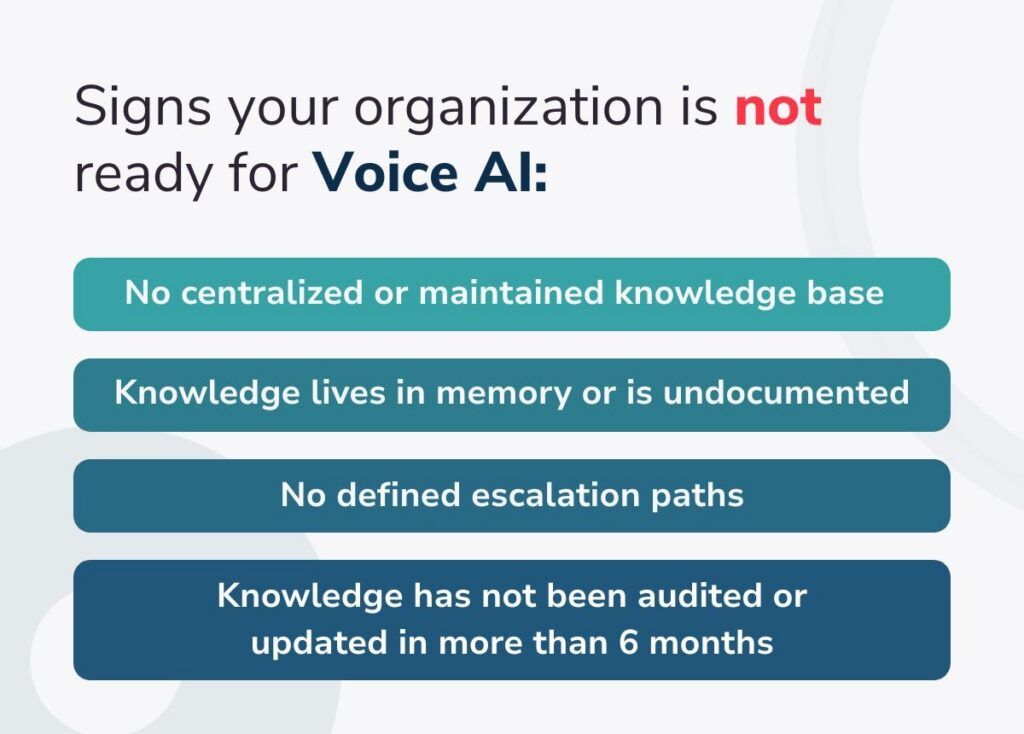
Signs your organization is not ready for knowledge-based voice AI:
- You have no centralized, maintained knowledge base.
- Support answers live primarily in agent memory or undocumented tribal knowledge.
- There is no defined escalation path when the AI cannot find an answer.
- Your knowledge has not been audited or updated in more than six months.
If two or more of these apply, start with workflow-based use cases instead.
Why Do Most Voice AI Implementations Fail?
The failure numbers are sobering. More than 80% of all AI projects fail, roughly double the failure rate of non-AI IT projects (RAND Corporation, 2024). By mid-2025, 42% of companies had abandoned most of their AI initiatives (S&P Global Market Intelligence, 2025).
Most failures trace back to five root causes:
- Misunderstood problem definition: the team automates the wrong thing.
- Inadequate training data: the AI has nothing clean or relevant to work with.
- Technology-first mentality: the platform gets bought before the problem is mapped.
- Insufficient infrastructure: there is no pipeline connecting the AI to live systems.
- Problems too difficult: the work exceeds what the technology can handle.
One failure point deserves special attention because customers feel it instantly: escalation architecture. There is a major difference between a warm handoff and a cold transfer. A warm transfer passes the complete interaction context to the human agent before the call connects, so the caller never repeats themselves. A cold transfer drops the customer into a queue with zero context, forcing them to start over.
The cost of getting this wrong is steep. Customers who receive a warm transfer are 74% more likely to use self-service on their next interaction (Contentstack, 2026). Well-configured voice AI deployments achieve average CSAT scores of 82 to 88 out of 100, but without proper escalation, scores decline sharply quarter over quarter (IrisAgent, 2026).
Netfor sees this firsthand. In one IVR Transformation engagement, Netfor's Business Assurance Manager identified and corrected a broken IVR configuration for a client, directly improving customer satisfaction. The technology was already in place. The problem was how it had been built and configured, which is the case far more often than not.
So what do the 30% that succeed do differently? They redesign workflows before selecting technology. They invest in data engineering rather than chasing the flashiest model. And they apply the same quality assurance and iteration process to AI that they apply to human staff. The industry-recommended budget allocation reflects this: 10% on algorithms, 20% on data infrastructure, and 70% on people, process, and change management (Eloize, 2026).
"Whatever expectations you have for your human staff, you need to have those exact same expectations for the AI."
David Cady, Chief Technology Officer at Netfor
A well-designed escalation policy is the backbone of AI for customer support that holds up under real call volume. Here is what it should include.
What a well-designed escalation policy includes:
- Immediate honor of any explicit "speak to a human" request.
- Confidence-threshold triggers, where below 70% confidence prompts one clarifying attempt, then a warm transfer.
- Real-time sentiment monitoring for frustration, anger, or distress.
- Loop detection, so the same intent repeated twice without resolution triggers escalation.
These are the same principles that drive a strong AI call center. They are not optional add-ons. They are the difference between a deployment that scales and one that quietly burns money.
Which AI Voice Agent Is Best for Small Businesses, Franchises, and Large Enterprises?
There is no universal answer here. The right choice depends on your call volume, knowledge base maturity, and operational complexity. Let's break it down by business type.
Small businesses should prioritize low up-front cost, rapid time to production, and no-code or low-code setup with visual workflow builders and subscription pricing. The right starting point is a single workflow-based use case, such as appointment booking, order status, or FAQ triage. Avoid knowledge-based deployments until you have a structured knowledge base in place.
Franchises need centralized brand control paired with local customization. The ideal platform offers a central dashboard that locks the persona and compliance scripts while letting individual locations modify hours, scheduling parameters, and local inventory. Multi-location management is the primary evaluation criterion. Platforms like ours are built for this, letting central administrators control voice persona and compliance while local operators adjust the variables that change store to store.
Large enterprises should evaluate for deep CRM integration, custom tenant architecture, compliance certifications, massive concurrency capacity, and enterprise AI governance frameworks. Enterprise buyers accounted for over 70.5% of the voice AI agents market share in 2024, and fully integrated platforms captured 76.4% of overall market share (Agxntsix, 2026). Platforms like ours serve this tier, and larger organizations often evaluate native options such as Google CCAI, Amazon Connect, Genesys Cloud, and Nuance (now Microsoft) for integration with existing infrastructure. Target use cases include high-concurrency inbound support and complex workflow automation across channels.
Healthcare deserves a separate note. Voice AI for AI patient intake and scheduling achieves 70% to 80% containment on routine scheduling, but it must run on HIPAA-compliant Business Associate Agreements, end-to-end AES-256 encryption, and strict model-training restrictions on protected health information. The payoff is significant. Healthcare AI scheduling delivers up to a 40% reduction in missed inbound calls, and patient no-show rates drop 20% to 30% with voice AI reminders (Thoughtly, 2026). Healthcare networks deploying AI-driven scheduling and intake report a median net ROI of 300% to 500% (Medozai, 2026).
See what happened when The Pain Experts put an AI Agent at the front door of patient access
What Does Voice AI Cost, and What Does "Doing It Right" Look Like?
The economics are the reason most businesses start looking at voice AI in the first place. Human-handled call center interactions average $6 to $12 per call, climbing toward $15 fully loaded. A well-configured voice AI averages $0.30 to $0.50 per completed interaction (LuMay AI, 2026).
Scale that out. A contact center handling 10,000 routine calls per month at $0.50 per AI interaction, versus $6 to $12 per human call, saves between $55,000 and $115,000 monthly (LuMay AI, 2026). The performance holds up too, with well-configured voice AI achieving FCR rates above 90% on targeted workflows, compared to a human baseline of 70% to 75% (CloudTalk, 2026).
Pricing models come in three main shapes:
- Per-minute (usage-based): best for variable, unpredictable call volume.
- Interaction-based: charges per completed conversation rather than per minute, typically around $2.00 per interaction. Best when call durations vary widely and per-minute billing becomes unpredictable.
- Subscription: predictable budgeting, best for small and mid-sized businesses.
- Outcome-based per-resolution: best for mature enterprise operations, since you pay only for completed resolutions.
Outcome-based pricing is the newest and arguably fairest model. Lorikeet, for example, charges $0.80 per digital resolution and $1.00 per voice resolution, and escalations to human agents are not billed (Lorikeet, 2026). You only pay when the AI actually solves something.
Now the part that does not show up on the invoice. Failed deployments do more than waste platform spend. They drag down CSAT, increase repeat call volume, and erode customer trust in your brand. That hidden cost often dwarfs the licensing fee.
Compliance is the other non-negotiable. The Federal Communications Commission confirmed in February 2024 that AI-generated voices count as "artificial or prerecorded voices" under the Telephone Consumer Protection Act (TCPA). Violations carry penalties of $500 to $1,500 per non-compliant call (Retell AI, 2026). Healthcare carries even higher exposure, with federal HIPAA breach penalties reaching up to $1.5 million per violation category (Trillet, 2026). BIPA voiceprint rules and EU AI Act Article 50 disclosure requirements add further layers depending on where you operate.
What "done right" looks like before go-live:
- Workflows are redesigned end-to-end before any platform is selected.
- The knowledge base is audited, structured, and connected to live systems of record.
- The escalation policy is defined with warm transfer, sentiment triggers, and loop detection.
- The QA process mirrors what is applied to human agents.
- A compliance review covers TCPA, HIPAA (if healthcare), and applicable state laws.
- The pricing model is matched to call volume and business size.
Workflow-Based vs. Knowledge-Based Voice AI at a Glance
| Workflow-Based | Knowledge-Based | |
| Best for | Scheduling, intake, order status, account actions | FAQ, policy lookup, general information |
| Containment rate | 65% to 95% depending on task | 55% to 70% |
| Dependency | Back-end API and system integration | Structured, maintained knowledge base |
| Failure risk | Low when workflows are mapped correctly | High when knowledge is tribal or unstructured |
| Recommended starting point | Yes, for most organizations | Only after a knowledge base is in place |
Build a Voice AI Strategy That Performs on Day One
The lesson across every statistic in this guide is the same. Voice AI performs best when it is scoped to deterministic, workflow-based tasks and backed by clean knowledge management and a structured escalation path. Failure is almost always an operational problem, not a technology problem. The organizations that succeed treat their AI agents with the same discipline they apply to their human ones.
This is exactly where Netfor sits. We have spent 30+ years designing and operating customer support workflows. The same principles that drive 92%+ First Call Resolution in our human-staffed operations are what we apply to voice AI: defined workflows, real-time QA, escalation design, and continuous iteration. We do not turn it on and walk away.
If you are evaluating voice AI and want a partner who understands the operations behind the technology, talk to Netfor about building a voice AI strategy that is ready to perform on day one.
Find the AI Ready Checklist Here.
Ready to book an AI Readiness Assessment? Check it out here.