
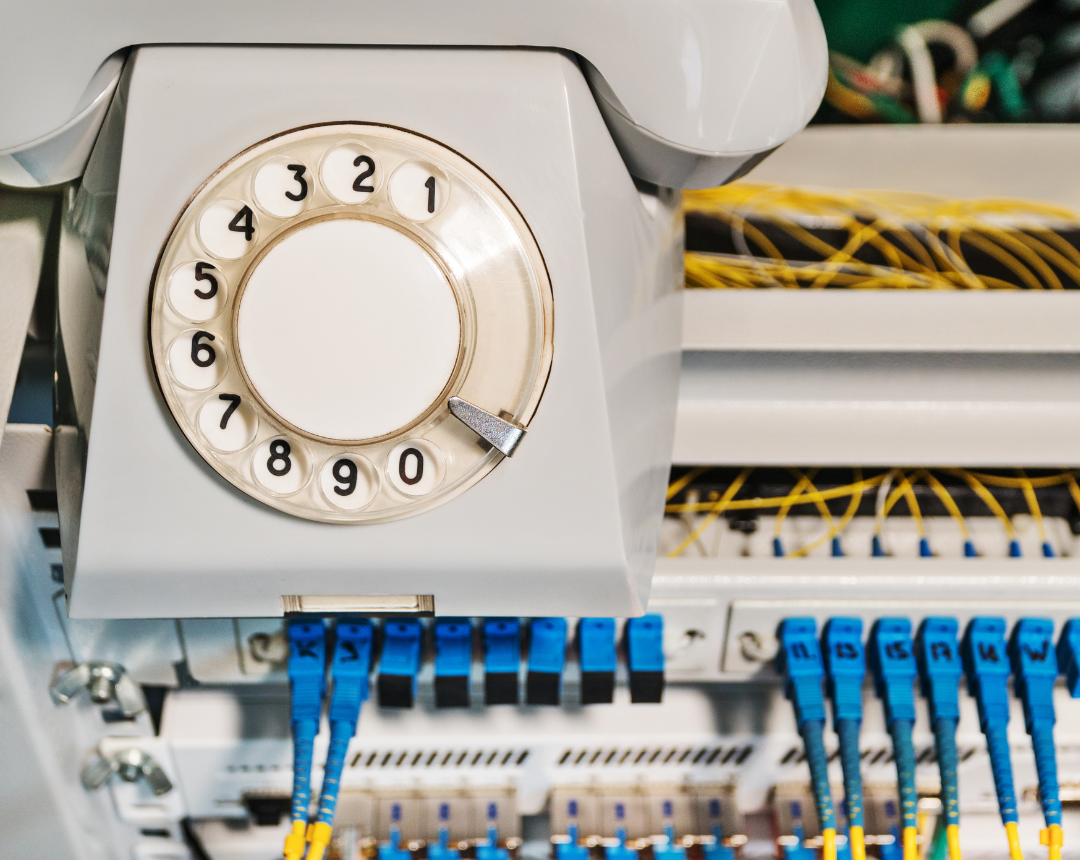
A POTS line (Plain Old Telephone Service) is a traditional copper-wire phone connection still used by many businesses for fire panels, alarm systems, elevator emergency phones, and payment terminal backups. The FCC's Network and Services Modernization Order now allows carriers to retire copper infrastructure on a streamlined 31-day approval window. There is no single national shutoff date. Retirement is rolling out market by market. Businesses that rely on POTS lines need a replacement plan using cellular, VoIP, or SD-WAN alternatives before their local wire center is retired, particularly where life-safety equipment is involved.
Copper phone lines built the backbone of American business communications for over a century. Now they are being torn out, wire center by wire center, across the country. The carriers doing it have regulatory clearance to move fast, and many already are.
For multi-location businesses, this is not a distant infrastructure story. It is an active operational deadline. Fire panels, elevator emergency phones, alarm dialers, fax lines, and POS backup connections still depend on these copper circuits in buildings across every industry. When a local wire center retires, those connections go silent without warning.
This guide explains what a POTS line is, why carriers are retiring them now, what the replacement options look like, and how organizations managing dozens or hundreds of locations can execute the physical cutover before service is cut off.
What Is a POTS Line, and Why Are Carriers Retiring It?
A POTS line, short for Plain Old Telephone Service, is a traditional analog telephone connection carried over copper wire through the Public Switched Telephone Network (PSTN). POTS phone service has been the default voice infrastructure in commercial buildings for decades, and in many facilities, it still is.
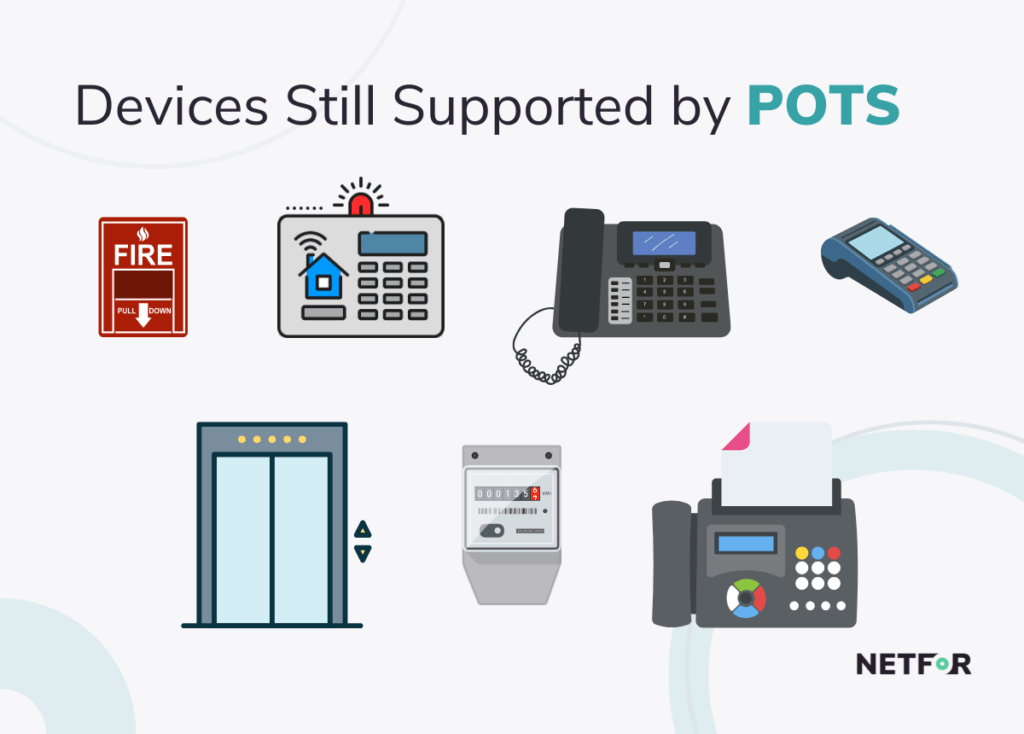
In a modern commercial building, POTS lines commonly support:
- Fire alarm panel signaling
- Elevator emergency phones
- Burglar alarm and security panel dial-out
- POS payment terminal backup connections
- Fax lines
The technology itself is not the issue. It works. The problem is that maintaining the physical copper plant that delivers it has become prohibitively expensive for carriers. AT&T alone estimates its annual cost of maintaining legacy copper infrastructure at $6 billion (MarketSpark, 2025). With VoIP, cellular, and fixed wireless alternatives now widely available, carriers no longer have a regulatory obligation to keep copper running.
The FCC's Network and Services Modernization Order fundamentally changed the approval process for copper retirement (FCC, 2026). Previously, dominant carriers like AT&T, Verizon, and Lumen faced a 60-day review window before a discontinuance application could be granted. The modernized framework replaced that with a uniform 31-day automatic grant period across all carriers (DataRemote, 2025). If the FCC does not actively intervene within 31 days of public notice, discontinuance authority is granted automatically.
The result: copper retirement is accelerating faster than most businesses have planned for.
There Is No Single Shutoff Date, and That Is the Problem
One of the most consequential misunderstandings about the POTS sunset is the expectation of a single national deadline. There is none.
POTS replacement is a rolling, market-by-market process. Each carrier files individual wire-center retirement notices, and those filings occur on different timelines in different states and regions. Businesses relying on POTS phone service need to track their specific local wire center status, not a national calendar date.
How the Major Carriers Are Moving
AT&T has published the most aggressive copper decommissioning roadmap of any Tier-1 carrier. On October 15, 2025, AT&T instituted a blanket service freeze on new copper orders, moves, and changes across approximately 20 states (Ooma, 2025). Physical copper facility retirements began in June 2026, starting with approximately 500 wire centers (MarketSpark, 2025). AT&T's published target is to exit copper-based services across the majority of its 21-state footprint by the end of 2029 (Phonewire, 2025).
Lumen Technologies (including CenturyLink) has issued grandfathering notices across 14 states, freezing new orders on analog voice and specialty copper circuits (GageTech, 2026).
Verizon is executing parallel rolling wire-center retirements across its Mid-Atlantic and Northeast footprint using the same streamlined 31-day approval process (GageTech, 2026). Carriers like Granite Telecommunications and Comcast Business are positioning VoIP and SD-WAN alternatives to capture customers transitioning off copper.
What the Notice Window Actually Means
Enterprise accounts receive a minimum 180-day notice window ahead of copper retirement, compared to a 90-day floor for residential lines (DataRemote, 2025). For a business managing a single location, 180 days is workable. For a multi-location organization managing 50, 100, or 500 sites, 180 days is a compressed runway that requires a coordinated execution plan to be already in motion before the notice arrives.
Carriers are also applying significant economic pressure ahead of physical retirement. Monthly recurring charges for legacy analog business lines, which historically averaged around $50 per month, have been repriced to between $1,000 and $3,300 per line per month across 10 states (Mettel, 2026). The pricing is designed to accelerate migration. Businesses absorbing those charges while waiting to act are paying substantially more than the cost of replacement hardware.
Signs that a specific location's POTS lines may already be on a sunset track include:
- New service orders, moves, or changes are frozen on the account
- Monthly line charges have increased sharply without explanation
- The carrier has issued a grandfathering or discontinuance notice
Why a Retired POTS Line Fails Without Warning
Most technology failures announce themselves. A router goes down and monitoring alerts fire within minutes. A fiber circuit drops and the NOC opens a ticket. A retired copper POTS line does neither.
When a wire center retires a copper circuit connected to a fire alarm panel, the panel shows no error. The display reads normal. In elevator shafts, the phone can even produce local dial tone from internal line voltage, even though the connection to the central office is already severed (Ooma, 2025). Nothing looks wrong until the system is tested or an emergency hits.
That creates specific, documented failure scenarios:
- A fire panel tries to transmit a smoke detector alert over a retired line. The signal never reaches the central station. The alarm sounds locally. No one is dispatched.
- An elevator passenger presses the emergency call button during an entrapment. The line is already dead. The call connects to nothing.
- An annual fire inspection requires a live dial-out test. The system can't confirm receipt. The Authority Having Jurisdiction (AHJ) issues a Notice of Impairment on the spot.
The Compliance Cost Behind a Silent Failure
Under NFPA 1, a fire alarm impairment lasting more than 4 to 8 hours can legally block a building from operating until it establishes a manual Fire Watch (TSS USA, 2024). Fire Watch means dedicated personnel walking every floor and mechanical space, around the clock, until the system is restored and re-certified
Fire Watch labor runs $50 to $150 an hour, and over $200 an hour if an off-duty fire marshal is required by local code (Mettel, 2026). A full day of coverage costs $1,200 to $4,800 in labor alone, a cost most businesses only discover after the impairment has already started.
If compliance isn't restored quickly, the AHJ can revoke the property's Certificate of Occupancy and force an immediate shutdown.
POTS Line Replacement Options: A Technical Comparison
Three primary paths exist for replacing a POTS line. The right choice depends on what the line was actually supporting.
Cellular Gateway Replacement
This is a small box that plugs into your existing phone wiring and sends the signal over cell networks (LTE or 5G) instead of copper. It's the right choice for anything tied to life safety: fire alarm panels, elevator emergency phones, and alarm systems.
Regular internet phone service (VoIP) doesn't work here because it compresses audio to save bandwidth, and that compression garbles the precise tones fire alarms use to send their alerts (TeleDynamics, 2024). A cellular gateway keeps that signal clean.
For life-safety lines, the hardware needs to meet a few requirements:
- Certified for fire alarm use (a UL 864 listing)
- A backup communication path if the main one fails
- Battery backup lasting 8 to 24 hours during a power outage
- A fixed address on file so 911 knows exactly where the call is coming from
Elevators have their own rule too. The emergency phone must keep working during a power outage, or the building won't pass inspection.
VoIP with an Adapter
This option uses a small adapter to convert your regular phone line into an internet-based one. It's a solid, affordable choice for normal office phones and fax machines.
It's not a good fit for anything life-safety related. Internet calls can lag or drop tiny bits of data, and that's enough to scramble the precise tones fire alarms use to send their alerts. Comcast Business and similar providers offer good VoIP options for everyday phone lines, just not for fire panels or alarm systems.
SD-WAN with Backup Voice
This is a smarter version of your internet setup. It combines multiple connections (like broadband and cellular) and automatically switches to whichever one is working best. It can carry phone calls along with your regular internet traffic, with cellular kicking in as backup if the main connection drops.
This makes sense if a business is already upgrading its whole network, not as a standalone fix for one fire alarm line. It can run alongside a cellular gateway at the same location, but it doesn't replace one.
| Replacement Option | Best Fit | Life-Safety Compliant | Notes |
| Cellular Gateway | Fire panels, elevator phones, alarm dialers | Yes, with UL 864 hardware | Requires battery backup and dual-path supervision |
| VoIP / ATA | Office phones, fax lines | No | Codec compression corrupts DTMF on alarm circuits |
| SD-WAN with Voice Failover | Sites modernizing full network stack | Partial | Supports voice; requires separate certified hardware for life-safety |
Switching from legacy copper to dedicated cellular gateways has produced recurring monthly savings between 30% and 50% on isolated life-safety lines, and up to 80% reductions across broader corporate telecom expenditure, with hardware capital payback typically achieved within 6 to 12 months (Mettel, 2026).
How Multi-Location Businesses Can Replace POTS Lines Without Disrupting Operations
Choosing a replacement technology is the straightforward part. Executing the physical cutover consistently across dozens or hundreds of locations before local wire centers retire is where most multi-location businesses face their real operational challenge.
What Coordinated Multi-Site Execution Requires
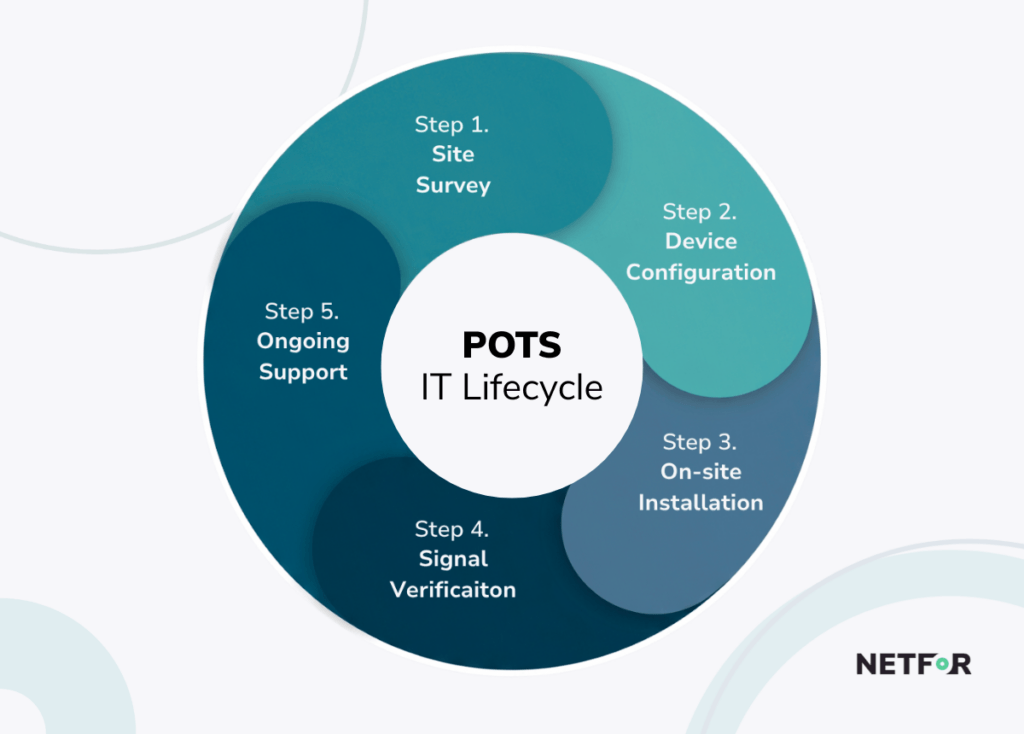
This is where IT lifecycle management planning matters. A structured field execution approach for POTS line replacement across a multi-location portfolio should include:
- A physical audit of every active line and the equipment it connects to, including cross-connect tracing to fire panels, elevator cabs, alarm panels, and POS terminals.
- Pre-configured, pre-tested hardware shipped from a central staging facility with dual-carrier SIM cards pre-activated and static E-911 address mappings programmed before field deployment.
- On-site technical support from certified technicians who can run external antenna cabling in basements or shafts where cellular signal attenuation is a factor.
- Signal verification and AHJ sign-off confirming that Contact ID event codes route successfully to the central monitoring station before the old copper line is retired.
- Ongoing remote monitoring through cloud management portals tracking signal strength, battery health, SIM consumption, and FXS line voltage continuously after installation.
Enterprise organizations attempting fragmented or self-managed migrations show site-level failure rates between 25% and 50% depending on portfolio size, driven by improper DTMF codec configuration, incorrect battery backup sizing, and missed line-seizure wiring on fire panels (DataRemote, 2025). Organizations using dedicated field execution partners show failure rates below 2% (DataRemote, 2025).
Execution at Scale
Netfor's nationwide field technician network handles exactly this type of coordinated, site-by-site deployment. With over 100,000 technicians, a 95%+ First Time Fix Rate, and more than 45,000 sites completed, the Netfor field execution model is built for the operational complexity that POTS replacement creates across large location portfolios. The AIMCO rollout, a 956-site deployment executed through Netfor's centralized staging model, demonstrates the kind of coordinated execution that is required when the alternative is a fragmented, location-by-location scramble.
For organizations that need to deploy technology across every location without building out an internal project management infrastructure to match, a single execution partner removes the coordination overhead from an already compressed migration timeline. Netfor's experience supporting franchise locations nationwide provides direct proof that this execution model scales to large, geographically distributed portfolios.
Every physical POTS cutover also involves structured cabling installation at the demarc level, cross-connect tracing, and in some cases conduit or antenna work inside the building. That work requires qualified, experienced hands on site, not remote configuration, which is why on-site technical support from vetted technicians who understand the compliance requirements of life-safety circuits is non-negotiable.
Plan Your POTS Replacement Before the Notice Arrives
The POTS sunset is already in progress. AT&T has begun physical copper retirements. Lumen has frozen new orders across 14 states. Verizon is executing rolling wire-center shutdowns. The FCC has cleared every procedural barrier that previously slowed this process down.
For multi-location businesses, the highest-risk lines are the ones supporting fire panels, elevator emergency phones, and alarm systems. Those lines fail without local indication, the compliance exposure from a single missed cutover can trigger mandatory Fire Watch requirements and Certificate of Occupancy risk, and the notice window available to act is shorter than most migration timelines for large portfolios.
The technology choices are clear. Cellular gateways for life-safety circuits. VoIP and ATA for general administrative lines. SD-WAN with voice failover for sites already upgrading network infrastructure. What separates a successful transition from a reactive fire drill is whether the physical execution across every site is coordinated before the carrier files the notice, not after.
Netfor executes the physical replacement through a structured field process: site survey, discovery and signal mapping, centralized staging, certified on-site installation, verification, and continuous remote IT support. That process applies whether an organization has 10 locations or 1,000. To start planning your multi-site POTS replacement now, talk to Netfor's Field Services team about a multi-location POTS replacement plan.