

Scaling customer support requires more than hiring additional agents. The most effective approach combines structured processes, omnichannel systems, outsourcing, and AI-driven automation to handle growing demand without sacrificing quality or increasing costs.
Customer support does not break slowly. It breaks all at once, during an outage, a surge, or rapid growth. Support volume is rising fast, with 57% of leaders expecting up to a 20% increase in demand over the next two years (Zendesk, 2026). Yet most teams still rely on headcount to keep up, a model that you have to train and that fails under pressure.
The companies that scale successfully build systems that handle volume, prioritize correctly, and resolve issues faster. This guide breaks down the proven strategies to help you scale customer support efficiently using AI, outsourcing, and omnichannel models.
The Benefits of Scaling Customer Support
Scaling customer support is not just about handling more tickets. It is about improving how your operation performs as demand increases. When done correctly, you maintain fast response times, consistent service quality, and operational efficiency, even during spikes or outages.
The result is simple: growth no longer creates chaos. Instead, your support system absorbs demand and continues to perform.
Key benefits of scaling customer support include:
- Faster response and resolution times during high-volume periods.
- Lower cost per ticket through automation and optimized workflows.
- Improved First Contact Resolution (FCR) and customer satisfaction, with top-performing teams reaching 85%+ FCR rates and teams like Netfor achieving 95% FCR.
- Ability to handle spikes, outages, and multi-location demand without failure, 24/7.
- Consistent support quality across channels and regions.
- Reduced agent burnout, as 56% of service agents report burnout under traditional models (Mosaic AI, 2026).
When support scales the right way, it becomes a competitive advantage, not a bottleneck.

Why Traditional Scaling Models Fail
Relying on internal hiring creates a linear cost problem. As ticket volume grows, so do costs, with in-house agents averaging ~$72,700 annually compared to ~$28,000 for outsourced roles (The Office Gurus, 2025).
Burnout makes it worse. Labor accounts for 60–80% of total support costs (LiveChatAI, 2025), and human-led Tier 1 support averages $22 per ticket compared to ~$1.84 for AI-driven interactions (MetricNet, 2024) .
How do you scale customer support without increasing headcount?
Use AI for ticket deflection, automate workflows, improve self-service, and leverage BPO partners for flexible capacity.
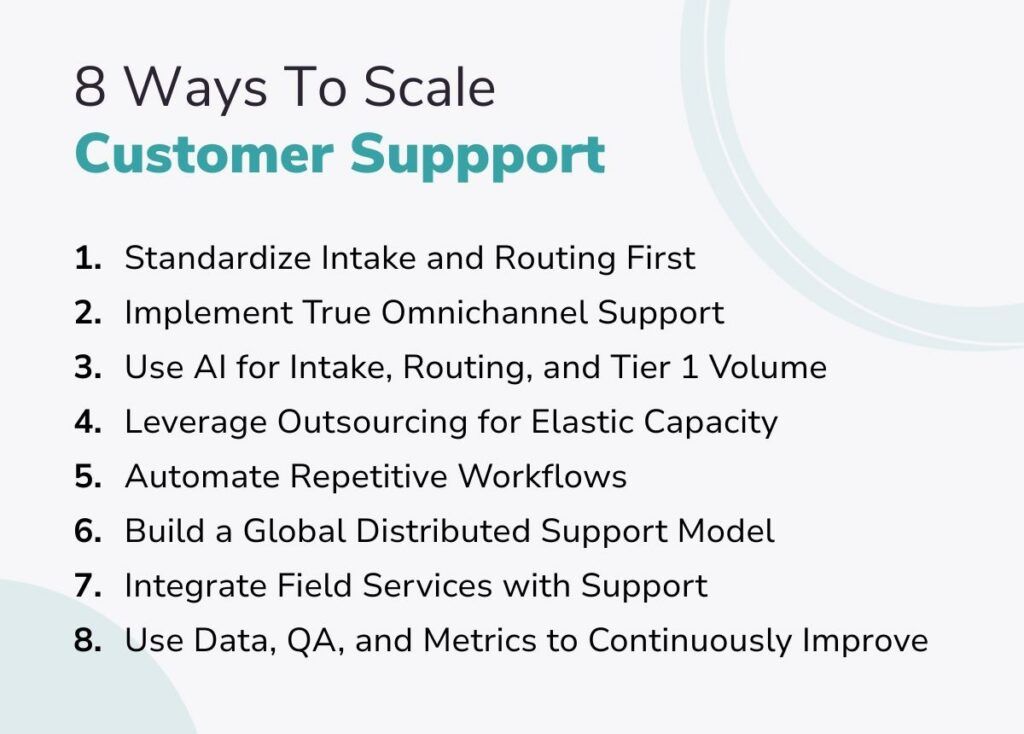
8 Strategies for Scaling Customer Support Teams Successfully
Building a scalable support infrastructure requires a mix of classic frameworks and modern technology.
What are the best strategies to scale customer support operations?
The best strategies involve standardizing your intake processes, implementing true omnichannel tools, leveraging AI, outsourcing for flexible capacity, and integrating your field services. Here are the eight proven ways to grow your capabilities successfully.
1. Standardize Intake and Routing First
Most scaling issues start with bad inputs. When customers submit wrong ticket types or missing data, your team wastes time manually sorting the mess.
- What to do: Implement structured intake forms with required fields and data validation. Use intelligent call routing and intake rules based on issue type and urgency.
- Business impact: This eliminates transfer loops, leading to faster time-to-resolution, fewer escalations, and much higher First Contact Resolution rates.
2. Implement True Omnichannel Support
Customers want to reach you on their preferred channels, but your systems must connect them all. Having multiple disconnected channels is not the same as having omnichannel customer support.
- What to do: Centralize phone, chat, email, and SMS into one unified platform. Ensure you maintain full conversation history across all channels.
- Business impact: Customer context is never lost. Solutions like Netfor’s can centralize customer relationship data securely, keeping your team perfectly aligned.
3. Use AI for Intake, Routing, and Tier 1 Volume
Artificial intelligence is the only reliable way to scale operations without linear headcount growth. See how these strategies fix broken queues and hold times.
- What to do: Automate intake and intent detection. Use AI to prioritize the most urgent issues automatically.
- Business impact: Platforms the offer AI agents that can autonomously resolve routine interactions, drastically reducing your team's overall workload.
4. Leverage Outsourcing for Elastic Capacity
Ticket volume is unpredictable, meaning your workforce should never be entirely fixed.
- What to do: Use a BPO partner for Tier 1 and overflow support. Scale your agent count up or down based on seasonal demand.
- Business impact: You maintain your Service Level Agreements (SLAs) through shared queues while benefiting from the significant cost difference between internal and outsourced labor.
5. Automate Repetitive Workflows
Agents waste countless hours on administrative work that should not require human intervention.
- What to do: Automate ticket creation, categorization, and status updates. Use tools that manage your internal knowledge.
- Business impact: This lowers average handle time and reduces agent fatigue.
6. Build a Global Distributed Support Model
Scaling successfully means providing wider coverage, not just raw capacity.
- What to do: Implement a follow-the-sun support model to provide 24/7 service. Centralize your standards but decentralize your execution across multiple global regions.
- Business impact: You gain continuous coverage while mitigating the risk of localized outages taking your entire support network offline.
7. Integrate Field Services with Support
For multi-location businesses, customer service does not end at the call center. It often extends to physical repairs and dispatching technicians.
- What to do: Connect your IT service desk and contact center operations directly to your field dispatch systems. Ensure your tickets include complete field data before a technician rolls out.
- Business impact: This eliminates vendor fragmentation and prevents costly dispatch errors.
8. Use Data, QA, and Metrics to Continuously Improve
Scaling without accurate measurement guarantees operational failure.
- What to do: Track your FCR, Average Handle Time (AHT), and Customer Satisfaction (CSAT) scores relentlessly.
- Business impact: You identify bottlenecks quickly and optimize your routing rules to continuously improve your processes.
How to Scale Omnichannel Customer Support
Customers expect a seamless experience across channels, and 97% expect they won’t have to repeat themselves when switching between them (ltvplus.com, 2025) . The problem is most systems aren’t built that way, leading to fragmented conversations and slower resolution.
To scale effectively, companies need to unify phone, chat, email, and SMS into one system with consistent routing and full context. When everything flows through a single system of record, teams move faster and customers get answers without friction.
How does AI help scale omnichannel customer support?
AI helps scale omnichannel customer support by providing unified intake, analyzing customer intent across all text and voice channels, sharing context automatically with human agents, and resolving basic inquiries instantly before they ever reach a human desk.
How to Scale Customer Support Globally
Scaling globally introduces complexity across time zones, languages, and compliance. Without a centralized approach, service quality quickly becomes inconsistent.
The most effective model is simple: centralize your standards, distribute your teams. A follow-the-sun approach ensures 24/7 coverage while maintaining consistency. Partnering with a BPO can also offload hiring, training, and compliance, making global expansion far more manageable.
How can companies scale customer support globally while maintaining quality?
Companies maintain global quality by centralizing their standard operating procedures, utilizing a follow-the-sun coverage model, and partnering with established BPO providers who handle local hiring, training, and regulatory compliance.
Nationwide Scale, Field Services, and Real-World Operations
For multi-location businesses, support doesn’t stop at the contact center. Outages can trigger hundreds of locations to call at once, putting immediate pressure on your system.
If support and field services aren’t connected, things break fast. Bad routing, incomplete tickets, and failed dispatches create delays and drive up costs. Every failed dispatch can lead to repeat visits and unnecessary expense. Scalable operations integrate intake, routing, and field execution into one system, ensuring issues are resolved quickly the first time. One project, one team.
How can companies scale customer support operations across thousands of locations?
Companies scale across thousands of locations by establishing centralized intake systems, integrating their IT service desks with nationwide field service platforms, and consolidating vendors to ensure consistent service delivery and strict accountability.
Comparing Your Scaling Options
When you decide to scale customer support operations, you generally have three main paths to choose from. Each approach comes with distinct benefits and limitations.
Approach 1: Hiring More Internal Agents
This method provides high control over your staff and keeps all institutional knowledge strictly internal. However, it is the most expensive path. It offers very little scalability during sudden volume spikes and carries a high risk of employee burnout. This approach works best for very small teams with low ticket volume.
Approach 2: Customer Support Outsourcing
Outsourcing to a BPO provides massive cost savings and flexible scalability. You can ramp up staff quickly for busy seasons. The main drawback is the risk of quality degradation if the partnership is poorly managed. This approach is ideal for growing teams that need reliable coverage without the heavy overhead of internal HR and facilities.
Approach 3: AI-Enabled Hybrid Model
The hybrid model combines outsourced human agents with powerful AI automation. It handles high volume, resolves complex issues, and absorbs traffic spikes effortlessly. While it requires upfront work to design the processes and integrate the technology, it delivers the highest efficiency and the best customer experience. This is the optimal choice for scaling enterprises.
Build a Resilient and Scalable Support System
Scaling customer support operations is ultimately about building resilient systems, not just hiring more people. Traditional headcount models simply cannot survive the financial and operational pressures of modern business growth.
When you combine intelligent process design, customer support outsourcing, and AI-enabled automation, you create a sustainable support infrastructure. These strategies work together to lower your resolution times, reduce your operational costs, and protect your customer experience during critical outages. Real scale is defined by how well you handle complexity and spikes, not just your steady-state ticket volume.
If you are ready to modernize your support operations, you need an execution partner who understands both technology and human delivery. Explore our customer service call center solutions and see how Netfor can help you handle volume, reduce complexity, and improve outcomes across your entire organization.