

Having supported technology across more than 7,000 franchise locations, we’ve seen exactly where IT support models break down and what it takes to scale them effectively.
Franchise growth is accelerating rapidly. There are over 851,000 locations projected in the United States by 2025 (International Franchise Association, 2024). But with that incredible growth comes a new and complex problem. Organizations face extreme technology complexity at scale.
As franchises expand from regional clusters to national brands, information technology becomes the backbone of daily operations. But most brands are still managing their support with fragmented vendors, reactive processes, and highly inconsistent service delivery across their locations.
This blog shows how franchise IT support, powered by full IT lifecycle management and nationwide field services, creates scalable, reliable, and revenue-protecting operations. By centralizing these efforts, businesses can protect their bottom line and support rapid expansion.
Why Franchise IT Support Is Now a Revenue-Critical Function
The footprint of the average franchise is growing. Along with new stores comes a massive expansion of the technology surface area. Retailers and quick service restaurants rely entirely on technology to operate. From self-service kiosks to complex networking hardware, technology is no longer just a background utility. It is the primary engine of business operations.
When these critical systems go offline, the financial impact is devastating. Consider a point-of-sale system outage stopping all transactions during a lunch rush. Or picture a payment failure leading to immediate customer churn. These events cost companies heavily. Research shows that a mid-market organization faces a $300,000 per hour downtime cost benchmark (The Network Installers, 2024).
The revenue impact accelerates the longer the system stays down. Businesses lose up to 70% of their at-risk revenue after just 23 minutes of an outage (Payments Dive, 2024). This makes immediate and reliable IT support an absolute necessity for protecting the bottom line.
So, why is IT support critical for franchise operations? Because technology failures directly stop revenue, disrupt operations, and impact customer experience across all locations.
What happens when franchise tech fails:
- Sales stop immediately, halting all cash flow.
- Employees become idle, costing the business wages without generating revenue.
- Customers leave and often do not return.
- Brand trust declines, requiring months of recovery.
The Hidden Problem of Fragmented Franchise Technology
Multi-location businesses are currently struggling with an unprecedented level of vendor sprawl. Companies often use multiple vendors to handle different tasks. They might have one vendor for the help desk, another for field service, and yet another for hardware procurement.
This multi-vendor approach causes major problems. There is a severe lack of integration across these systems. The average enterprise uses 897 applications, but only 29% of them are actually integrated (Integrate.io, 2024). In a franchise environment, this creates operational inefficiencies. For example, using separate vendors for point-of-sale support and networking often leads to misrouted tickets. A network issue gets sent to the hardware vendor, causing massive delays in resolution.
Franchises can achieve up to a 30% cost reduction from vendor consolidation (Salesforce, 2024). By moving away from multi-vendor support models, companies regain control over their infrastructure.
Problems caused by fragmentation:
- Delayed issue resolution due to confusing processes.
- Miscommunication between different vendors.
- Increased costs from overlapping service contracts.
- Lack of accountability when critical systems fail.
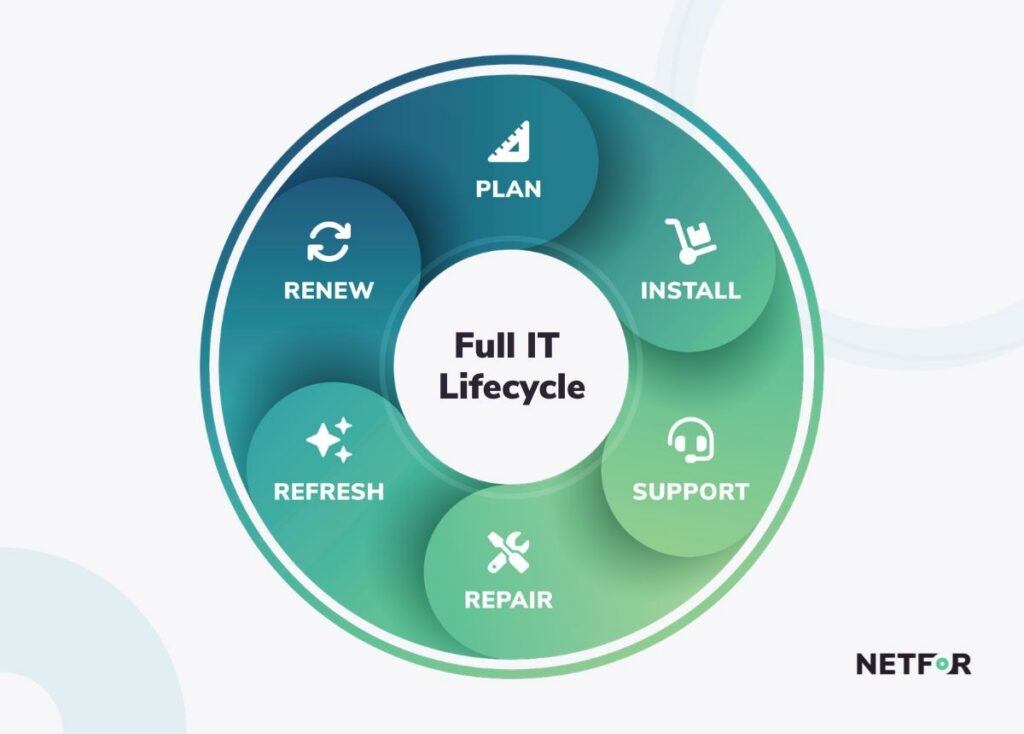
What Full IT Lifecycle Management Looks Like for Franchises
IT lifecycle management is the practice of tracking and maintaining technology from the moment you purchase it until you dispose of it. For multi-location franchises, standardizing this process across all locations is vital.
Instead of waiting for hardware to fail, a proactive approach ensures systems stay online. A great example is device deployment for new store openings. A central team configures the hardware before shipping it. Another example is scheduling a hardware refresh before a thermal printer breaks down during the holiday rush.
Franchise technology solutions built around proactive maintenance deliver massive savings. Organizations see an 18 to 25% cost reduction with predictive maintenance (Envision Consulting, 2024). Proper management also causes a reduction in hardware value erosion from 8.6% down to 3% (Leah AI, 2024).
Core stages of lifecycle management:
- Procurement and staging of new devices.
- Configuration and deployment to specific store locations.
- Help desk and remote support for daily operations.
- Field service and break/fix maintenance.
- Asset tracking and scheduled replacement.
Nationwide Field Services Support Franchises at Scale
You cannot maintain a national brand without true nationwide coverage. However, there is a big difference between "paper coverage" and having an active technician network. Paper coverage means a vendor claims they can service an area, but they do not have vetted technicians ready to go.
First-Time Run Rate is the most important metric in field services. If a technician is dispatched to a rural location and fails to fix the issue on the first visit, the costs multiply. A failed first visit causes multiple truck rolls.
To learn more about how a comprehensive approach helps brick-and-mortar stores, explore Netfor's retail industry solutions.
How do franchises scale IT support? By centralizing support, using standardized processes, and leveraging nationwide service coverage.
What great field service looks like:
- Fast dispatch times regardless of location.
- High first run rates to minimize disruptions.
- Consistent technician quality across all visits.
- Reliable coverage in both rural and urban areas.
How Franchises Scale IT Support from 50 to 1,000 Locations
Scaling IT support is not a linear process. What works for 50 locations will completely break when you reach 1,000. Franchises face extreme non-linear scaling challenges.
A primary issue is call volume spikes. During a holiday surge, support tickets skyrocket. Data shows a 42% increase in support volume during peak holiday periods (Zendesk, 2024). If an outage happens, 300 stores might call the help desk at the exact same time. Staffing limitations make this impossible to handle internally. Retail IT staffing ratios can be as high as 1 IT staff member to 500 users (Workwize, 2024).
What breaks when scaling:
- Ticket backlogs build up over several days.
- Slow response times frustrate store managers.
- Technician burnout leads to high staff turnover.
- Lack of prioritization keeps critical stores offline.
Comparing Your Support Alternatives
When evaluating franchise IT support, leaders must compare different operating models. Each approach offers specific benefits and drawbacks.
- In-house IT teams: This model offers high control but is not scalable. It makes sense for a very small footprint.
- Regional Managed Service Providers (MSPs): These provide good local service but have limited geography. They are best for strictly regional operations.
- Staffing-based models: These charge by the hour and are highly reactive. They are not optimized for long-term improvements.
- Multi-vendor approach: This causes data silos and integration failures.
- Centralized lifecycle partner: This provides a single, scalable franchise technology solution. It is the only choice for large scale operations.
Structured comparison of a centralized IT lifecycle model:
- Scalability: Easily handles volume spikes and new store openings.
- Cost efficiency: Consolidates vendor fees and reduces hourly waste.
- Response time: Offers 24/7 coverage with standardized service level agreements.
- Consistency: Delivers the exact same experience to a store in New York and a store in rural Texas.
- Accountability: Provides one single point of contact for all technology failures.
Transforming Your Franchise Technology Strategy
Franchise IT is now a revenue-critical function. Technology outages immediately stop sales and drive customers away. Relying on fragmentation and multiple vendors creates severe operational risk. Full IT lifecycle management is the only way to enable true scale. Furthermore, an active nationwide support network is absolutely essential to maintain uptime across diverse geographies.
What should you look for in an IT partner? Nationwide coverage, lifecycle capabilities, proven metrics, and the ability to reduce downtime and vendor complexity.
Organizations that modernize their franchise IT support reduce downtime, improve operational efficiency, and protect their revenue. The ultimate differentiator is finding a single partner capable of delivering full IT lifecycle management across all locations.
If you want to see exactly how this works in the real world, read about how a centralized support model generated massive savings. Discover how we simplified franchise technology and scale support across all locations for a Fortune 500 Company.