
An Intelligent Virtual Agent (IVA) is an AI-powered system that replaces traditional IVR phone trees by understanding natural language, capturing customer intent, and routing or resolving issues more efficiently. While IVR systems rely on menu-based inputs like "press 1 for support," IVAs use artificial intelligence to hold conversations, gather context, and prioritize requests in real time. The result is faster resolution, fewer transfers, and improved customer experience. For modern service operations, IVAs are not just an upgrade to IVR. They are a foundational shift toward intelligent, scalable customer support.
Everyone has experienced it. You call a support line, get stuck in a frustrating phone tree, press "0" repeatedly, and still cannot get the help you need.
Traditional IVR systems were built on assumptions that simply do not match real customer behavior. This disconnect leads to high frustration, constant misrouting, and massive amounts of lost time for both callers and service agents.
This blog breaks down the debate of IVA vs. IVR. We will explore what an IVA actually is and how intelligent virtual agents are transforming customer service through better intake, routing, and resolution.
What is an IVA and an IVR?
To understand how customer service is evolving, we must define the core technologies driving the change.
What is an IVA? An Intelligent Virtual Agent is an AI-powered system that understands natural language, captures intent, and routes or resolves customer issues without relying on menu-based inputs.
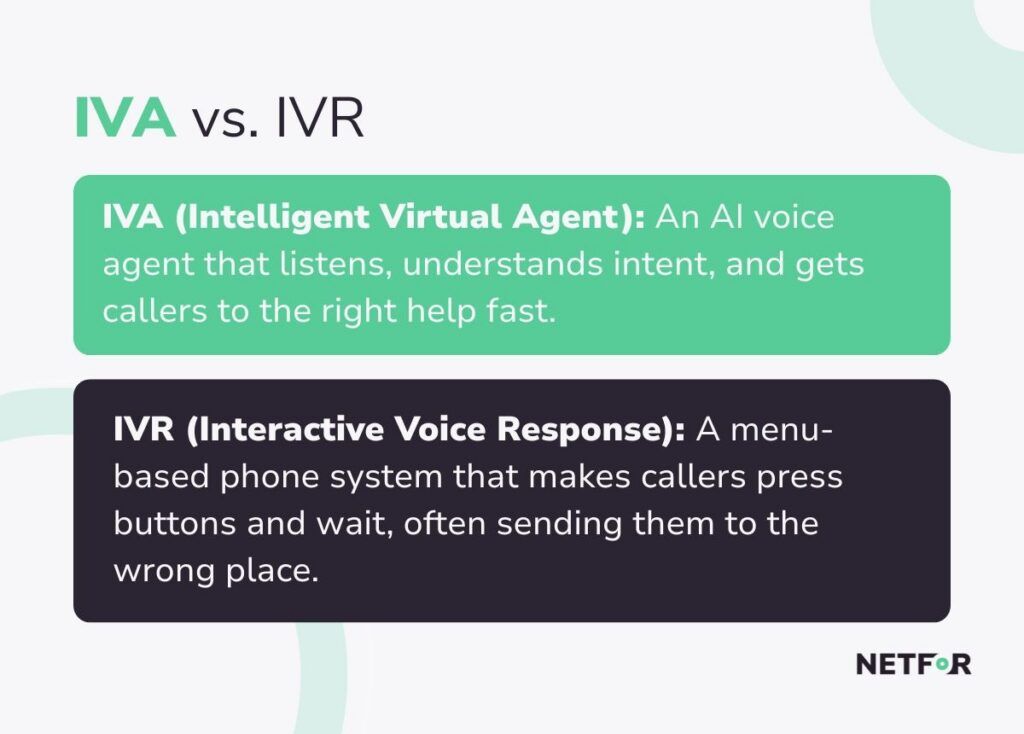
On the other hand, IVR (Interactive Voice Response) is a legacy system founded in the early 1970s. It operates on predefined rules and requires users to navigate options using their keypad or highly restricted voice commands. The core difference in IVA vs. IVR comes down to rule-based logic versus AI-driven conversations. Traditional systems force callers into boxes. Virtual agents artificial intelligence uses Natural Language Processing (NLP), Natural Language Understanding (NLU), and Large Language Models (LLM) to recognize intent dynamically.
For example, a standard IVR provides a rigid menu tree: "Press 1 for support. Press 2 for billing." If a caller has a complex issue, they often guess which number to press. Conversely, an IVA uses natural conversation intake. It simply asks, "Tell me what is going on today." The caller can explain their issue naturally, and the system understands exactly where to send them.
The technical specifications highlight this gap. IVR relies on Dual-Tone Multi-Frequency (DTMF) signaling and strict rule-based logic. IVA leverages advanced NLP and intent recognition to drive actual conversations.
Key differences between IVR vs IVA:
- IVR functions purely as a routing system.
- IVA operates as a complete understanding, routing, and resolution system.
- IVR demands that the user adapts to the system.
- IVA ensures the system adapts to the user.
Why IVRs Are Failing Modern Customer Service
Traditional IVRs are failing because their assumptions about caller behavior are entirely wrong. Systems assume callers know exactly what department they need. However, callers often do not know exactly what they need when calling.
This leads to excessive menu depth, repetition, and frequent misrouting. When customers get confused by vague menu options, they experience frustration and often abandon the call entirely. Callers find themselves trapped in touchtone hell, prompting them to create behavioral workarounds. A common example is customers pressing "0" repeatedly or screaming "representative" into the phone to bypass the automation.
The data supports this widespread failure. Research shows a 31% dissatisfaction rate with traditional IVR systems (ICMI, 2011). Furthermore, standard abandonment rates hover around 15% (Call Centre Helper, 2008). Notably, abandonment spikes after 3 prompts. If a caller has to press a button more than three times, they simply hang up.
Common failure points of IVR:
- Rigid menu trees result in poor navigation and wasted time.
- No intent understanding causes consistent misrouting to the wrong departments.
- Sequential audio creates cognitive overload for the caller.
- A complete lack of context means human agents must restart conversations from scratch.
How IVAs Fix the Front Door Problem
Customer service often suffers from a "front door" problem. Poor intake creates bottlenecks before the caller ever reaches an agent. IVAs fix this by utilizing intelligent intake instead of tedious menu navigation.
What is the difference between IVR vs IVA in terms of intake? IVR uses pre-set menus and keypad inputs, while IVA uses artificial intelligence to understand spoken or typed language and dynamically respond.
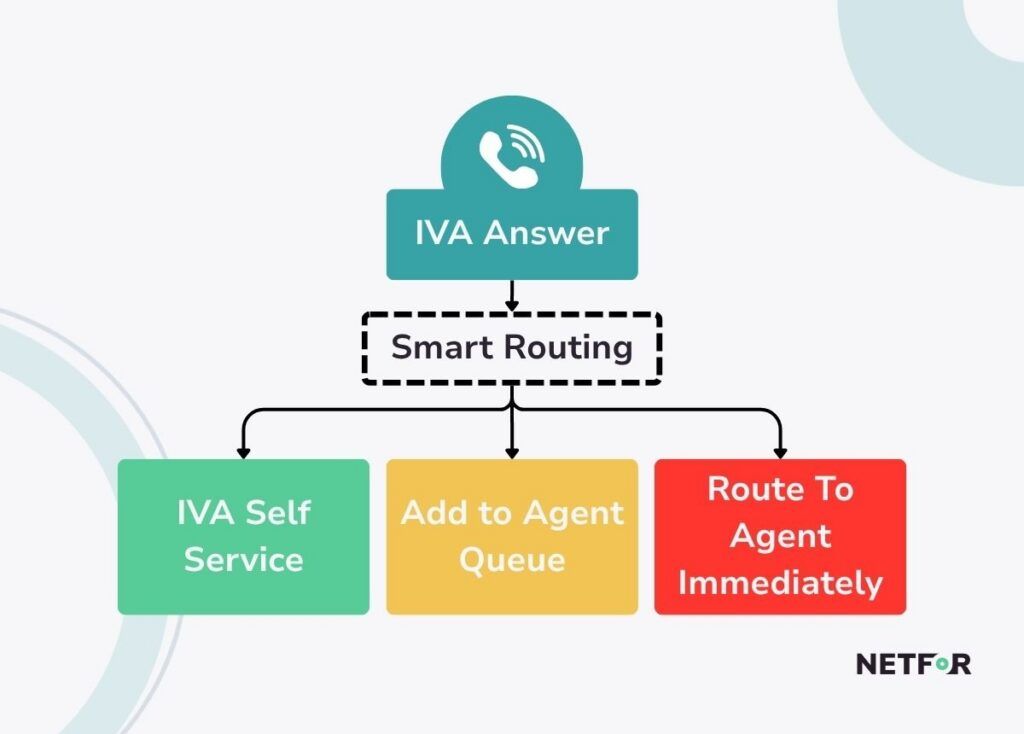
An IVA captures context before the agent handoff occurs. Through accurate intent detection and prioritization, the system adopts a "resolution-first" model rather than a "routing-first" model. For example, an IVA can capture a caller's name, their specific issue, and account context before any human gets involved. If the system detects a revenue-impacting issue, it prioritizes that call immediately. For simple Tier 0 requests, the IVA resolves them instantly without agent intervention.
In many contact centers, the first 20 to 30 seconds of every call is spent collecting basic information. Automating that step through intelligent intake adds up quickly. A company handling 5,000 calls per month can save roughly 500 agent hours per year by reducing just 30 seconds per call, shifting time from repetitive intake to real problem solving.
The technical performance of virtual agents artificial intelligence is highly impressive. Industry data shows that 80 to 90 percent of routine queries can be automated (Gartner, 2025). Advanced systems achieve a 97% intent recognition accuracy (Interactions IVA, 2024). By switching to conversational models, companies see a 40% reduction in abandonment with natural language IVR (Subverse AI, 2025).
What improves immediately with intelligent intake:
- Overall caller experience
- Fewer transfers between departments.
- Faster time connecting to the correct team.
- Higher-quality tickets with complete context.
- Reduced agent handle time across the board.
Operational Impact, ROI, and Real Use Cases
Upgrading your phone intake strategy directly impacts critical operational metrics. Businesses see major improvements in First Call Resolution (FCR), Average Handle Time (AHT), and overall call volume management.
When comparing human resolution to AI resolution, the cost differences are staggering. The average cost per call for a human agent is $5 to $15, while an IVA costs approximately $1.25 per interaction (Magai, 2025). Beyond simple cost savings, IVAs allow organizations to scale seamlessly during outages and call spikes. This protects revenue and dramatically improves the customer experience (CX).
Consider a retail outage scenario. A massive point-of-sale failure generates hundreds of simultaneous calls. An IVA can instantly identify the outage, prioritize calls from critical stores, and provide automated status updates to the rest. In an IT help desk environment, an IVA can automate simple password resets. This frees up human agents to focus entirely on complex issues.
The operational outcomes are heavily backed by data. Organizations report an 80% reduction in AHT for L0/L1 issues when utilizing AI (Milestone Tech, 2026). Furthermore, intelligent intake helps push FCR improvements toward 90%. Globally, analysts project an $80B labor savings from AI customer service by 2026 (Gartner, 2026).
Measurable business outcomes:
- Lower overall support costs.
- Faster resolution times for standard issues.
- Higher customer satisfaction due to zero wait times for intake.
- The ability to scale operations without hiring massive numbers of new staff.
How to Implement an IVA
How long does it take to implement an IVA? Implementation typically takes weeks to months depending on integrations, knowledge readiness, and operational complexity.
See how ready your operation is with an AI Readiness Assessment before you commit to an implementation timeline.
Implementing intelligent virtual agents requires careful planning. Many companies fail because they treat AI like magic rather than a tool requiring structure. A successful deployment requires rigorous knowledge base quality and strict lifecycle management.
You must establish robust guardrails for both pre-generation and post-generation responses. Additionally, a human-in-the-loop escalation path is absolutely necessary. The IVA must feature tight integration with your existing CRM, ticketing platforms, and service desk tools.
Required examples of failure and success make this clear. AI projects fail quickly when fed poor knowledge, such as unstructured files from a chaotic share drive. Conversely, strict guardrails prevent hallucinations and automatically escalate confused callers to human agents.
The technical reality of implementation is challenging. Only 11% of companies successfully deploy AI in production (Deloitte, 2026). Furthermore, 48% of organizations cite governance as their top challenge (PYMNTS, 2025), while 55% struggle heavily with system integration (451 Research, 2026).
Implementation must-haves:
- A clean, highly structured knowledge base.
- Clearly defined intents and routing paths.
- Strict escalation rules for unknown exceptions.
- A continuous optimization loop to refine responses.
AI must be structured exactly like a human agent. It must be trained, guided, and constrained. It cannot be left entirely autonomous without supervision. Netfor specializes in providing this human-in-the-loop AI framework.
IVR vs IVA
Understanding when to use each system is critical for operational leaders. Let us look at the alternatives available in the market today.
Companies can choose a traditional IVR, a hybrid model blending IVR and AI, or a full IVA implementation.
Competitor positioning varies wildly across the industry. Most vendors position IVA purely as an automation tool to cut headcount. Few vendors address the true value: intake quality, routing accuracy, or outage handling.
When does each approach make sense? Traditional IVR is acceptable only for simple routing in very low-complexity environments. Full IVA deployment is required for high-volume, multi-location, and CX-driven operations.
Structured comparison of IVR vs IVA:
- IVR is cheaper upfront but results in a higher long-term cost due to inefficiency.
- IVA offers much higher capability and drives vastly better operational outcomes.
- IVR is strictly a routing tool.
- IVA serves as a comprehensive intake, routing, and resolution platform.
Why are IVRs frustrating for customers? IVRs rely on rigid menu trees and assumptions about caller behavior, leading to misrouting, long navigation times, and repeated interactions.
Can IVA replace human agents? No. IVA handles repetitive and intake tasks, while human agents handle complex, emotional, or nuanced issues.
The Future of Service Operations
To review our key takeaways, IVR is merely a routing system. IVA is a highly intelligent intake and resolution system. Poor intake is the root cause of most service desk and contact center inefficiencies. Upgrading to an IVA fixes the "front door" of your customer service.
Organizations that adopt intelligent virtual agents see immediate, measurable improvements in speed, operational cost, and customer experience. The differentiator for your business is clear. The real value of an IVA is not just automation. The true value lies in better intake, better routing, and ultimately better outcomes.
If you are ready to modernize your service desk, learn how AI-driven intake and routing can transform your customer service operations today. Reach out to Netfor to see how a structured, execution-focused approach to virtual agent artificial intelligence can solve your most pressing operational challenges.