
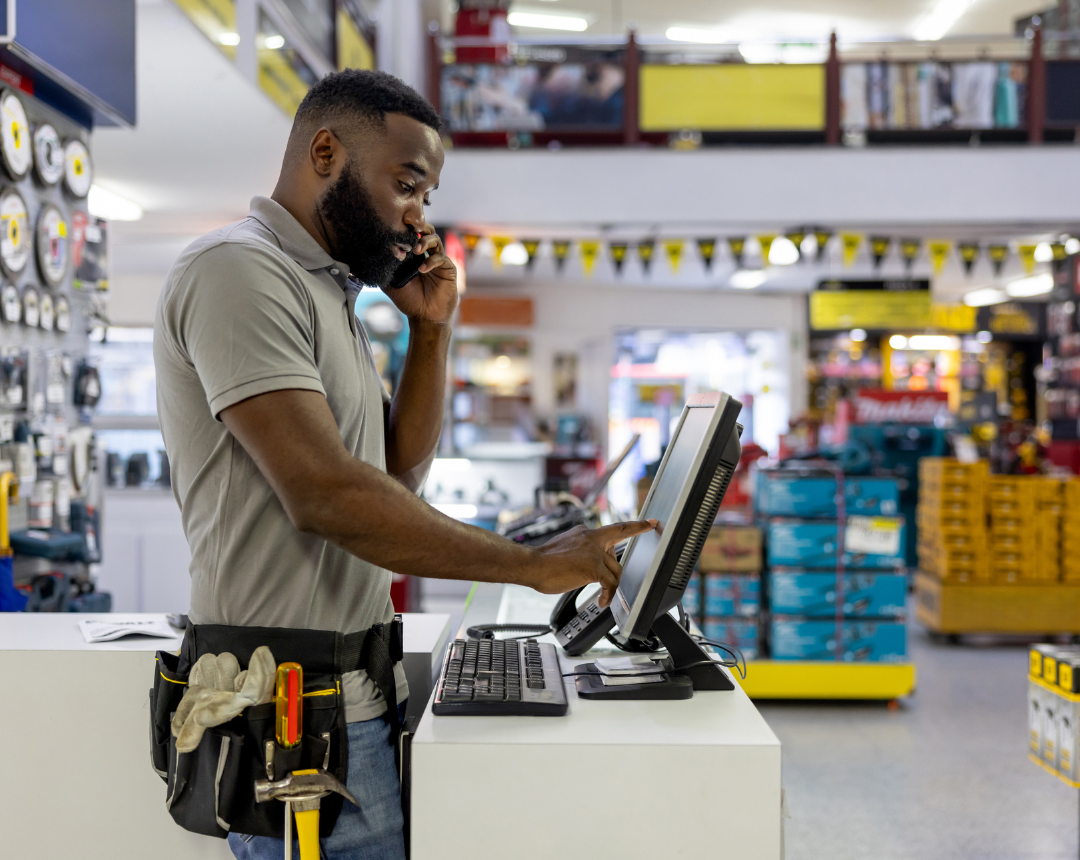
Point of sale service includes the installation, configuration, deployment, support, and ongoing maintenance of POS systems across retail, QSR, and franchise environments. Effective point of sale services ensure hardware is properly staged, software is configured correctly, issues are resolved quickly, and downtime is minimized. For multi-location brands, structured onsite and remote support models protect revenue, reduce service delays, and maintain consistent customer experiences across every location.
A POS outage is not just an inconvenience. For a Fortune 500 retailer, it can cost between $500,000 and $1,000,000 per hour. (Erwood Group, 2025) For a QSR operator, even a 15-second delay per transaction can reduce total revenue by 3 to 5%. (RSS Technology Solutions, 2025) These are not worst-case scenarios. They are industry realities that organizations with distributed footprints face every time a system goes offline without a structured support plan.
Most organizations still treat POS support as a reactive task. When something breaks, someone fixes it. That model works for a single location. It does not work for a franchise network with 200 locations across 30 states, or a QSR chain running high-volume drive-thrus from coast to coast.
This guide explains what point of sale service actually includes, why nationwide field services matter, how self service point of sale systems create new maintenance challenges, and how lifecycle governance protects revenue at scale.
The Real Price of POS Downtime
The financial risk of POS instability goes well beyond lost transactions. Research shows that the average consumer will wait just 7 minutes during a payment disruption before abandoning a purchase. (Dynatrace/FreedomPay, 2025) The average resolution time for a major retail POS outage is approximately two hours. That gap between consumer patience and actual resolution time is where revenue disappears.
The numbers escalate quickly:
- A 23-minute outage can wipe out approximately 70% of at-risk revenue for that period
- 40% of customers will defect to a competitor after a single unresolved technical issue (Netfor, 2026)
- QSR operators lose one in five drive-thru customers if wait times to order exceed two minutes (RSS Technology Solutions, 2025)
For multi-location brands, these losses multiply across every affected site. A single platform-wide outage affecting 50 locations during peak hours carries a financial consequence that most organizations have never fully calculated.
Point of sale customer service is not a support function. It is a revenue protection strategy.
What POS Services Actually Include
The term “point of sale service” covers the full hardware and software lifecycle, from the moment a device is configured to the moment it is securely decommissioned.
Staging and Kitting
Before hardware reaches a store, it should be centralized, configured, tested, and validated in a controlled environment. Professional staging reduces store opening timelines significantly and eliminates “dead on arrival” hardware failures that cause costly deployment delays. (Netfor, 2025)
Installation and Deployment
Onsite installation involves physical setup, software configuration, network connectivity, and employee orientation. For multi-location rollouts, standardized installation blueprints ensure every site is configured identically, which simplifies future troubleshooting.
Break/Fix Support
When hardware fails, break/fix services dispatch a qualified technician to diagnose and resolve the issue. The speed and accuracy of this response directly determines how long a store remains offline.
Preventative Maintenance
Scheduled maintenance programs extend hardware lifespan and reduce unexpected failures. Businesses that implement structured maintenance can save up to 25% in annual replacement costs and extend terminal life by two to three years. (szzcs.com, 2025)
Decommissioning
End-of-life hardware must be retired following NIST 800-88 data sanitization guidelines and PCI DSS 4.0 compliance requirements. Secure decommissioning protects against data breaches and regulatory penalties.
Hardware Lifespan Reference
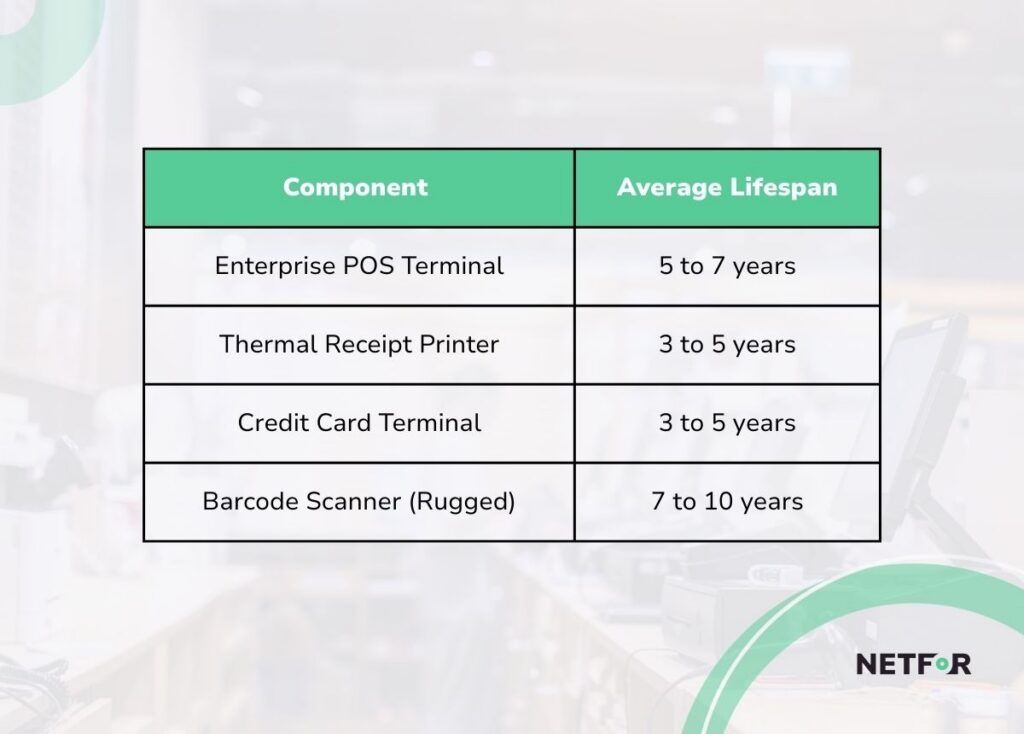
Devices beyond 4 to 5 years of age show exponentially higher repair frequencies. Operating hardware past its recommended window is one of the most common and avoidable causes of retail downtime.
Self-Service and Full-Service Restaurant POS Complexity
Self-service point of sale systems are now standard in airports, fast-food chains, and retail environments. The self-service kiosk market is projected to reach $65.31 billion by 2030, growing at a CAGR of 8.18%. (Research and Markets, 2025)
Fact: More than 56% of QSR employees are required to troubleshoot or fix kiosks on a daily or weekly basis. (PMQ Pizza Magazine, 2025) Every time a front-line employee is pulled away to fix a kiosk, service slows, customers notice, and productivity drops. That hidden labor cost rarely appears in the operational budget, but it accumulates quickly.
Full service restaurant point of sale environments carry their own complexity. These systems must handle high transaction volumes, table management integration, handheld device support, and peak-hour resilience. A thermal printer failure during a dinner rush or a credit card terminal that goes offline on a Friday evening creates an immediate and measurable revenue impact.
Both environments require structured support models with fast response times, high first-time fix rates, and remote diagnostics that resolve non-critical issues before a technician is ever dispatched.
Nationwide Field Services and the Coverage Problem
One of the most underestimated risks in multi-location POS management is geographic inconsistency. In Tier 1 urban markets, technician availability is high and 4-hour response times are standard. In Tier 3 and Tier 4 rural markets, wait times of 48 to 72 hours are common. (Netfor, 2026)
For a franchise brand with locations in both Chicago and rural Nebraska, that inconsistency means different customers experience different service levels. Over time, that gap erodes brand trust.
First Run Rate (FRR) is the most important metric in field service operations. The industry average sits at approximately 88%, meaning more than 1 in 10 service calls fail and require a repeat visit. Top-performing providers achieve 95% or higher. Netfor achieves 98%.
Every failed first visit carries a real cost. The Technology and Services Industry Association estimates the true cost of a truck roll at approximately $1,000 per dispatch when all indirect expenses are included. (Blitzz, 2025) Repeat visits double that cost while the store remains offline.
Mean Time to Repair (MTTR) is the second critical benchmark. Best-in-class providers target under 4 hours. Achieving this consistently across a national footprint requires vetted technician networks, centralized dispatch, and pre-dispatch triage that ensures technicians arrive with the right parts and skills.
Lifecycle Governance and the Case for Managed Services
The operational complexity of managing a distributed POS environment has pushed many multi-location brands toward a managed service model. Instead of coordinating multiple regional vendors, they consolidate under a single national partner accountable for the full lifecycle.
Eighty percent of executives plan to maintain or increase their investment in third-party outsourcing. (Prialto, 2025) Organizations that consolidate vendors report cost reductions of up to 40% and significantly lower administrative overhead. (prombs.com, 2025)
A full lifecycle managed model with Netfor covers every stage of the technology journey:
- AI-assisted intake and triage routes issues to the right resolution path immediately
- Help desk support resolves issues remotely before a field dispatch is needed
- Warehouse staging ensures hardware is configured and ready before it ships
- Onsite installation and break/fix resolves issues that require a physical technician
- Ongoing support maintains uptime through preventative maintenance and monitoring
- Secure decommissioning retires end-of-life hardware in compliance with regulatory standards
Netfor’s nationwide field services model covers every one of these stages under a single partner relationship, providing consistent SLAs, centralized dispatch, and measurable performance benchmarks across every location.
Comparing Your Options: Four POS Support Models
In-House POS Support Team: Best for organizations with fewer than 10 to 15 locations concentrated in urban markets with predictable service volume. High fixed labor costs, limited geographic reach, and no rural coverage make this model difficult to scale. Employee turnover, retirement, and PTO create SLA risk across the entire network.
Fragmented Multi-Vendor Model: Common in legacy environments or organizations that grew reactively without centralized oversight. Multiple vendors create finger-pointing during outages, redundant costs, administrative burden, and SLA confusion. This model consistently produces higher MTTR and lower revenue protection.
Nationwide Managed Field Service Partner: The right model for organizations with 20 or more locations across multiple states, franchise or distributed retail models, and revenue-sensitive POS environments. This approach delivers standardized staging and deployment, centralized dispatch and triage, 95%+ First Run Rate benchmarks, reduced truck rolls, Tier 3 and Tier 4 coverage, and lifecycle governance under one partner. The operational outcomes are predictable SLAs, reduced downtime, and lower administrative overhead.
Commonly Asked Questions
What do point of sale services include?
Point of sale services include hardware staging, onsite installation, POS deployment, remote diagnostics, break/fix services, preventative maintenance, compliance oversight, and secure decommissioning. Nationwide field services also include technician dispatch, SLA management, and standardized rollout processes across all locations.
What support does a full service restaurant point of sale require?
A full service restaurant point of sale requires high transaction speed, payment processing reliability, printer and handheld device support, and peak-hour resilience. Support models must prioritize rapid triage, reduce repeat truck rolls, and ensure network and hardware stability during high-volume periods.
How does point of sale customer service reduce downtime and protect revenue?
Point of sale customer service reduces downtime by ensuring issues are routed correctly, technicians arrive prepared, and remote triage resolves non-critical issues before dispatch. Higher first run rates and reduced MTTR directly protect revenue by minimizing transaction interruption and customer abandonment.
How long does a typical POS deployment take across multiple locations?
Deployment timelines vary based on complexity. Small rollouts may take 2 to 4 weeks, while enterprise deployments can require 6 to 16 weeks depending on software integration, staging, and training coordination. Phased rollouts with centralized staging reduce deployment risk.
Build a POS Support Model That Protects Revenue at Scale
POS downtime carries measurable financial risk. First Run Rate and MTTR are revenue protection metrics, not just service benchmarks. Fragmented vendor models increase operational instability. And nationwide managed field services provide the consistency, accountability, and coverage that distributed brands require.
A structured, lifecycle-driven approach to point of sale service shifts the model from reactive repair to proactive revenue protection. Multi-location brands gain predictable SLAs, reduced truck rolls, and improved operational resilience when they work with a single partner accountable for the full technology lifecycle.
If your retail, QSR, or franchise organization depends on consistent uptime across multiple locations, evaluate whether your current point of sale services model is protecting revenue at scale. Learn how Netfor’s nationwide field services and POS installation services simplify deployment, reduce downtime, and support your full technology lifecycle.