

Customer expectations are always on the rise. Today, 90% of consumers demand an immediate response to their inquiries, and a single negative support experience is enough to make 73% of them abandon a brand for good. While customer demands are growing, internal IT and customer support teams can fall behind. They face overwhelming ticket volumes, high employee turnover rates, and the costs of maintaining reliable operations. Now imagine adding 24/7/365 support to that burden.
For many organizations, the breaking point has arrived. Internal service desks can no longer scale effectively, hire fast enough, or meet modern expectations for omnichannel availability and rapid resolutions. Costs are ballooning, burnout is real, and the operational strain is becoming unsustainable. An in-house team alone is often no longer a viable model for delivering the level of service required to compete.
This is where a modern Business Process Outsourcing (BPO) contact center offers a solution. By providing scalable, expertly trained, and omnichannel support backed by advanced analytics and AI, today’s contact center BPO companies are more than just cost-saving vendors. They are strategic partners that strengthen customer experience, accelerate IT resolution, and remove the immense operational burdens of staffing, training, and infrastructure. This guide will explain how a BPO contact center works, the measurable advantages it delivers, and what to look for when choosing a partner.
BPO Contact Center vs. BPO Call Center: Key Differences Explained
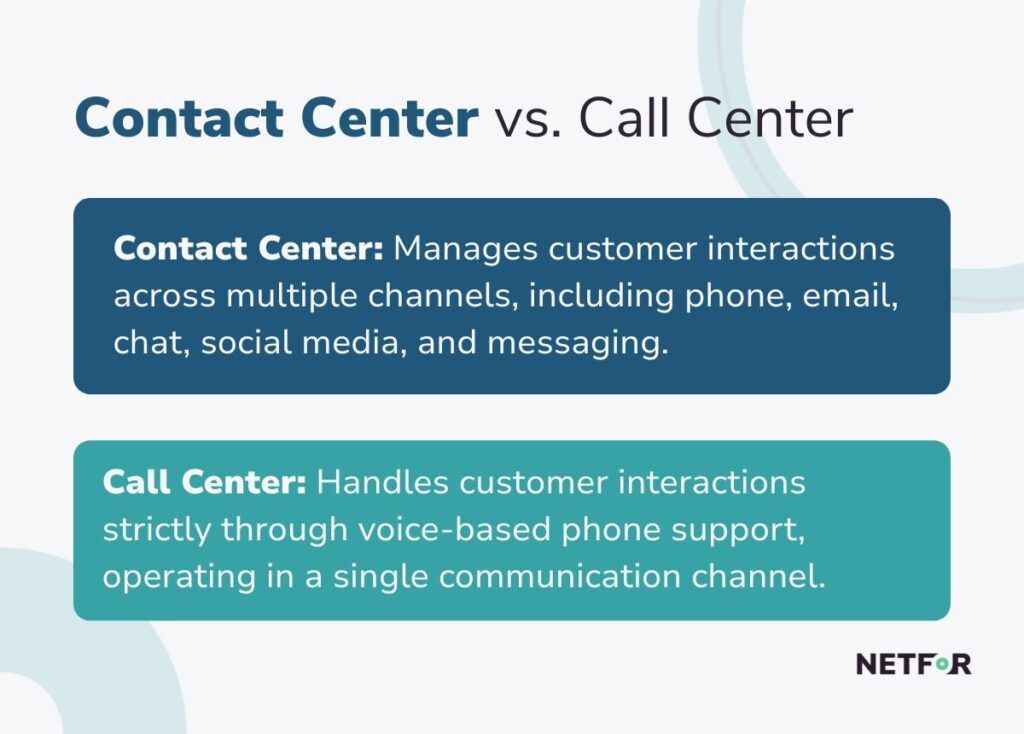
The term "call center" often brings to mind images of agents tethered to phones, handling one call after another. However, the modern BPO contact center has evolved far beyond this voice-only model. Understanding this distinction is the first step toward appreciating its strategic value. A traditional call center is limited to voice-based communication, whereas a contact center is a unified, omnichannel hub designed to manage customer interactions across every channel, including email, web chat, social media, and messaging apps.
Rather than acting as a siloed vendor, a modern BPO partner becomes an extension of the client's brand. For IT teams, this means the BPO contact center can function as the front line of the service desk, handling high-volume Tier 1 issues like password resets and FAQs. This frees up internal IT experts to focus on complex, high-impact problems. For customer care, it means providing seamless, consistent support across multiple locations and time zones. This integration is powered by a sophisticated technology stack.
- Tiered Support: Many companies use BPO contact center services to manage Tier 1 support. This model deflects a high volume of repetitive queries, allowing skilled internal teams to address more strategic challenges.
- AI-Driven Efficiency: Today’s BPOs leverage AI for intelligent routing, demand forecasting, and promoting self-service options, which can deflect up to 53% of incoming tickets before they ever reach a human agent.
- Operational Benchmarks: Performance is measured against strict Service Level Agreements (SLAs). Key metrics include Average Handle Time (AHT), with a recent industry benchmark of 697 seconds, and First Contact Resolution (FCR), where shorter calls often yield higher success rates. A well-run center maintains an abandonment rate of 2–5% and adheres to SLAs like answering 80% of calls within 20 seconds, a common SLA for Netfor clients.
The Strategic Advantages of BPO Contact Center Outsourcing
The decision to outsource has shifted from a purely transactional choice to a strategic one. Where organizations once saw BPO and call center services as a simple way to cut costs, they now recognize the immense operational and competitive advantages of BPO. The modern BPO contact center delivers value that goes far beyond labor arbitrage, offering scalability, quality, and risk mitigation that are difficult to achieve in-house.
One of the most compelling arguments for BPO contact center outsourcing is the dramatic reduction in the total cost of ownership, which can be as high as 50-60% compared to an internal team. The cost of an in-house agent in the U.S. can easily exceed $66,000 annually when salary, benefits, training, and infrastructure are factored in.
In contrast, an outsourced agent can cost between $31,200 and $40,800. This is compounded by the industry’s high turnover rate of 30-45%, with each agent replacement costing an estimated $10,000–$20,000.
- Unmatched Scalability: A BPO contact center provides the flexibility to scale support up or down instantly. For example, retailers facing holiday surges can increase staffing by 300% without hiring permanent employees.
- 24/7 Availability: Providing round-the-clock support in-house requires at least four full teams to cover all shifts. A BPO partner delivers 24/7 coverage seamlessly through a global or multi-shift workforce.
- Improved Performance: A SaaS startup that outsourced its support saw a 40% improvement in response times and a jump in customer satisfaction (CSAT) from 78% to 91%. Likewise, outsourcing IT service desk functions can reduce Mean Time to Resolve (MTTR) by up to 900%, making resolutions ten times faster.
Check out our Service Desk Calculator to see how much savings a BPO Contact Center can unlock for your organization.
The Technology That Powers Modern BPO Contact Center Services
The operational excellence of a modern BPO contact center is built on a foundation of advanced technology, with Artificial Intelligence at its core. An estimated 98% of contact centers are already using AI in some capacity, transforming everything from agent assistance to customer routing. The rise of cloud-based Contact Center as a Service (CCaaS) platforms has further accelerated this trend, enabling rapid scalability and giving organizations a unified view of their omnichannel operations. Cloud deployments now account for 51% of the U.S. BPO market.
Generative AI is making a particularly significant impact. Instead of replacing human agents, it is augmenting their capabilities. AI can draft responses, summarize long conversations, and retrieve relevant information from knowledge bases in real time. This "hybrid agent" model, which combines human empathy with machine efficiency, reduces agent burnout and improves the quality of service.
- AI for Agent Support: Generative AI tools assist agents by providing real-time guidance and automating repetitive tasks, allowing them to focus on complex, high-value interactions.
- Improved Resolution Times: Contact center AI has been shown to reduce MTTR from over 30 hours to under 15 hours by quickly identifying and routing issues.
- Predictive Analytics: AI algorithms can forecast call volume spikes with high accuracy, allowing managers to optimize agent scheduling and prevent understaffing.
What to Look for in Top Contact Center BPO Companies
Choosing the right BPO partner is a critical decision that requires careful evaluation. Not all contact center BPO companies are created equal, and the best fit depends on your organization's specific needs, including security requirements, cultural alignment, and performance expectations. Key considerations include the provider's operational model, their demonstrated performance metrics, their compliance certifications, and their ability to integrate seamlessly with your brand.
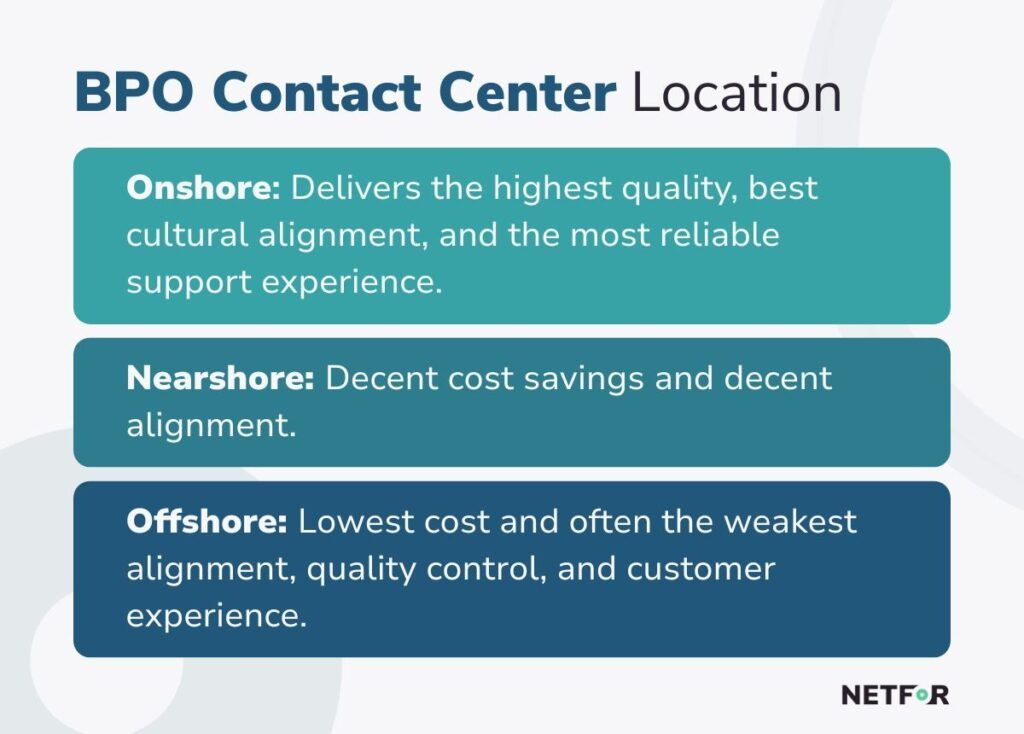
The location of the BPO is another crucial factor. Onshore (domestic) providers offer cultural and linguistic alignment, which is essential for complex or high-touch interactions. Nearshore partners in nearby countries provide a balance of cost savings and time zone compatibility. Offshore providers in distant locations typically offer the lowest costs, making them ideal for high-volume, transactional tasks. You should also scrutinize a provider's performance metrics, such as their agent ramp-up time (around 50 days industry-wide) and their attrition rates compared to the industry average of over 31%.
- Security and Compliance: A top-tier BPO contact center will hold key certifications like SOC 2, HIPAA, ISO 27001, and PCI DSS. Outsourcing to a PCI-compliant partner can save a company $50,000–$200,000 in annual compliance costs.
- Proven Performance: Look for providers with a track record of success. For example, Netfor’s work with FEMA involved mobilizing over 600 agents to handle more than 217,000 calls, achieving an 88% quality assurance score under immense pressure.
- Cultural and Brand Alignment: The BPO should function as an extension of your team. Ensure their agents are trained to represent your brand voice and values consistently.
- Advanced Technology: Leading BPOs use tools like sentiment analytics, AI-powered workforce management, and seamless omnichannel CRM integrations to deliver superior BPO customer care.
The Real Business Impact of Contact Center BPO Services
The decision to partner with a BPO contact center is about more than just operational efficiency, it is a strategic move that directly impacts revenue and business growth. Superior customer experience Management (CXM) is a powerful revenue driver, with studies showing that companies with strong CX can achieve a revenue lift of 4–8%. Conversely, poor support can be devastating. With 73% of customers willing to switch brands after just one bad experience, the stakes are incredibly high.
Outsourcing frees internal teams from the daily grind of frontline support, allowing them to focus on their core competencies and higher-value strategic initiatives. For IT departments, this means engineers can work on infrastructure projects instead of resetting passwords. For BPO customer care, it means your internal experts can handle escalations and proactive engagement. This strategic reallocation of resources strengthens everything from incident management to multi-location tech support.
- Meeting Customer Expectations: Modern customers expect an immediate response, which is often defined as under 10 minutes. They also expect agents to have full context of their history, with 70% stating they should not have to repeat information. A unified BPO contact center makes this possible.
- Reliability for Multi-Location Brands: For retail and QSR businesses, technology failures like a POS outage can halt operations. Outsourcing provides a rapid-response tech support team that can resolve issues quickly and minimize downtime.
- Voice Remains Critical: Even with the rise of digital channels, 49% of consumers still prefer the phone for urgent issues, making a high-quality voice support channel essential.
From Cost Center to Strategic Engine
The modern BPO contact center has evolved far beyond its origins as a simple cost-saving measure. Today, it stands as a strategic asset that delivers speed, scalability, operational stability, and the service quality that only an AI-enabled workforce can provide. By partnering with the right provider, organizations can dramatically improve resolution times, reduce operational costs, and elevate customer satisfaction scores.
More importantly, BPO contact center outsourcing liberates internal teams to focus on high-value work that drives innovation and growth. For organizations looking to gain a competitive edge, a high-performance onshore BPO partner can be the key to strengthening both the service desk and the customer experience.
At Netfor, our onshore, high-performance model has been delivering proven results for over 30 years. With 97% of calls answered in under 20 seconds, deep compliance expertise, and omnichannel capabilities, we are a uniquely strong partner for organizations seeking excellence.