

The term “Nationwide field services” has become one of the most widely used and frequently misunderstood phrases in IT and operations. For many organizations, the promise of nationwide coverage suggests a simple, reassuring reality: a qualified technician is available in every zip code, ready to solve problems at a moment’s notice. However, the gap between marketing claims and operational reality is often stark. Buyers frequently discover the limitations of their provider only after a critical failure, a missed Service Level Agreement (SLA), a delayed rollout, or a dispatch that never arrives.
The fundamental issue lies in the difference between “paper coverage” and true operational readiness. A provider might claim to cover the entire country based on a database of names, but without active management, that database is often a “ghost network.” When a server fails in a rural location or a Point of Sale (POS) system goes down during a busy weekend, a list of inactive names offers no value. This gap creates significant risk, leading to extended downtime, unexpected travel costs, and frustration for stakeholders.
In this guide, we break down what nationwide field services actually look like in practice. We explore how modern field services providers operating nationwide in the us achieve real coverage at scale, the workforce models that power them, and what organizations should evaluate before trusting a partner. By understanding these dynamics, businesses can secure the predictable, high-quality execution they need to support distributed technology environments.
What “Nationwide Field Services” Actually Means
At its core, true nationwide field services is defined by operational readiness, not just a map of theoretical coverage. It is easy for a provider to download a list of licensed technicians and claim they have a footprint in every state. It is entirely different to maintain active relationships with vetted professionals who are ready to deploy with the right tools, skills, and insurance.

Paper Coverage vs. Operational Readiness
Many providers rely on “paper coverage,” which refers to a database populated with technician profiles that may be dormant or outdated. These profiles might represent individuals who have left the industry, retired, or simply stopped accepting work in that specific region. When a dispatch request comes in for a Tier 3 or Tier 4 market. such as a small town in the Dakotas or a rural manufacturing hub, the “nationwide” claim often falls apart.
Operational readiness, in contrast, means the provider has:
- Active Engagement: Recent contact and verified availability of technicians in the area.
- Tooling Verification: Confirmation that local resources possess the specific equipment (e.g., fiber splicers, specific cable testers) required for the job.
- Logistical Support: The ability to move parts and people to the site without excessive delays.
Netfor has been doing field services for decades, building a network based on proven performance rather than just database volume. We know the best technicians in the business based on previous jobs and can deploy the best tech for the job nationwide, ensuring that coverage is a reality rather than a statistic.
The Reality of Market Tiers
Understanding coverage requires looking at market density.
- Tier 1 (Major Metros): High technician density makes “nationwide” claims easy to fulfill.
- Tier 2 (Mid-Sized Cities): Reliable coverage, though specialty skills may be scarcer.
- Tier 3 & 4 (Rural/Remote): This is where most “nationwide” providers fail. Low local volume means few technicians can sustain a living solely on field work, requiring providers to manage travel logistics effectively.

True nationwide field services require managing “dormant” vs. “active” availability. A robust provider constantly refreshes their network to ensure that when a client needs support in a low-density area, the resources are not just on a list, but ready to work.
The Workforce Behind Nationwide Coverage
The structural foundation of any nationwide offering is the workforce model. The debate between using internal W2 employees versus independent contractors (1099s) is central to cost, scalability, and speed.
W2 vs. Independent Contractor Models
Historically, companies believed that only full-time W2 employees could deliver quality. However, maintaining a W2 workforce in every zip code is financially unsustainable. The bench cost paying an employee during idle time drains profitability, especially in regions where work is sporadic.
- W2 Model: Offers high control but high fixed costs. The “burdened” cost of a W2 employee includes a markup of approximately 30% for benefits, health insurance, and paid time off (ADP, 2021).
- 1099 Model: Offers high flexibility and variable costs. Organizations pay only for the work performed, allowing for “100% utilization” efficiency (Field Nation, 2025).
The Power of the Hybrid Model
Outsourced field service workforce models are becoming the easiest and most effective way in technology deployment. By utilizing a hybrid approach, providers can leverage W2 employees for core leadership and high-density work while tapping into a vast network of professional contractors for scale and geographic reach.
This model allows for:
- Scalability: Rapidly ramping up for a 500-site rollout without the months-long process of hiring internal staff.
- Cost Efficiency: Eliminating the need to pay for idle time or travel expenses for W2 staff driving hundreds of miles to a remote site.
- Agility: Accessing specialized skills on demand rather than keeping generalists on payroll.
Comparing the Costs
When evaluating the total cost of ownership (TCO), the differences become clear:
- Burdened Labor: W2 models carry fixed overheads regardless of demand.
- On-Demand Labor: Costs are directly tied to revenue-generating activities.
- Availability: Internal teams are limited by headcount. A platform-enabled network offers elastic capacity.
Netfor operates on a simple premise: Use us when you need us. This flexibility allows clients to convert fixed labor costs into variable operational expenses, optimizing their budget without sacrificing reach.
Speed, Dispatch, and Same-Day Deployment at Scale
In a digital-first world, downtime is expensive. Industry data suggests the cost of IT downtime can reach $9,000 per minute for large enterprises (Tabush Group, 2025). Consequently, the speed of dispatch is a critical metric for nationwide IT field services.
Dispatch Realities Across Markets
Marketing materials often promise consistent “4-hour response” times nationwide, but logistics dictate reality.
- Tier 1 Markets: Same-day service is standard due to high technician density.
- Tier 3 & 4 Markets: Same-day service is a premium capability that requires advanced logistics and algorithmic matching.
Standard dispatch times typically hover between 24 to 48 hours for non-critical issues in outlying areas. Achieving faster speeds requires a provider that utilizes platform-enabled dispatch systems. These systems use algorithms to instantly identify the closest available technician with the right skill set, significantly faster than a human dispatcher calling down a phone list.
Accelerating Matching with On-Demand Marketplaces
Modern field services providers operating nationwide in the U.S. leverage technology to bridge the gap between need and fulfillment.
- Algorithmic Matching: Platforms can broadcast work to thousands of techs instantly.
- Real-Time Visibility: Buyers can track the technician’s location and status, similar to consumer ride-sharing apps.
- SLA Management: Automated systems ensure that if a primary technician doesn’t accept the job within minutes, it is escalated immediately.
By moving away from manual coordination to platform-driven execution, organizations can achieve dispatch benchmarks that were previously impossible, turning potential days of downtime into hours or minutes.
Quality, Vetting, and Risk Management Nationwide
Speed and coverage mean nothing if the work is not done right. The “First Run Rate” (FRR), the percentage of tickets resolved on the first visit, is the gold standard KPI for quality.
First Run Rate: The Ultimate Metric
A high FRR indicates that the technician arrived on time, possessed the right skills, carried the correct tools, and successfully resolved the issue.
- Industry Average FRR: Typically falls between 72% and 80% (FieldAx, 2025).
- Netfor FRR: We consistently achieve a 95% First Run Rate.
Most failures in field services are not due to technical incompetence but blind dispatch. This occurs when a provider sends a technician without proper triage or detailed instructions. The technician arrives willing to work but lacking the necessary parts or site access codes to complete the job.
Managing Risk Through Vetting
Utilizing a nationwide network of independent professionals requires rigorous vetting to manage security and compliance risks.
- Background Checks: Standard checks often miss local criminal history. Comprehensive vetting requires county-level searches and regular re-screening (Checkr, 2025).
- Identity Verification: Ensuring the person who was vetted is the same person who arrives on site.
- Drug Screening: While optional on some platforms, verified technicians secure significantly more work, indicating a market preference for safety (Field Nation, 2025).
Nationwide field service companies must have robust quality assurance processes in place, including:
- Mandatory deliverables (e.g., photos of completed work).
- Remote coaching support for complex tasks.
- Strict compliance checks before dispatch.
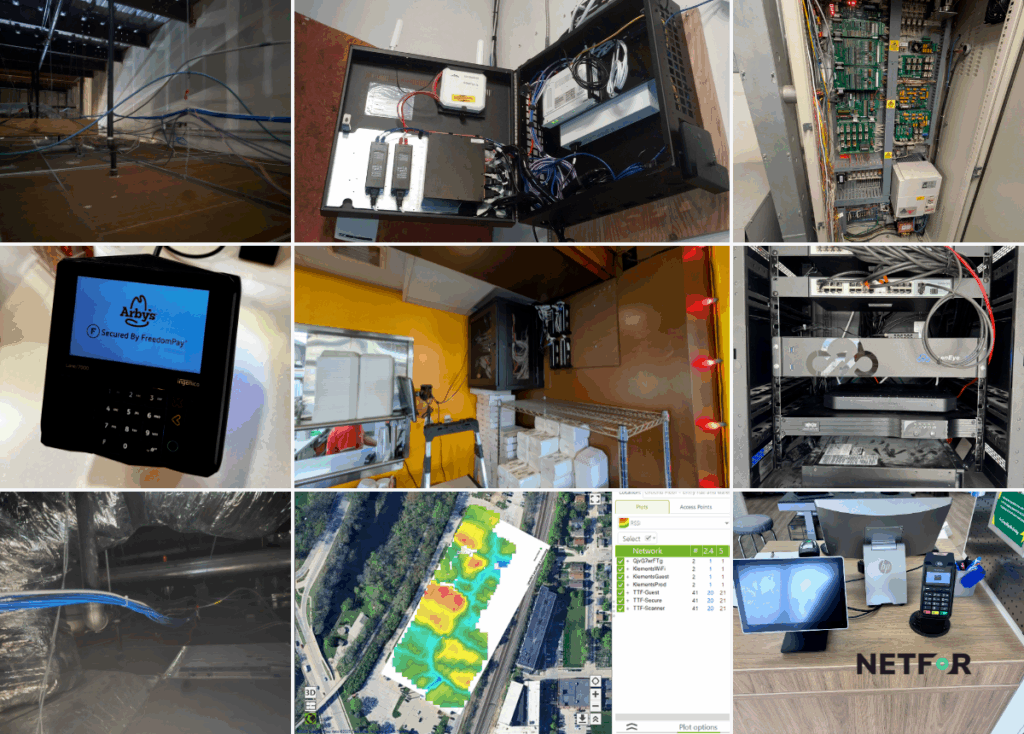
When Nationwide Field Services Are Essential
Not every organization needs a national partner, but for distributed enterprises, the need is critical. Retailers, franchise owners, and financial institutions are prime candidates for outsourcing field services.
Common Use Cases
Industries that rely on nationwide it field services often face specific triggers:
- Technology Rollouts: upgrading POS systems or installing digital signage across thousands of locations.
- Break/Fix Support: Managing emergency repairs for critical infrastructure like servers or networking gear.
- CX Tech Expansion: Installing traffic counters, kiosks, or IoT sensors to improve customer experience.
- IoT Maintenance: Servicing distributed networks of smart devices that require physical intervention.
Evaluating Providers: What to Watch For
When issuing a Request for Proposal (RFP) or evaluating potential partners, buyers should look for specific red flags that indicate “paper coverage.”
Red Flags in Nationwide Field Services:
- Vague Headcount Claims: If a provider claims “20,000 employees,” verify if they are W2s or contractors.
- Lack of Tiered Pricing: A flat rate for downtown New York and rural Wyoming suggests the provider doesn’t understand the cost of travel logistics.
- No FRR Data: If they cannot provide their First Run Rate, they likely do not track quality closely.
Key Evaluation Questions:
- “What is your technician reuse rate on large deployments?” (High reuse indicates a stable, reliable workforce).
- “How do you handle background checks, national only or county-level?”
- “Can you demonstrate execution proof with case studies from Tier 3 and 4 markets?”
Buyers should demand transparency. The best field services providers operating nationwide in the us will be open about their hybrid models, their use of platforms, and their strategies for maintaining quality across difficult geographies.
The End Goal: Technology Installed Correctly the First Time
The term “nationwide” should imply more than just a map; it should represent a promise of operational readiness. True nationwide field services are built on a foundation of technician vetting, intelligent dispatch technology, and best practices in field service management.
For organizations managing distributed environments, the choice of a partner is critical. Relying on marketing claims instead of execution proof can lead to costly downtime and failed deployments. By understanding the mechanics of the workforce, the importance of First Run Rate, and the necessity of platform-enabled speed, buyers can make informed decisions that reduce risk and drive efficiency.
Read how Netfor supported Charise Addicks with reliable, on-demand field services, and what real nationwide execution looks like when speed and consistency matter.
Organizations that understand what nationwide actually means reduce downtime, avoid labor risk, and gain predictable execution across all markets. It is time to move beyond paper coverage and demand a partner that delivers results.
Ready to deploy anywhere?
Netfor delivers nationwide field services with same-day deployment, vetted technicians, and proven execution across the U.S. Learn how our decade-plus experience and 95% First Run Rate can support your next rollout.